
On this page
Key takeaways
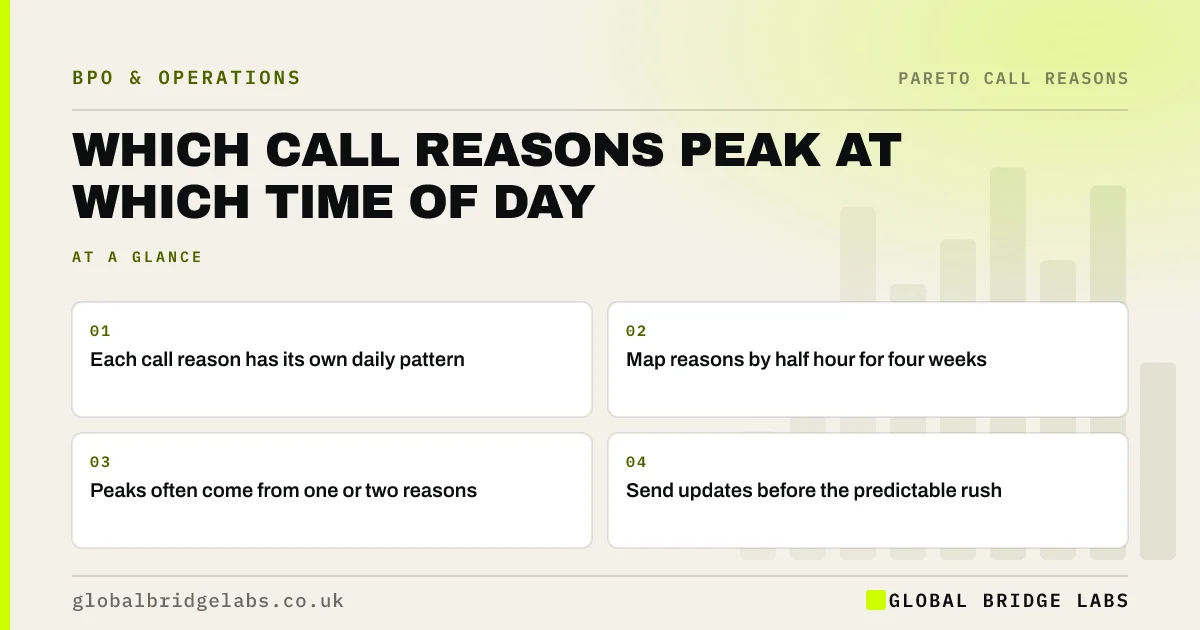
Different call reasons peak at different times. Delivery questions may arrive mid-morning, billing queries after invoices go out, and appointment changes first thing. Mapping reasons by half hour shows which reasons drive each peak, so you can prevent the right calls, staff the right skills and schedule outbound updates before the rush.
- Each call reason has its own daily pattern.
- Map reasons by half hour for four weeks.
- Peaks often come from one or two reasons.
- Send updates before the predictable rush.
Want to see which reasons cause your peaks? Message us on WhatsApp.
Chat on WhatsApp →Why map reasons by time?
A total call volume curve tells you when calls arrive but not why. When one reason causes most of a peak, a single fix can flatten it. Without the map, the only answer to a peak is more staff.
How do you build the map?
Export four weeks of coded calls with their start times. Build a grid of reasons against half hours, and count calls in each cell. Shade the busiest cells. Patterns usually jump out, such as a cluster of order questions straight after a dispatch email.
What patterns are common?
A few daily patterns appear in most businesses. Seasonal patterns sit on top of them, such as a rush of calls on the first working day after a bank holiday, or after a price change takes effect.
- Changes and cancellations at opening time.
- Status questions after a dispatch or update.
- Billing questions after invoices go out.
- Problem calls on Monday after a weekend issue.
Want your reason map built? Send us four weeks of coded calls on WhatsApp.
Chat on WhatsApp →How do you use the map?
Fix the reasons behind the biggest peak first. Move outbound messages, such as dispatch emails, to times when the team has capacity. Schedule staff with the right skills for the reasons that arrive at each time. And brief the team on what to expect each morning.
What does this look like in practice?
A pattern we see: an online retailer's 10am peak is mostly customers asking about orders after a dispatch email that lacks tracking links. Adding tracking links and sending the email at 7am flattens the peak, and the mid-morning service level recovers.
Reason by time checklist
- Export four weeks of coded calls with times.
- Build a reason by half hour grid.
- Shade the busiest cells.
- Fix the reason behind the biggest peak.
- Move outbound messages to quieter times.
Next step
Build a reason by half hour grid from four weeks of calls, pick the biggest shaded cell and find what triggers it.
Message us on WhatsApp to map your call reasons, or book a 30-minute consultation.
Chat on WhatsApp →Sources and further reading
- Measuring success · GOV.UK Service Manual
- UK bank holidays · GOV.UK
Frequently asked questions
How much data do I need to see time patterns?
Four weeks is usually enough for daily patterns, because each weekday appears four times. For seasonal patterns you need a year or more. Small teams with few calls per half hour may need to group by hour instead, so the counts are large enough to compare.
Can my own emails cause call peaks?
Often. Dispatch emails, invoices, renewal notices and service updates all trigger calls if they raise questions. Check what was sent just before each peak. Clearer messages, links to answers and sending at quieter times can reduce or spread those calls.
Should different reasons go to different staff?
If some reasons need specific skills or system access, routing them to trained staff can shorten calls and avoid transfers. Keep it simple in a small team: a short menu and a clear back-up rule work better than many queues with one person each.
Written by

Global Bridge Labs (GBL) is a UK–Sri Lanka partner for social media, websites and BPO. Everything here comes from client delivery, not theory.


