On this page
- 01Key takeaways
- 02What kinds of opinion are there?
- 03Which opinions attract the right customers?
- 04What test should a view pass before posting?
- 05Should a small business comment on social issues?
- 06What are the legal risks?
- 07How do you handle disagreement?
- 08What does this look like in practice?
- 09Opinion post checklist
- 10Next step
- 11Sources and further reading
- 12Frequently asked questions
Key takeaways
Should a business share opinions on social media? Yes, about its own field, where it has expertise and evidence. Views on how the work should be done attract buyers who agree. Views on politics and unrelated social issues rarely help a small business and can cost customers and staff goodwill.
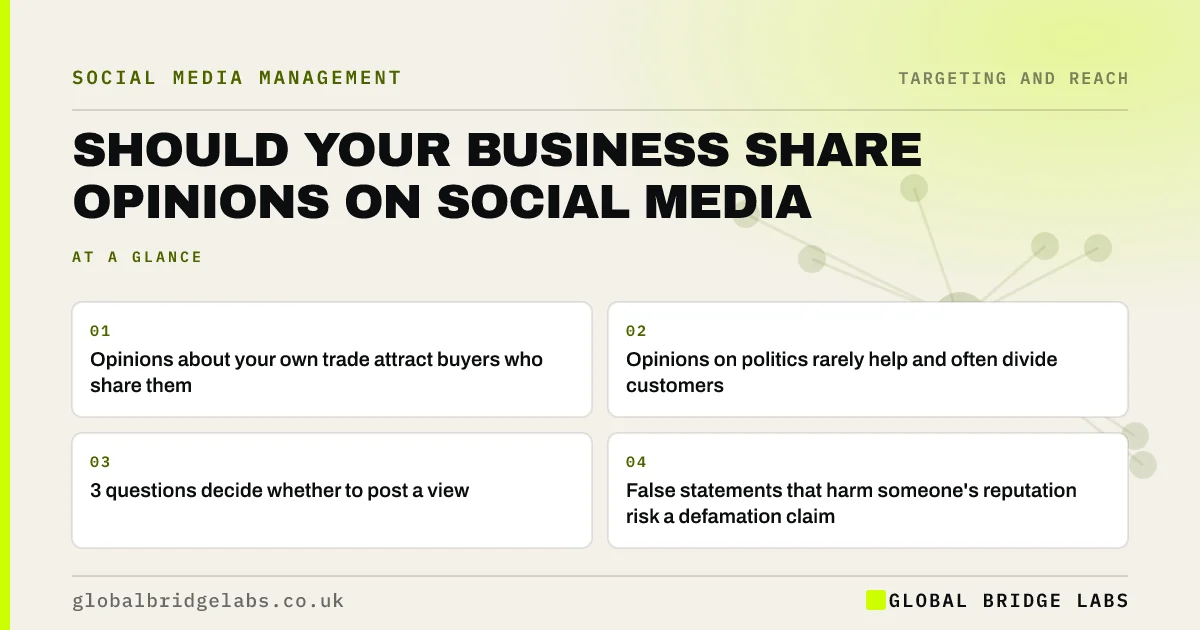
- Opinions about your own trade attract buyers who share them.
- Opinions on politics rarely help and often divide customers.
- 3 questions decide whether to post a view.
- False statements that harm someone's reputation risk a defamation claim.
Unsure whether a post is wise? Send us the draft on WhatsApp first.
Chat on WhatsApp →What kinds of opinion are there?
There are three kinds. Professional opinions concern how your work should be done. Industry opinions concern rules, standards and practices in your sector. Social and political opinions concern everything else. The first two are where a business has standing. The third is where the risk sits.
Which opinions attract the right customers?
Professional opinions attract the right customers, because they show what it is like to work with you. 'We will not fit a kitchen without a site survey, and here is why' tells a careful buyer you are careful. It also deters buyers who wanted a shortcut, which is useful.
What test should a view pass before posting?
Ask three questions. Do we have real expertise or evidence on this? Does it help our customers decide something? Would we be comfortable discussing it with any customer face to face? Three yeses mean post. Any no means leave it, or keep it to a personal account.
- Expertise: do we actually know this subject?
- Relevance: does it help a customer decide?
- Comfort: would we say it to any customer in person?
Want a second view on a draft? Message us on WhatsApp and we will discuss your requirements.
Chat on WhatsApp →Should a small business comment on social issues?
Usually not, unless the issue is central to what the business does or stands for and it is prepared to act on it. Customers and staff hold a range of views. A statement with nothing behind it reads as opportunism. Local causes you actively support are a different matter.
What are the legal risks?
The main legal risk is defamation. Under the Defamation Act 2013 a statement is defamatory if it causes or is likely to cause serious harm to someone's reputation, and for a business claimant that means serious financial loss. Criticising a named competitor or customer is where small firms go wrong. Stick to practices, not people.
How do you handle disagreement?
Expect it, and welcome the reasonable kind. Reply once, calmly, with your reasoning. Do not argue at length in the comments. If a post draws abuse instead of debate, follow your moderation rules. A measured reply in public usually does more for your reputation than the original post.
What does this look like in practice?
A pattern we see with UK owner-managed firms: the owner's personal views and the company's posts share one account. Separating the two, and keeping the business account to professional opinions, removes most of the risk without making the business bland.
Opinion post checklist
Before posting a view.
- It concerns your own field.
- You have evidence for it.
- It helps a customer decide.
- It criticises a practice, not a named person or firm.
- A second person has read it.
- You are ready to reply to disagreement calmly.
Next step
Write down three things you believe about how your work should be done that not everyone in your trade agrees with. Those are your safest and most useful opinions.
Message us on WhatsApp to talk through your point of view, or book a 30-minute consultation.
Chat on WhatsApp →Sources and further reading
- Defamation Act 2013 · legislation.gov.uk
- Recognising ads: brand-owned and paid social media · ASA / CAP
- Unfair commercial practices guidance (CMA207) · Competition and Markets Authority
Frequently asked questions
Should a business share its opinions on social media?
Yes, on its own field. Views about how the work should be done, backed by experience, attract customers who agree. Opinions on unrelated political or social matters seldom help a small business and may alienate customers. Apply the three-question test first.
Is controversial content good for business?
Disagreement about professional practice can be useful, because it shows a clear approach. Controversy for attention is not. It draws an audience interested in the argument, not the service, and can damage trust. Stay with subjects you can back up from your own work.
Can I criticise a competitor on social media?
It is unwise. A false statement that seriously harms a competitor's reputation may be defamatory, and comparative advertising must be fair and verifiable. Criticise practices in general terms without naming a business. If a comparison matters to buyers, describe your own approach and let them draw the conclusion.
Should the owner's personal views appear on the business account?
No. Keep personal opinions on a personal account and keep the business account to professional matters. Set this out in your social media policy so that anyone posting for the business knows the boundary. It also protects staff who post.
Written by

Global Bridge Labs (GBL) is a UK–Sri Lanka partner for social media, websites and BPO. Everything here comes from client delivery, not theory.