On this page
- 01Key takeaways
- 02What should you do in the first hour?
- 03How should you respond?
- 04Should you delete the post?
- 05What if the criticism is false or defamatory?
- 06How does consistency help recovery?
- 07What does this look like in practice?
- 08Who should do what during a backlash?
- 09What should you avoid saying?
- 10Next step
- 11Sources and further reading
- 12Frequently asked questions
Key takeaways
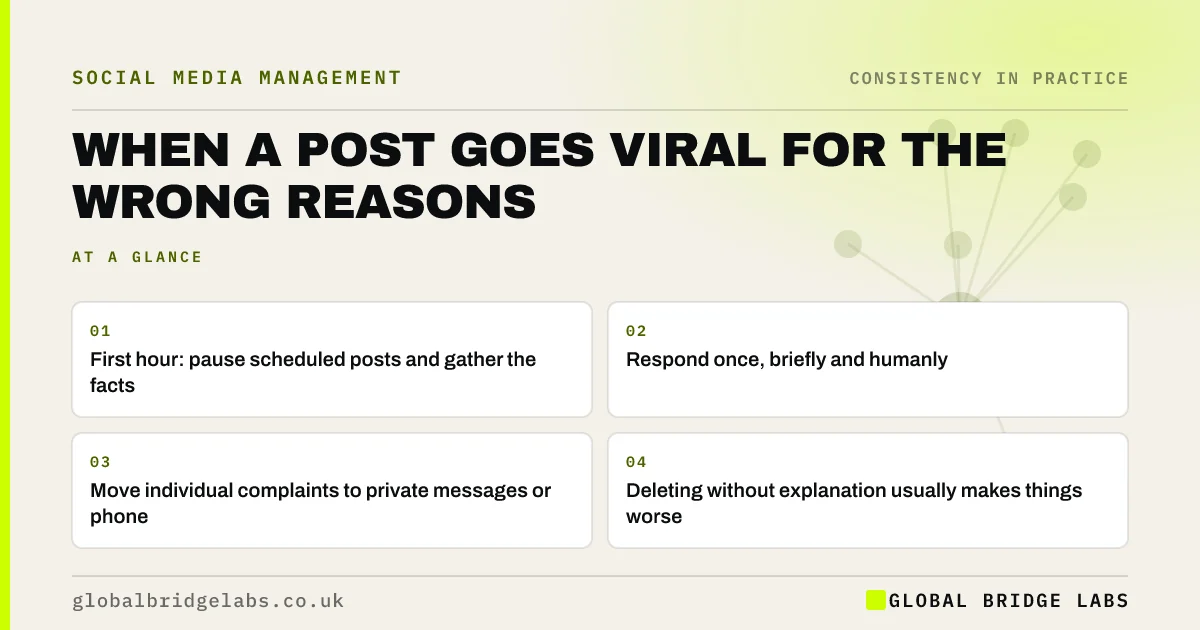
When a post goes viral for the wrong reasons, pause scheduled posts, work out the facts, respond once with a short, human statement, and move individual complaints to private channels. Do not argue in comments or delete without explanation. Recovery depends on returning to consistent, normal posting once the facts are clear.
- First hour: pause scheduled posts and gather the facts.
- Respond once, briefly and humanly. Do not argue in comments.
- Move individual complaints to private messages or phone.
- Deleting without explanation usually makes things worse.
- Return to normal, consistent posting once the issue is handled.
Facing a backlash now? Message us on WhatsApp for help with your response.
Chat on WhatsApp →What should you do in the first hour?
Pause scheduled posts so a cheerful promotion does not land in the middle of criticism. Gather the facts: what was said, who is affected, whether a mistake was made. Agree who will respond and who approves the wording. Speed matters, but accuracy matters more.
How should you respond?
- Acknowledge the issue in plain language.
- Apologise if you got something wrong, without excuses.
- Say what you are doing about it and when you will update.
- Give a private route for affected customers.
- Post the response once, rather than replying to every comment.
Want a response drafted and checked? Message us on WhatsApp.
Chat on WhatsApp →Should you delete the post?
Only if it is genuinely harmful, inaccurate or unlawful, and then explain that you have removed it and why. Silent deletion is usually noticed, screenshotted and treated as evidence of hiding something. If the post was simply misunderstood, a clarifying response is usually better than deletion.
What if the criticism is false or defamatory?
Respond factually and calmly, correct errors once and report posts that breach platform rules. If false statements are seriously damaging the business, take legal advice; the Defamation Act 2013 sets out when a statement is defamatory, including a serious harm test for businesses. Legal threats in public comments rarely help.
How does consistency help recovery?
An account with a long history of consistent, helpful posts gives people context: one bad moment against years of good ones. Once the issue is handled, returning to normal posting shows the business is stable. Accounts that go silent after a backlash often leave the negative post as the last thing people see.
What does this look like in practice?
A UK restaurant's reply to a bad review was shared widely as rude. The owner paused scheduled posts, posted a short apology acknowledging the tone, contacted the reviewer privately and made a donation the reviewer suggested. A week later the restaurant resumed its normal posts. Its long history of consistent, friendly posts meant many locals defended it, and bookings recovered within a month.
Who should do what during a backlash?
- Owner or MD: approves the statement and any decisions.
- Social media lead: pauses posts, monitors, posts the approved response.
- Customer service: handles individual complaints privately.
- Staff: do not comment publicly; refer questions to the social media lead.
What should you avoid saying?
- Blaming the customer or staff publicly.
- Sorry if anyone was offended, which reads as not sorry.
- Legal threats in public comments.
- Promises you cannot keep.
- Different stories on different channels.
Next step
Write a one-page crisis plan now: who decides, who responds, how to pause posts and where to send complaints. It is far easier to follow a plan than to invent one mid-backlash.
Message us on WhatsApp and we will help you write your crisis plan.
Chat on WhatsApp →Sources and further reading
- Defamation Act 2013 · legislation.gov.uk
- Publishing consumer reviews and complying with consumer protection law · Competition and Markets Authority
- Meta Business Help Centre · Meta
Frequently asked questions
What should a business do if a post goes viral negatively?
Pause scheduled posts, gather the facts, respond once briefly and honestly, move individual complaints to private channels and avoid arguing in comments. Once handled, return to normal consistent posting.
Should I delete a post that is getting backlash?
Only if it is harmful, inaccurate or unlawful, and say that you have removed it and why. Silent deletion often makes things worse because screenshots circulate and it looks like hiding.
How long does a social media backlash last?
Most peak within a few days and fade within one to two weeks, especially if the business responds well. Recovery is faster for accounts with a strong history of consistent, positive activity.
Can I take legal action over false social media posts?
In serious cases, possibly. The Defamation Act 2013 includes a serious harm test, and for businesses this means serious financial loss. Take legal advice before acting, and avoid public legal threats in comments.
Should staff respond to criticism of the business online?
Generally no. Staff responding individually can escalate things and create conflicting messages. A short social media policy should ask staff to refer questions to the named lead and not engage publicly during a backlash.
Written by

Global Bridge Labs (GBL) is a UK–Sri Lanka partner for social media, websites and BPO. Everything here comes from client delivery, not theory.