On this page
- 01Short answer
- 02Why does the public reply matter more than the complaint?
- 03What does a good reply contain?
- 04When should you not reply immediately?
- 05When can you delete or report a comment?
- 06What about false or malicious reviews?
- 07What does this look like in practice?
- 08How do you reduce complaints at source?
- 09Next step
- 10Sources and further reading
- 11Frequently asked questions
Short answer
Acknowledge publicly within one working hour, take the detail private, never argue about facts in a comment thread, and never delete a complaint unless it is abusive. The reply is not written for the complainant. It is written for everyone who reads it afterwards, which is where the commercial value sits.
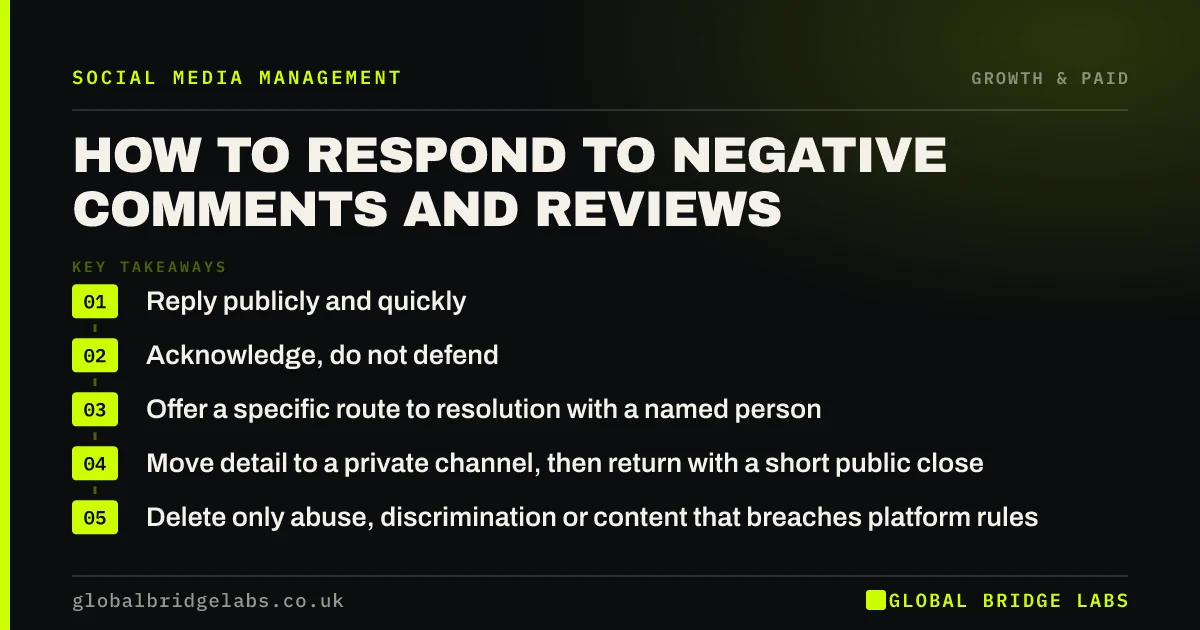
- Reply publicly and quickly. Silence is read as agreement.
- Acknowledge, do not defend. Even when you are right.
- Offer a specific route to resolution with a named person.
- Move detail to a private channel, then return with a short public close.
- Delete only abuse, discrimination or content that breaches platform rules.
Facing a live situation? Message us on WhatsApp and we will help you draft the reply.
Chat on WhatsApp →Why does the public reply matter more than the complaint?
Because complaints are read by people who were not involved, often months later, when they are deciding whether to hire you.
A calm, specific reply to a bad review does more for trust than several positive reviews, because it demonstrates how you behave when something goes wrong, which is the thing a buyer actually wants to know. An unanswered complaint answers that question badly by default.
What does a good reply contain?
Four elements, in order, kept short. Acknowledge what happened from their point of view. State what you are doing about it. Provide a specific route to resolve it, with a name. Close without defensiveness.
What it does not contain: an explanation of why they are wrong, a list of what you did correctly, a reference to their tone, or the phrase we take all feedback seriously, which reads as a form letter and signals that nobody is actually engaged.
- Acknowledge: I am sorry the installation ran over by two days.
- Act: we have reviewed what happened with the team.
- Route: can you call me directly, I am Sarah on 0113 xxx xxxx.
- Close: we will make this right.
When should you not reply immediately?
When you are angry, when the facts are unclear, and when the complaint involves anything legal, contractual or safety-related.
The rule that works is a one-hour holding acknowledgement followed by a considered response. Thank you for raising this, I am looking into it now and will come back to you today buys time without leaving silence, which is what actually damages you.
We handle community escalation for UK clients inside working hours. Message us on WhatsApp.
Chat on WhatsApp →When can you delete or report a comment?
Delete abuse, discrimination, threats, spam and anything containing someone's personal data. Report content that breaches platform rules. Those are legitimate and nobody reasonable objects.
Do not delete genuine criticism. It almost always reappears louder, screenshotted, with the deletion as the story. The exception worth noting is a complaint containing a customer's own personal information, which should be removed and continued privately, with an explanation posted so it does not look like censorship.
What about false or malicious reviews?
Reply factually and briefly, without accusation, then use the platform's reporting process. A measured reply saying you have no record of this order and inviting the reviewer to contact you directly is read correctly by everyone else.
Resist the urge to prove it is fake in public. A long forensic reply reads as defensive even when it is accurate, and it keeps the review visible at the top of the thread for longer.
What does this look like in practice?
A pattern we see whenever a one-star review lands: the owner's first draft runs to six paragraphs and disputes the timeline in detail.
The reply that works is three sentences: an apology for what went wrong, confirmation of what has been fixed, and a direct number. Whether the reviewer removes the review is not the point. The reply is read by everyone who looks afterwards, and that is where it earns its value.
How do you reduce complaints at source?
Most public complaints in small businesses are second attempts. Somebody tried a private route first, did not get a response they found adequate, and escalated to a place where you have to answer.
That makes the response standard on your private channels the most effective complaint-prevention tool available. A four-working-hour reply standard on messages and email removes the frustration that drives escalation in the first place.
The second pattern worth fixing is expectation setting. A large share of complaints concern timing rather than quality: an arrival window that slipped, an update that never came. Saying what will happen and when, then telling people early when it changes, prevents more public criticism than any response framework manages to repair.
- Most public complaints are escalations from an unanswered private message.
- A published private-channel response standard prevents more than it repairs.
- Timing failures cause more complaints than quality failures.
- Tell people early when something slips. Silence is what escalates.
Next step
Write your response rules before you need them. Nobody makes good decisions about public criticism at nine in the evening.
Message us on WhatsApp for a complaint and review response framework for your team.
Chat on WhatsApp →Sources and further reading
- Publishing consumer reviews and complying with consumer protection law · Competition and Markets Authority
- Google Business Profile Help · Google
Frequently asked questions
Should I reply to every negative review?
Yes. The reply is written for future readers rather than the complainant, and it demonstrates how you behave when something goes wrong. An unanswered complaint answers that question badly by default, and silence is commonly read as agreement.
Can I delete negative comments?
Delete abuse, discrimination, threats, spam or anything containing personal data. Do not delete genuine criticism, which typically reappears with the deletion itself as the story. If you must remove something, explain why publicly so it does not look like censorship.
How quickly should I respond to a complaint?
Acknowledge within one working hour, even if you cannot resolve it yet. A short holding reply saying you are looking into it and will come back today buys time to respond properly without leaving the silence that does most of the damage.
What do I do about a fake review?
Reply briefly and factually without accusation, noting that you have no record of the transaction and inviting direct contact, then use the platform's reporting process. Long forensic rebuttals read as defensive and keep the review prominent for longer.
Written by

Global Bridge Labs (GBL) is a UK–Sri Lanka partner for social media, websites and BPO. Everything here comes from client delivery, not theory.