On this page
- 01Short answer
- 02What is a website content plan?
- 03Why do most small business blogs fail?
- 04Which pages should you build first?
- 05How do you choose article topics?
- 06What publishing rhythm can a small business sustain?
- 07When should you stop adding content?
- 08What does this look like in practice?
- 09Content plan checklist
- 10Next step
- 11Sources and further reading
- 12Frequently asked questions
Short answer
A website content plan for a small business starts with the pages closest to money: service pages, pricing, proof and FAQs. Only then add articles that answer the questions buyers ask before they buy, organised into topic clusters, published at a pace you can sustain and reviewed quarterly against enquiries rather than traffic.
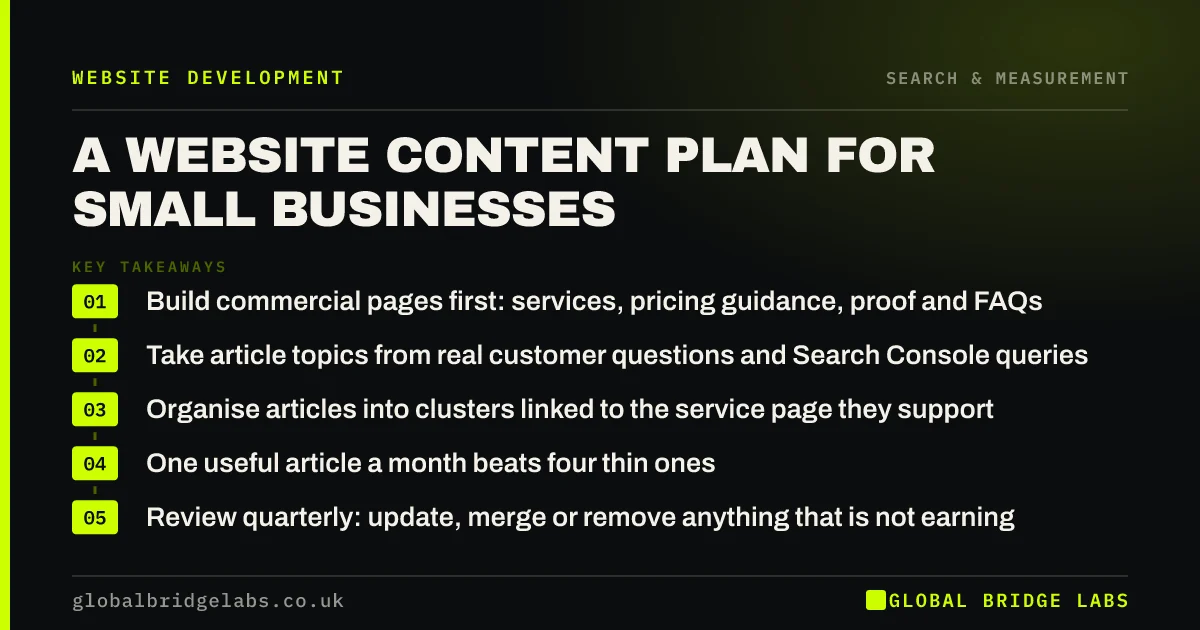
- Build commercial pages first: services, pricing guidance, proof and FAQs.
- Take article topics from real customer questions and Search Console queries.
- Organise articles into clusters linked to the service page they support.
- One useful article a month beats four thin ones.
- Review quarterly: update, merge or remove anything that is not earning.
Want a 12-month content plan for your site? Message us on WhatsApp with your main services.
Chat on WhatsApp →What is a website content plan?
A website content plan is a prioritised list of pages and articles a business will create or improve, each tied to a specific audience question and commercial goal, with a schedule, an owner and a way to measure whether it worked.
It is narrower than a content marketing strategy. It deals only with what lives on your website, which is the part you own and control, and where enquiries actually happen.
Why do most small business blogs fail?
Most small business blogs fail because they publish news and generic tips that nobody searches for and that do not lead to a purchase. After a year of posts about company events and industry trends, traffic is flat and enquiries are unchanged.
The alternative is to write for the buyer's questions. Google's guidance on helpful content asks whether content provides original information, demonstrates first-hand expertise and leaves the reader feeling they have learned enough. That is exactly what a buyer's question article should do.
- News posts nobody searches for.
- Generic tips copied from bigger sites.
- Irregular bursts followed by months of silence.
- No links from articles to services, so readers never become enquiries.
Which pages should you build first?
Build in order of commercial value. Most SMEs have gaps in the first three items that matter more than any blog post.
- 1. A dedicated page for each core service.
- 2. Pricing guidance: ranges, packages or cost factors.
- 3. Proof: case studies, reviews and a projects or work page.
- 4. FAQs answering pre-purchase questions.
- 5. Area or industry pages where you have genuine proof.
- 6. Articles answering buyer questions, grouped by service.
How do you choose article topics?
Collect the questions customers ask on calls and emails, the queries already bringing visitors in Google Search Console, and the People Also Ask questions shown for your main services. Group them by service. Each group becomes a cluster.
Prioritise questions with commercial intent: cost, comparisons, how to choose, what to expect, and problems your service solves. These attract readers who are close to buying.
Want your customer questions turned into a prioritised topic list? Message us on WhatsApp.
Chat on WhatsApp →What publishing rhythm can a small business sustain?
One genuinely useful article a month is sustainable for most small businesses and compounds over a year. Twelve strong articles, each linked to a service page and updated when facts change, will usually outperform fifty thin ones.
Protect the rhythm by batching: plan a quarter of topics at once, draft with the person who knows the answer, and edit for clarity. Record the primary question each article owns so you never write two articles on the same topic.
When should you stop adding content?
Stop adding when the pages you have are weak. Updating and improving existing pages, merging overlapping ones and removing outdated posts often produces more than publishing new ones.
The trade-off is effort against compounding. Content takes months to earn rankings. If you need enquiries next month, fix conversion and consider paid channels, and treat content as the long-term engine.
What does this look like in practice?
A pattern in professional services: 80 blog posts about firm news and general market commentary, a single Services page, and no pricing information anywhere on the site.
Pausing new posts, building proper service pages with fee guidance, and rewriting the ten most visited articles to answer buyer questions and link to those services shifts the site from publishing activity to producing enquiries.
Content plan checklist
Set this up once, then review quarterly.
- List core services and check each has a page.
- Add pricing guidance and proof.
- Collect customer questions and Search Console queries.
- Group questions into clusters by service.
- Assign one primary question per article.
- Link every article to its service page.
- Publish at a sustainable pace.
- Review quarterly against enquiries.
Next step
If you are writing content that does not lead to enquiries, we will build a 12-month plan around your services with you in 30 minutes.
Message us on WhatsApp for a website content plan, or book a 30-minute consultation.
Chat on WhatsApp →Sources and further reading
- Creating helpful, reliable, people-first content · Google Search Central
- Google Search Console · Google
- SEO Starter Guide · Google Search Central
Frequently asked questions
Does a small business website need a blog?
Not necessarily. Service pages, pricing guidance, proof and FAQs matter more. A blog is worth it if you can publish genuinely useful answers to buyer questions regularly and link them to your services. News posts and generic tips rarely produce enquiries for a small business.
How often should a small business publish content?
One genuinely useful article a month is sustainable for most small businesses and builds steadily over a year. Consistency and quality matter more than frequency. Updating and improving existing pages can be as valuable as publishing new ones, especially once you have a library.
What should a small business write about?
Write about the questions customers ask before buying: costs, comparisons, how to choose a provider, what to expect, and the problems your service solves. Use your own experience and examples. Group topics by service and link each article to the relevant service page.
How do I know if my content is working?
Track which articles bring visitors who go on to view service pages and enquire, using GA4 key events and landing page reports. Check Search Console for impressions and positions. Content that brings traffic but no enquiries may need better links to services or a different topic.
Written by

Global Bridge Labs (GBL) is a UK–Sri Lanka partner for social media, websites and BPO. Everything here comes from client delivery, not theory.