On this page
- 01Short answer
- 02Why do company pages underperform?
- 03What should a small business post on LinkedIn?
- 04Why does commenting matter more than posting?
- 05How do you turn LinkedIn activity into meetings?
- 06Should you use LinkedIn ads?
- 07What does this look like in practice?
- 08What should your profile say before you start posting?
- 09Next step
- 10Sources and further reading
- 11Frequently asked questions
Short answer
On LinkedIn, people outperform pages. For a UK small business, the strategy is a complete company page for credibility plus consistent posting from two or three named individuals, with commenting treated as a first-class activity rather than an afterthought.
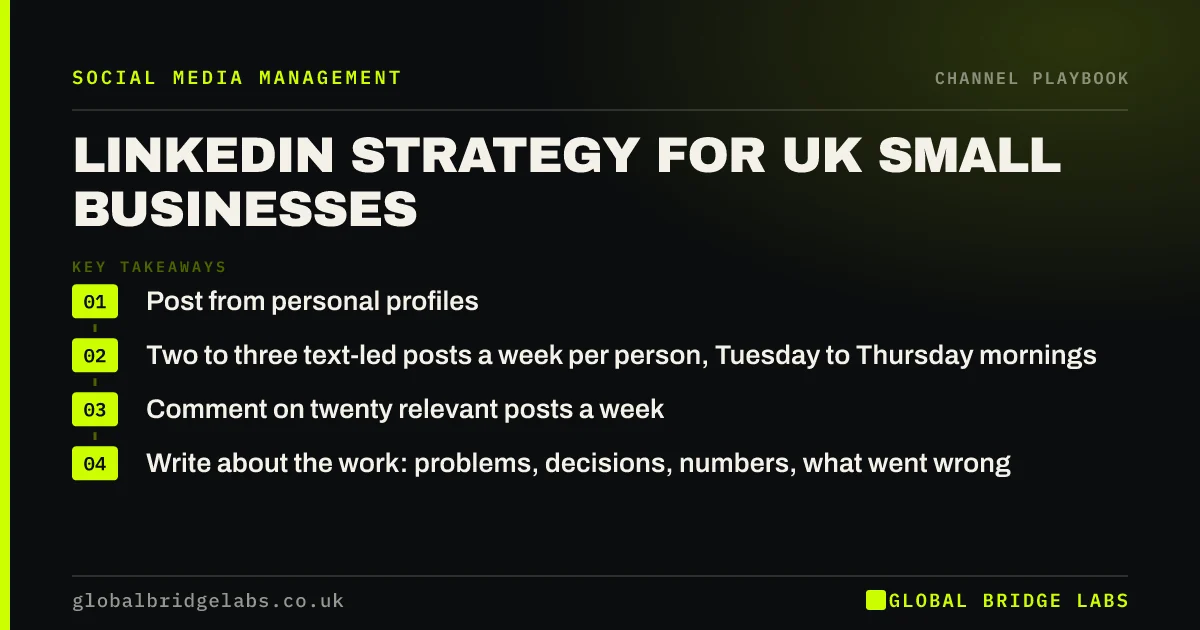
- Post from personal profiles. The company page is a credibility check, not a distribution channel.
- Two to three text-led posts a week per person, Tuesday to Thursday mornings.
- Comment on twenty relevant posts a week. This produces more reach than a fourth post would.
- Write about the work: problems, decisions, numbers, what went wrong.
- Move to direct messages only after a genuine exchange, never immediately after a connection.
Want a LinkedIn plan for your leadership team? Message us on WhatsApp.
Chat on WhatsApp →Why do company pages underperform?
Because LinkedIn is built around professional identity, and people engage with people. A post from a named director with a job title and a face gets substantially more distribution than the identical post from a logo.
That does not make the page worthless. Buyers check it, particularly in B2B where procurement will look before a meeting. Keep it complete, current and consistent with your website, and put the posting effort into individuals.
What should a small business post on LinkedIn?
Write about decisions rather than announcements. The posts that perform for UK B2B firms are specific accounts of a problem, what was tried, what it cost, and what happened.
The format is text-first, 800-1,300 characters, with the first two lines carrying the whole argument because that is what appears before the see more fold. Documents and carousels perform well for frameworks; external links reduce distribution, so put the link in the first comment when you need one.
- A decision you made and the trade-off you accepted.
- A number from your own delivery, with the context that makes it meaningful.
- A mistake, and what you changed afterwards.
- A client problem, anonymised, and how it was solved.
- A contrarian position you can actually defend in the comments.
Why does commenting matter more than posting?
Because a thoughtful comment on a post with two thousand views puts you in front of an audience you did not have to build, and it costs two minutes rather than forty.
For a small firm starting from a few hundred connections, twenty good comments a week will reliably produce more relevant reach than an extra post. Comment on posts from your buyers and their peers, not from your competitors.
We will build the posting and commenting routine with your team. Message us on WhatsApp.
Chat on WhatsApp →How do you turn LinkedIn activity into meetings?
Slowly, and never with an immediate pitch after connecting. The sequence that works is: they engage with your content, you engage with theirs, a genuine exchange happens in comments, and only then a message that references that exchange specifically.
The alternative, a connection request followed by a sales message, is the most common behaviour on the platform and the most reliably ignored. It also costs you the audience, because people who mute you never see your content again.
Should you use LinkedIn ads?
Only when you have a high enough deal value to absorb the cost. LinkedIn advertising is expensive relative to other platforms, with cost per click for UK B2B targeting frequently several times what the equivalent audience costs on Meta.
The arithmetic works when a single closed deal is worth thousands and your targeting is genuinely precise. For a small firm with lower deal values, organic posting plus commenting is a better use of the same money.
What does this look like in practice?
The most common LinkedIn pattern in UK B2B: company updates published from the page once or twice a week, reaching a few hundred people, almost none of them buyers.
What changes it is moving posting to two named people, typically an operations lead and a commercial lead, writing about specific delivery problems and how they were solved. Inbound conversations then start coming from individuals at target accounts, which a company page very rarely produces.
What should your profile say before you start posting?
Fix the profile first, because posting drives profile visits and a weak profile converts none of them.
Four things matter. The headline should state what you do for whom rather than your job title, since the title means nothing to someone outside your company. The about section should open with the problem you solve, not your career history. Featured items should include one piece of proof. And the company should be linked properly so the page is reachable.
Then check what a stranger sees on a phone: headline, photo, first two lines of the about section. That is the whole first impression, and for most small business owners it currently says operations director rather than anything a buyer could act on.
- Headline: what you do for whom, not your job title.
- About: open with the problem you solve.
- Featured: one piece of proof, visible without scrolling.
- Check the phone view. Three elements carry the first impression.
Next step
LinkedIn rewards a small number of people posting consistently about real work. It is the cheapest B2B channel available to a UK small business, and the main cost is a habit rather than a budget.
Message us on WhatsApp for a LinkedIn content plan for your leadership team.
Chat on WhatsApp →Sources and further reading
- LinkedIn Pages best practices · LinkedIn
- Online Nation: how the UK uses online services · Ofcom
Frequently asked questions
Should I post from my company page or my personal profile?
Personal profiles, for distribution. LinkedIn is built around professional identity, and posts from a named person with a job title reach significantly further than the same post from a logo. Keep the page complete for credibility checks before meetings.
How often should I post on LinkedIn?
Two to three times a week per person, Tuesday to Thursday mornings for UK audiences. Beyond that, extra reach comes more reliably from commenting on twenty relevant posts a week than from adding a fourth post.
Do links reduce LinkedIn reach?
External links in the post body typically reduce distribution, since the platform prefers to keep readers on site. Put the link in the first comment or in a follow-up, and make the post itself complete enough to be valuable without clicking anything.
Are LinkedIn ads worth it for small businesses?
Only with high deal values. Cost per click for UK B2B targeting is frequently several times the equivalent on Meta. If a closed deal is worth thousands and your targeting is precise, the arithmetic works. Otherwise organic posting is a better use of the money.
Written by

Global Bridge Labs (GBL) is a UK–Sri Lanka partner for social media, websites and BPO. Everything here comes from client delivery, not theory.