On this page
- 01Key takeaways
- 02What is trade press advertising?
- 03How do the audiences compare?
- 04How do the costs compare?
- 05Which carries more credibility?
- 06Which is easier to measure?
- 07When does the trade press win?
- 08When does LinkedIn win?
- 09How do you make one feed the other?
- 10What does this look like in practice?
- 11Next step
- 12Sources and further reading
- 13Frequently asked questions
Key takeaways
Trade magazine advertising vs LinkedIn is a choice between borrowed authority and direct access. A respected trade title puts you beside the news your buyers trust. LinkedIn lets you reach the same job titles by name, talk to them and see who responded.
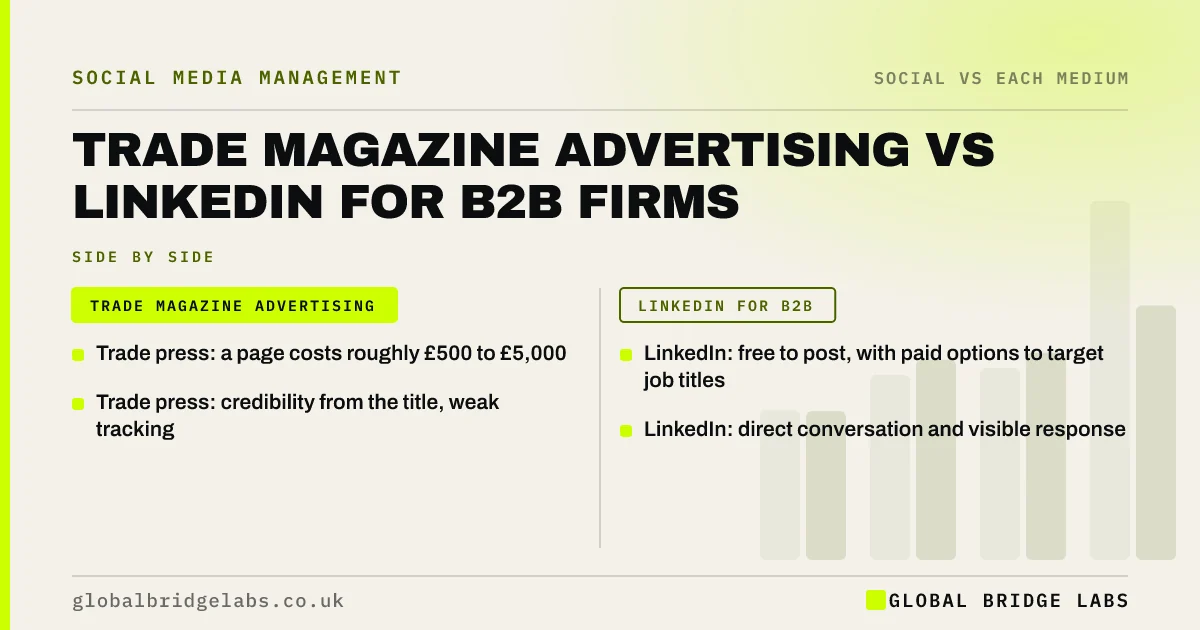
- Trade press: a page costs roughly £500 to £5,000.
- LinkedIn: free to post, with paid options to target job titles.
- Trade press: credibility from the title, weak tracking.
- LinkedIn: direct conversation and visible response.
Been sent a trade press media pack? Message us on WhatsApp and we will help you read it.
Chat on WhatsApp →What is trade press advertising?
Trade press advertising is paid space in a magazine, website or newsletter written for one industry or profession. Options usually include display adverts, sponsored articles, directory listings and email sponsorship. Many titles are sent free to a controlled list of people in the sector.
How do the audiences compare?
A trade title reaches a defined sector, including people who are not active online. LinkedIn reaches individuals by job title, company size, industry and location. The LinkedIn B2B Institute's research suggests only about 5% of business buyers are in the market at any time, so both channels are mostly about being remembered by the other 95%.
How do the costs compare?
As an indicative range, a page in a UK trade magazine costs £500 to £5,000 depending on the sector and circulation, and smaller sizes less. Posting on LinkedIn costs time, and LinkedIn adverts are among the dearer forms of paid social per click. A managed social media service for most UK SMEs costs £950–£2,500 a month.
Want a trade press plan compared with a LinkedIn plan? Message us on WhatsApp and we will discuss your requirements.
Chat on WhatsApp →Which carries more credibility?
A good trade title carries more borrowed credibility, particularly editorial coverage, which cannot be bought as an advert. LinkedIn credibility is built by the people in your firm: what they post, who engages and what clients say publicly. One is lent to you. The other is earned.
Which is easier to measure?
LinkedIn is easier to measure. You see who viewed, reacted, clicked and messaged. A print advert in a trade title needs a dedicated web address or contact route. Ask the publisher what response other advertisers of your size have had, and ask to speak to one.
When does the trade press win?
The trade press wins in sectors with one or two titles everybody reads, and for audiences who do not use LinkedIn much, such as site-based or workshop-based managers.
- A sector with a dominant, respected title.
- Buyers who are rarely at a desk.
- A product launch that merits editorial coverage.
- A special issue tied to a major show.
When does LinkedIn win?
LinkedIn wins when your buyers are office-based professionals, when the sale depends on trust in named people, and when you need to reach a short list of companies. It also wins on budget, because consistent posting by two or three senior people costs time, not space.
How do you make one feed the other?
Offer the editor a useful article before you buy an advert. If it runs, share it on LinkedIn, where the title's name adds weight. If you do advertise, repeat the same message on LinkedIn in the same month and send both to one tracked page.
What does this look like in practice?
A pattern we see with B2B firms: an annual series of trade adverts is booked on the back of one phone call, while the directors' LinkedIn profiles sit unused. Halving the series and putting the saved time into regular, practical posts from named people often changes who gets in touch.
Next step
Ask your last ten clients which trade titles they read and whether they use LinkedIn. Their answers decide the split.
Message us on WhatsApp with what they say and we will suggest a plan, or book a 30-minute consultation.
Chat on WhatsApp →Sources and further reading
- The 95-5 rule: most B2B buyers are out of market · LinkedIn B2B Institute
- LinkedIn Pages best practices · LinkedIn
- UK Code of Non-broadcast Advertising and Direct & Promotional Marketing (CAP Code) · ASA / CAP
Frequently asked questions
Is advertising in trade magazines worth it?
It can be in sectors where one or two titles are widely read and trusted. It is less useful where readers have moved online. Ask for audited circulation, ask clients whether they read the title and track responses with a dedicated web address.
Is LinkedIn better than trade press for B2B leads?
For most office-based buyers LinkedIn is easier to target and measure, and it allows direct conversation. Trade press can reach people who are not active on LinkedIn and adds the authority of the title. Many B2B firms use both, weighted towards LinkedIn.
How much does a trade magazine advert cost?
It varies widely by sector and circulation. As an indicative range, a full page in a UK trade title costs about £500 to £5,000, with half and quarter pages proportionally less. Series bookings and late space are usually discounted.
Can I get into a trade magazine without paying?
Often, yes. Editors need useful articles, comment and case studies from people in the sector. Offer a practical piece that is not a sales pitch. Editorial coverage usually carries more weight with readers than a paid advert. Send a short outline first, and respect the editor's deadline and word count.
Written by

Global Bridge Labs (GBL) is a UK–Sri Lanka partner for social media, websites and BPO. Everything here comes from client delivery, not theory.