On this page
- 01Key takeaways
- 02What is the real B2B and B2C difference?
- 03Why does LinkedIn dominate B2B platform choice?
- 04Why does B2B content show low engagement?
- 05Where does the usual B2B advice go wrong?
- 06What if you sell to businesses and consumers?
- 07What does this look like in practice?
- 08How does deal size change the answer?
- 09Next step
- 10Sources and further reading
- 11Frequently asked questions
Key takeaways
The real B2B and B2C difference is not the platform, it is the buying journey. B2B buyers research in private, involve three to six people and take months. B2C buyers decide alone and fast. Choose channels that match the journey, not the label.
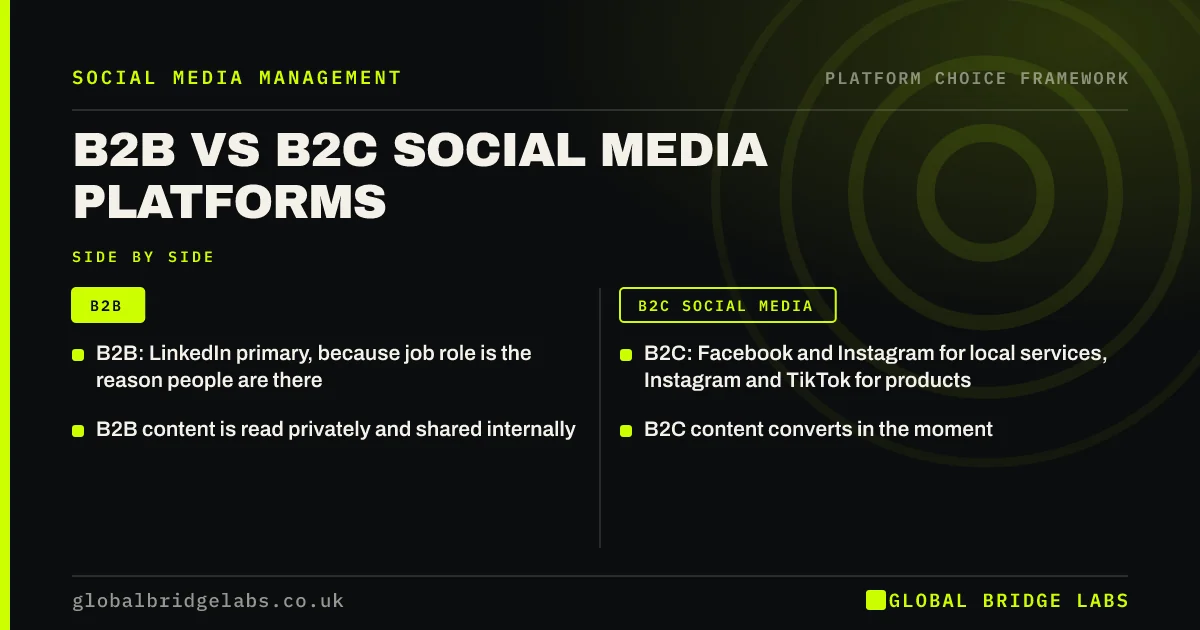
- B2B: LinkedIn primary, because job role is the reason people are there.
- B2C: Facebook and Instagram for local services, Instagram and TikTok for products.
- B2B content is read privately and shared internally. Expect low visible engagement.
- B2C content converts in the moment. Expect visible engagement and fast decay.
- Selling to both: separate channels, not separate pillars on one channel.
Sell to both businesses and consumers? We will split your channels properly on WhatsApp.
Chat on WhatsApp →What is the real B2B and B2C difference?
The buying journey, not the audience. A B2B purchase typically involves several people, a written justification and a procurement step, which means your content has to survive being forwarded to someone who has never heard of you. A B2C purchase usually involves one person deciding within days or minutes.
That difference determines format, cadence and metric far more than the B2B or B2C label does. Two businesses selling to consumers can need completely different channels if one sells a £12 product and the other sells a £12,000 extension.
Why does LinkedIn dominate B2B platform choice?
Because it is the only major platform where your buyer's job title is the reason they are there. On every other channel, occupation is incidental. On LinkedIn it is the organising principle, which makes both targeting and credibility work differently.
The qualifier matters: LinkedIn rewards individuals far more reliably than company pages. For a small UK firm the practical setup is a modest company page for credibility plus consistent posting from two or three named people. Buyers check the page and follow the people.
Why does B2B content show low engagement?
Because the behaviour that matters is invisible. A procurement lead who reads your post carefully, screenshots it and sends it to a colleague generates no like, no comment and no share. The engagement rate on a well-performing B2B post often looks poor next to a consumer post that sold nothing.
This is the single most common reason UK B2B firms abandon a channel that was working. Judge B2B social on qualified conversations started and on how many enquiries arrive already knowing what you do. Judge B2C social on visible engagement and on direct response, where the metric genuinely reflects the outcome.
We will set B2B metrics that do not punish a working channel. Message us on WhatsApp.
Chat on WhatsApp →Where does the usual B2B advice go wrong?
In three places. It assumes B2B means corporate, when most UK B2B is one owner-manager selling to another, which behaves much more like consumer buying. It assumes consumer platforms have no B2B use, when trades, hospitality suppliers and local wholesalers find real buyers in community groups. And it assumes seniority means professional networks only, when plenty of directors spend more evening attention on video platforms than on any professional feed.
The practical correction is to research your actual buyers rather than applying the label. An owner-managed business selling to other owner-managed businesses is frequently better served by the channels the advice files under B2C.
What if you sell to businesses and consumers?
Separate the channels rather than splitting the content on one. A feed that alternates between a trade audience and a homeowner audience serves neither well, because the questions, the price sensitivity and the proof required are all different.
The cheapest workable structure is one channel per audience, with shared production. Photograph the job once, then write two different sets of copy: specification and lead times for the trade audience, finish and disruption for the homeowner. Same shoot, two channels, roughly 30% more time rather than double.
What does this look like in practice?
A UK flooring supplier sold to contractors and to homeowners from one Instagram account. The homeowner content performed visibly better, so it gradually took over. Contract enquiries, which were roughly four times the average order value, fell away.
The fix was a professional network presence for the contract side with specification-led posts and named salespeople, and the existing account kept for homeowners. Visible engagement on the professional channel remained modest for two quarters, which is normal. Contract enquiries recovered because the buyer finally had somewhere to check the firm that spoke their language.
How does deal size change the answer?
More than the B2B or B2C label does. Above roughly £10,000 a year, a UK purchase usually involves more than one person, a written comparison and sometimes a procurement step, which favours a platform organised around job roles.
Below that, one person usually decides, often outside working hours and often after asking a peer. That behaviour is closer to consumer buying than to anything in a B2B textbook, and it is reachable in exactly the places the formal advice tells you to ignore. Write down your average deal size before you write down your channel.
Next step
Write down how a purchase actually happens in your business: who is involved, how long it takes, and what they check before they call. That description will point at a platform more reliably than the B2B or B2C label ever will.
Message us on WhatsApp and we will map your buying journey to the right two channels.
Chat on WhatsApp →Sources and further reading
- LinkedIn Pages best practices · LinkedIn
- Online Nation: how the UK uses online services · Ofcom
Frequently asked questions
Is LinkedIn the only platform for B2B?
No. It is the strongest default because job role is the reason people are there, but owner-managed B2B often behaves like consumer buying and finds real buyers in local community groups and on video platforms. Research your actual buyers before applying the label.
Why does B2B social media get so little engagement?
Because the valuable behaviour is invisible. Reading carefully, screenshotting and forwarding to a colleague generate no likes or comments. Judge B2B channels on qualified conversations started and on how informed enquiries arrive, not on visible engagement.
Can one account serve both B2B and B2C audiences?
It usually serves neither well, because the questions, price sensitivity and proof required all differ. Run one channel per audience with shared production: photograph the work once, then write two sets of copy for the two buyers.
Do B2C platforms work for business customers?
Often, particularly for trades, wholesalers and hospitality suppliers whose buyers are owner-managers spending their own money. Local community groups and sector recommendation threads regularly produce business-to-business enquiries that a professional network would never have surfaced, because that is where those buyers already are.
Written by

Global Bridge Labs (GBL) is a UK–Sri Lanka partner for social media, websites and BPO. Everything here comes from client delivery, not theory.