On this page
- 01Key takeaways
- 02Which platform gives the most B2B leads?
- 03Why are B2B leads hard to attribute?
- 04What produces leads on LinkedIn specifically?
- 05When do other channels beat LinkedIn for B2B?
- 06How should you measure a B2B channel?
- 07What does this look like in practice?
- 08What should a B2B post actually contain?
- 09Next step
- 10Sources and further reading
- 11Frequently asked questions
Key takeaways
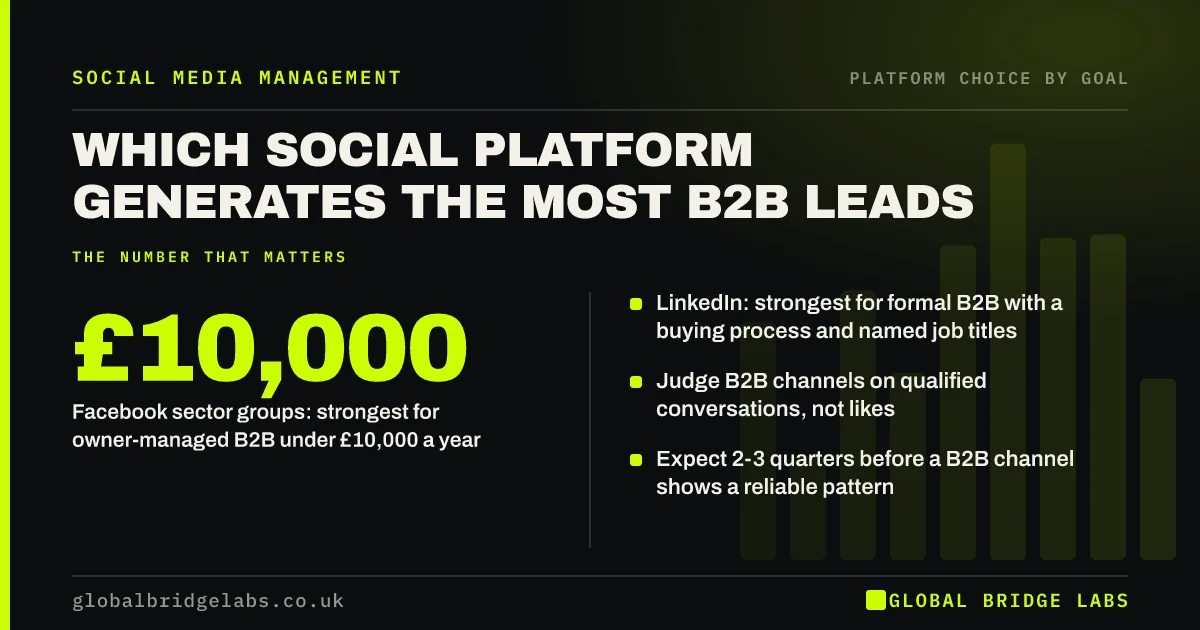
LinkedIn produces the most qualified B2B leads for UK firms selling above roughly £10,000 a year, because job role is the reason people are there. Below that threshold, sector Facebook groups and referral networks often out-produce it at lower cost.
- LinkedIn: strongest for formal B2B with a buying process and named job titles.
- Facebook sector groups: strongest for owner-managed B2B under £10,000 a year.
- Judge B2B channels on qualified conversations, not likes. The signal is invisible.
- Expect 2-3 quarters before a B2B channel shows a reliable pattern.
- Named individuals outperform company pages by a wide margin on LinkedIn.
Want your B2B channel chosen on deal size rather than habit? Message us on WhatsApp.
Chat on WhatsApp →Which platform gives the most B2B leads?
LinkedIn, for most UK firms with a formal sale, because it is the only major platform organised around what people do for work. That makes both targeting and credibility function differently from every other channel.
The qualification matters though. Around 5.5 million UK private sector businesses exist and the great majority have no employees, so a large share of UK B2B is one owner selling to another. That buyer often behaves like a consumer and is reachable in places the standard B2B advice ignores.
Why are B2B leads hard to attribute?
Because most of the valuable behaviour leaves no trace. A finance director who reads three of your posts over two months, checks your website twice and then calls you will appear in your data as a direct phone enquiry with no source.
This is why B2B channels get cut unfairly. The practical fix is to ask every new enquiry one question: what made you get in touch today. Recording that answer for six months produces better attribution data than any analytics setup, because it captures the invisible middle of the journey.
What produces leads on LinkedIn specifically?
Not company page posts, which reach very few people. Five things in rough order of return.
- Consistent posting from 2-3 named people with real roles and real opinions.
- Answering the questions clients ask on a first call, in public, without gating.
- Commenting substantively on your buyers' posts, which is where most conversations start.
- A complete company page as the verification step buyers actually check.
- Direct messages that reference something specific, never templated pitches.
We will build a LinkedIn rhythm for your named people. Ask on WhatsApp.
Chat on WhatsApp →When do other channels beat LinkedIn for B2B?
When the buyer is an owner-manager rather than a job title. Trades supply, hospitality supply, independent retail, childcare, fitness and logistics all have active UK Facebook groups where owners ask peers for recommendations daily.
YouTube also beats LinkedIn for technical B2B purchases, because a buyer evaluating equipment or software searches for demonstrations and comparisons rather than scrolling a feed. A video answering how a machine actually performs will still be generating enquiries two years later.
How should you measure a B2B channel?
On conversations, not impressions. Three measures that hold up: qualified conversations started per quarter, the share of enquiries arriving already informed about what you do, and pipeline value attributed by asking the buyer directly.
Set the review window at two quarters rather than one month. B2B buying cycles are long and a channel judged monthly will be closed before it has had a chance to produce anything, which is the most common self-inflicted wound in B2B marketing.
What does this look like in practice?
A UK industrial cleaning contractor posted from the company page for a year with almost no result. Switching to two named people, the operations director and a site supervisor, posting weekly about real jobs and real problems, changed the pattern within two quarters.
The posts were not polished. They described what went wrong on a site and how it was fixed, which is exactly what a facilities manager wants to read. Enquiries arrived from people who had never engaged publicly with a single post, which is how B2B social usually works.
What should a B2B post actually contain?
The detail a buyer cannot get anywhere else. Generic advice about your sector is already everywhere and competes with a thousand identical posts; what a specific job cost, what went wrong on it and how you handled that is available only from you.
The test we use is whether a competitor could publish the same post with their logo on it. If they could, it is not doing any work. Naming real constraints, real timescales and real numbers is uncomfortable and it is the entire reason anyone remembers a B2B account.
It is also what makes a post worth forwarding, which is how B2B content actually reaches the person who signs.
Next step
Write down your average deal size and who signs it. If that person holds a job title inside a larger organisation, put two named people on LinkedIn weekly. If they own the business, spend the same hours in the groups they already belong to.
Message us on WhatsApp and we will pick the B2B channel that matches your deal size.
Chat on WhatsApp →Sources and further reading
- LinkedIn Pages best practices · LinkedIn
- Business population estimates for the UK and regions 2025 · Department for Business and Trade
Frequently asked questions
Which social media platform is best for B2B lead generation?
LinkedIn for UK firms selling above roughly £10,000 a year, because job role is why people are there. Below that, sector Facebook groups where owner-managers ask peers for recommendations frequently produce better-qualified enquiries at lower cost.
How long does LinkedIn take to generate leads?
Two to three quarters of consistent posting from named individuals. B2B cycles are long and much of the valuable behaviour is invisible, so a channel judged after one month will be closed before it has had a chance to work.
Why do company pages perform worse than personal profiles?
Because LinkedIn distribution favours people and buyers treat pages as a verification step rather than a subscription. Keep the page complete and current, then invest the posting effort in two or three named people with real roles.
How do you attribute B2B leads from social media?
Ask every new enquiry what made them get in touch today, and record the answer for six months. That captures the invisible middle of the journey better than any analytics setup, because most B2B research leaves no trackable trace.
Written by
Global Bridge Labs (GBL) is a UK–Sri Lanka partner for social media, websites and BPO. Everything here comes from client delivery, not theory.