On this page
- 01Key takeaways
- 02Can one account serve both audiences?
- 03How do you share production across two channels?
- 04Which channels suit each side?
- 05How do you measure them fairly?
- 06What if you can only run one channel?
- 07What does this look like in practice?
- 08How do you stop the audiences overlapping?
- 09Next step
- 10Sources and further reading
- 11Frequently asked questions
Key takeaways
Run one channel per audience with shared production. Photograph the work once and write two sets of copy. The risk of a single mixed channel is that the more visibly engaged audience crowds out the more profitable one.
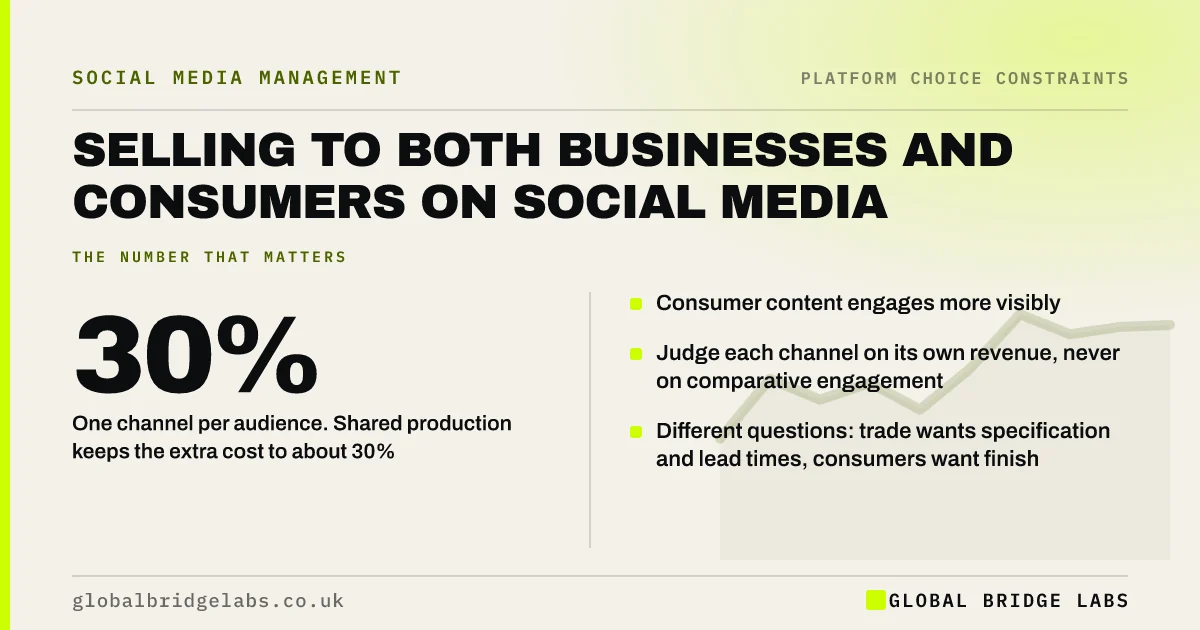
- One channel per audience. Shared production keeps the extra cost to about 30%.
- Consumer content engages more visibly. Trade content usually earns more.
- Judge each channel on its own revenue, never on comparative engagement.
- Different questions: trade wants specification and lead times, consumers want finish.
- If you can only run one, run the one serving your most profitable customer.
Selling to trade and public? We will structure both channels on WhatsApp.
Chat on WhatsApp →Can one account serve both audiences?
It can, and it usually serves neither well. A trade buyer and a consumer ask different questions, carry different price sensitivity and need different proof, so a feed alternating between them reads as unfocused to both.
There is also a quieter risk. Consumer content typically gets more visible engagement, so a mixed feed drifts toward it over time, and the trade side, which is frequently the more profitable, quietly disappears.
How do you share production across two channels?
By separating the asset from the message. The photograph, the video clip and the job itself are shared; the framing, the copy and the call to action are not.
- Photograph or film the job once, capturing both detail and finished result.
- Trade copy: specification, lead time, tolerances, availability, trade terms.
- Consumer copy: what it looks like, how long it took, what the disruption was.
- Different calls to action: account enquiry versus quote request.
- Expect about 30% more time than one channel, not double.
Which channels suit each side?
Usually different ones, which is what makes the separation practical rather than artificial.
Trade buyers are often reachable on a professional network or in sector groups, depending on whether they are corporate or owner-managed. Consumers are usually on the visual and local channels. Because the platforms differ, you are rarely running two accounts on the same platform, which avoids the audience confusion entirely.
We will map each audience to the right platform. Message us on WhatsApp.
Chat on WhatsApp →How do you measure them fairly?
Separately, on revenue rather than on engagement, and with the average order value attached to every enquiry count. This is the discipline that protects the trade side.
A consumer channel producing 40 enquiries a month at £300 average value and a trade channel producing three at £6,000 look completely different in a dashboard and are worth similar amounts. Without average order value attached, the trade channel will look like the failure it is not.
What if you can only run one channel?
Run the one serving your most profitable customer, and serve the other audience through your website instead. A clearly signposted trade section or a consumer page can carry the second audience without needing its own feed.
That is a better compromise than a mixed channel, because a website section can be found by people already looking for it, while a mixed feed confuses everybody. Point to it from your single channel's bio and pinned post.
What does this look like in practice?
A UK tile supplier ran one account for retail customers and trade fitters. Retail content performed visibly better and gradually took over, and trade accounts, which carried both higher volume and better margin, declined without anyone connecting the two.
Splitting into a consumer channel and a trade presence with specification-led content and named account managers took about a third more time in total. Trade enquiries recovered within two quarters. The retail channel was unaffected, because it had never needed the trade content in the first place.
How do you stop the audiences overlapping?
Accept that they will, and design for it rather than trying to prevent it. Trade buyers follow consumer accounts and consumers find trade accounts, and neither causes any harm as long as each channel is clear about who it is for.
What does cause harm is pricing. If trade terms are visible to consumers, or consumer prices are visible to trade buyers, you will spend time explaining the difference. Keep pricing detail in the channel it belongs to and handle the other audience by conversation.
Name the audience in each profile bio. One line saying trade enquiries and specifications, or for homeowners in the Manchester area, resolves almost all of the confusion before it starts.
Link each channel to the other in the bio. A trade buyer who lands on the consumer account should be one tap from the right place.
Next step
Work out the average order value for each audience, then look at how much of your content serves each. If the more profitable audience is getting less of your attention, you have found the problem and it is fixable this month.
Message us on WhatsApp and we will split your trade and consumer channels properly.
Chat on WhatsApp →Sources and further reading
- LinkedIn Pages best practices · LinkedIn
- Business population estimates for the UK and regions 2025 · Department for Business and Trade
Frequently asked questions
Can one social media account serve both trade and consumer customers?
It can, but it usually serves neither well. The two ask different questions and need different proof, and mixed feeds drift toward consumer content because it engages more visibly, which quietly starves the often more profitable trade side.
How much extra work is running two audience channels?
About 30% more than running one, rather than double, provided you share production. Photograph or film the job once, then write two sets of copy: specification, tolerances and lead times for trade, finish and disruption for consumers.
How do you measure a trade channel against a consumer one?
Separately, on revenue, with the average order value attached to every enquiry count. Forty consumer enquiries at £300 and three trade enquiries at £6,000 are worth similar amounts, but they look completely different in any engagement dashboard.
What if you can only run one channel for two audiences?
Run the one serving your most profitable customer and serve the other through a clearly signposted website section instead. A web page can be found by people already looking for it, whereas a mixed feed confuses everybody.
Written by

Global Bridge Labs (GBL) is a UK–Sri Lanka partner for social media, websites and BPO. Everything here comes from client delivery, not theory.