
On this page
Key takeaways
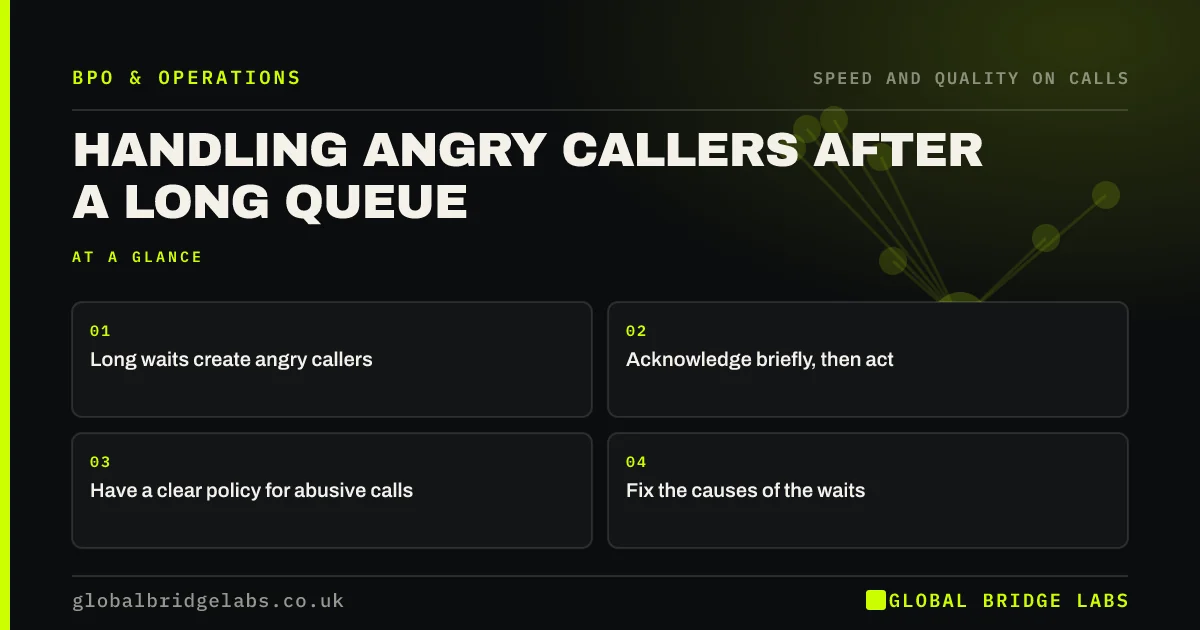
Long queues create angry callers, and angry callers take longer to help, which makes queues longer. Break the cycle by calming the call quickly with a short acknowledgement and clear action, protect staff with a policy for abusive calls, and fix the causes of long waits. Anger at the queue is usually a service problem, not a caller problem.
- Long waits create angry callers.
- Acknowledge briefly, then act.
- Have a clear policy for abusive calls.
- Fix the causes of the waits.
Dealing with more angry callers than usual? Message us on WhatsApp.
Chat on WhatsApp →Why do long queues make callers angry?
Waiting signals that the business does not value the caller's time, and uncertainty makes it worse. By the time the call is answered, the caller may be angry about the wait as well as the original problem. That second layer of frustration is entirely avoidable.
How do you calm the call quickly?
Let the caller speak, acknowledge the wait and the problem in one sentence and move to action. Use a calm, steady voice and avoid arguing about the wait. Most callers calm down once they hear a clear plan.
- Let them speak first.
- Acknowledge briefly and sincerely.
- Give a clear plan.
What about abusive callers?
Staff should not have to accept abuse. Agree a policy: warn the caller once, explain you will end the call if it continues, then end it and record what happened. Give staff a short break after a difficult call, and make sure a manager follows up where needed.
Want an abusive call policy drafted? Ask us on WhatsApp.
Chat on WhatsApp →How do you reduce angry calls?
Track complaints about waiting and angry calls by half hour. They usually cluster in the same intervals as long waits. Fix those intervals with staffing, callbacks or demand reduction, and the number of angry calls falls.
What does this look like in practice?
A pattern we see: staff report more angry callers on Monday mornings. The interval report shows Monday waits are the longest of the week. Fixing Monday cover and adding callbacks reduces angry calls more than any de-escalation training.
Staff sickness also eases, because the hardest calls of the week become less frequent.
Angry caller checklist
- Let the caller speak first.
- Acknowledge in one sentence.
- Give a clear plan.
- Follow an agreed abuse policy.
- Track angry calls against wait times.
Next step
Ask your team to flag angry calls for two weeks, compare the times with your interval report and fix the half hours where both peak.
Message us on WhatsApp to reduce angry calls, or book a 30-minute consultation.
Chat on WhatsApp →Sources and further reading
- Work-related stress and how to manage it · Health and Safety Executive
- Stop trying to delight your customers (Dixon, Freeman and Toman, 2010) · Harvard Business Review
Frequently asked questions
How do you calm an angry customer on the phone?
Let them explain without interrupting, acknowledge the problem and the wait in one sincere sentence and tell them clearly what you will do. Keep your voice calm and steady. Avoid arguing or blaming. Most callers calm down once they feel heard and see that action is being taken.
Can staff hang up on abusive callers?
Many businesses allow it under a clear policy. Typically staff warn the caller once, explain the call will end if the abuse continues, then end it and record what happened. Make sure the policy is written down, staff are supported and a manager follows up where needed.
Are angry callers a sign of poor service level?
Often. Angry calls tend to cluster when waits are long. If staff report more angry callers at certain times, compare them with your interval report. Fixing long waits usually reduces angry calls more than training alone, though training still helps staff cope.
Written by

Global Bridge Labs (GBL) is a UK–Sri Lanka partner for social media, websites and BPO. Everything here comes from client delivery, not theory.


