On this page
- 01Key takeaways
- 02Why does empathy matter on short calls?
- 03What does empathy sound like?
- 04How do you listen well on a busy line?
- 05When does a caller need more time?
- 06What does this look like in practice?
- 07Empathy on busy calls checklist
- 08Next step
- 09Sources and further reading
- 10Frequently asked questions
Key takeaways
Empathy on a busy call is less about long phrases and more about listening, acknowledging the problem and acting on it. A short, sincere acknowledgement, using the caller's words, followed by a clear plan, shows you understand without adding minutes to the call. Scripted empathy statements repeated on every call often sound hollow.
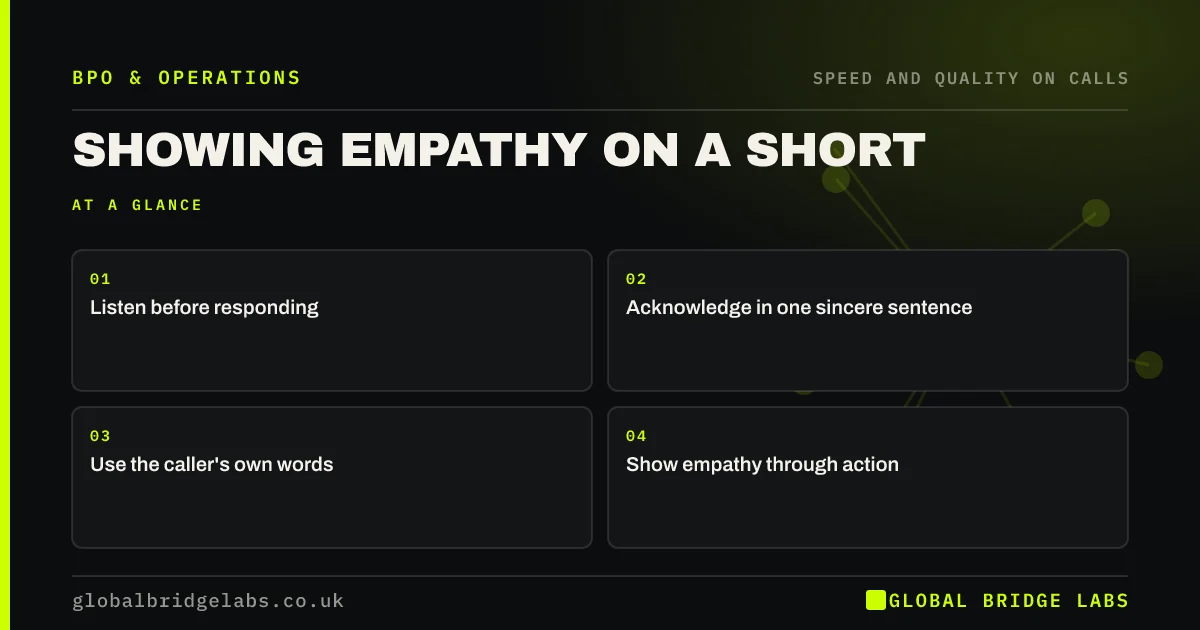
- Listen before responding.
- Acknowledge in one sincere sentence.
- Use the caller's own words.
- Show empathy through action.
Want help with empathy on busy lines? Message us on WhatsApp.
Chat on WhatsApp →Why does empathy matter on short calls?
Callers who feel understood are calmer, explain more clearly and are more likely to accept a solution. That often makes calls shorter, not longer. Callers who feel brushed off tend to repeat themselves, argue or call back.
What does empathy sound like?
Simple, specific acknowledgements work best: "That sounds really frustrating, especially with guests arriving tomorrow. Let me sort it now." It names the issue, shows you heard the detail and moves to action. Avoid repeating the same stock phrase on every call.
- Name the issue.
- Mention a detail they gave.
- Move straight to action.
How do you listen well on a busy line?
Let the caller finish their first explanation without interrupting, then summarise in a sentence. That one summary often saves several clarifying questions. Notes taken during this part of the call also make after-call work quicker.
Want examples of empathy that work on your calls? Send us a few recordings on WhatsApp.
Chat on WhatsApp →When does a caller need more time?
Some callers are distressed, bereaved or in vulnerable circumstances. Speed targets should never push these calls to end early. Give staff permission to take longer, and know when to offer extra support or a named contact.
What does this look like in practice?
A pattern we see: staff use a stock empathy line on every call, and feedback describes the team as robotic. Coaching people to name the caller's specific problem in their own words improves feedback without making calls longer.
Team leaders share one strong example in each weekly huddle, which spreads good habits faster than any written script.
Complaints that mention staff attitude also fall over the following quarter, even though the queue itself has not changed, because callers feel listened to once they reach someone.
Empathy on busy calls checklist
- Let the caller finish first.
- Summarise in one sentence.
- Acknowledge the specific issue.
- Move to action quickly.
- Allow extra time for vulnerable callers.
Next step
Listen to five recent calls and note where the caller felt heard and where they did not. Share one good example with the team.
Message us on WhatsApp to improve empathy on your calls, or book a 30-minute consultation.
Chat on WhatsApp →Sources and further reading
- Stop trying to delight your customers (Dixon, Freeman and Toman, 2010) · Harvard Business Review
- FG21/1: Guidance for firms on the fair treatment of vulnerable customers · Financial Conduct Authority
Frequently asked questions
Does empathy make calls longer?
Not usually. A short acknowledgement and a clear summary often make calls shorter, because the caller feels understood and explains less. Calls get longer when callers feel brushed off and repeat themselves. Some calls, such as those with distressed customers, should be longer, and that is fine.
What are good empathy statements for customer service?
Short, specific statements work best, such as "That sounds really frustrating, let me help sort it." Mention a detail the caller gave so it sounds genuine. Avoid repeating the same stock phrase on every call, because customers notice and it can feel insincere.
How do I train staff in empathy?
Use real call recordings, with consent and privacy in mind, to show good and weak examples. Practise summarising a caller's problem in one sentence. Recognise good examples in team meetings. Empathy improves most when people feel they have permission to take a little more time when needed.
Written by

Global Bridge Labs (GBL) is a UK–Sri Lanka partner for social media, websites and BPO. Everything here comes from client delivery, not theory.