On this page
- 01Key takeaways
- 02Can you add e-commerce to an existing website?
- 03What are the options?
- 04When does e-commerce justify a redesign?
- 05What legal requirements apply from the first sale?
- 06How do you test demand before building?
- 07What are the running costs to plan for?
- 08What must product pages include?
- 09What does this look like in practice?
- 10E-commerce decision checklist
- 11Next step
- 12Sources and further reading
- 13Frequently asked questions
Key takeaways
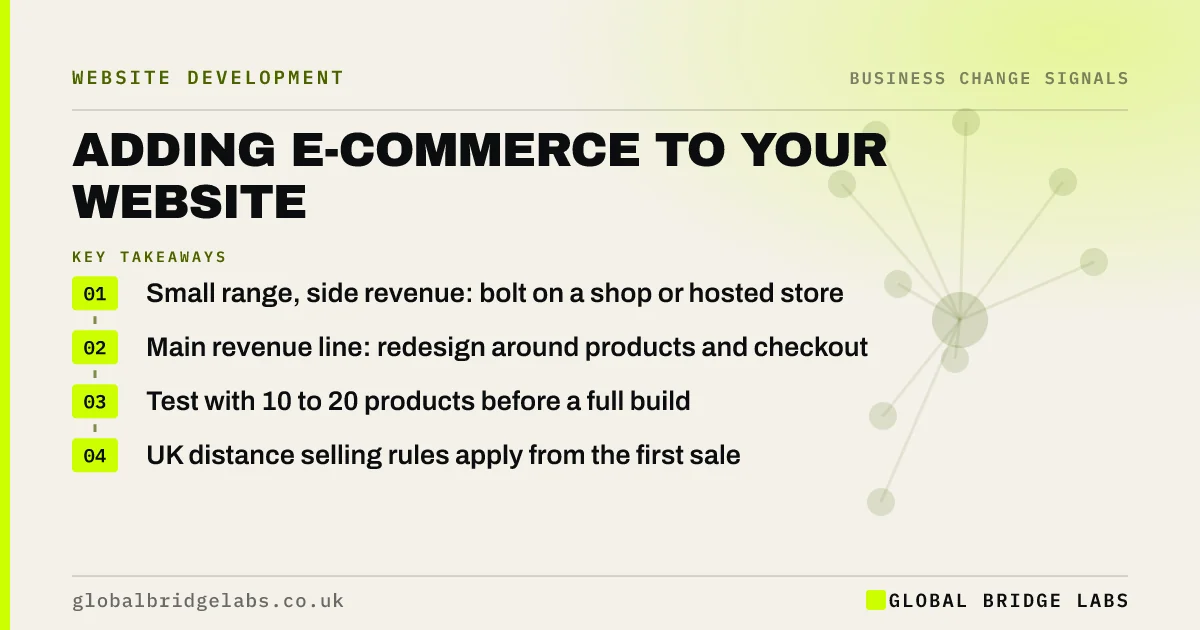
If online sales will be a small part of the business, add a shop to the existing site or link to a hosted store. If they will become a main revenue line, redesign around selling, because navigation, product pages, checkout, speed and legal pages all change. Test demand with a small range before committing.
- Small range, side revenue: bolt on a shop or hosted store.
- Main revenue line: redesign around products and checkout.
- Test with 10 to 20 products before a full build.
- UK distance selling rules apply from the first sale.
Thinking of selling online? We will tell you on WhatsApp which route fits.
Chat on WhatsApp →Can you add e-commerce to an existing website?
Usually, yes. Most modern platforms support a shop plug-in or integration, and hosted stores can sit on a subdomain linked from the main site. Whether that is enough depends on how central online sales will be. A few products alongside services can bolt on; a business moving to online retail needs a site designed for it.
What are the options?
Three routes cover most UK small businesses.
- Plug-in shop on the current platform: cheapest, shares the design, can slow the site.
- Hosted store on a subdomain, such as Shopify: robust checkout, separate design to maintain.
- Redesign or rebuild around e-commerce: best experience, highest cost and migration work.
Want the three routes costed for your products? Ask us on WhatsApp.
Chat on WhatsApp →When does e-commerce justify a redesign?
When products will lead the business. Product navigation, filtering, product pages, basket, checkout, delivery information and returns all need a structure the current site was not built for. If the existing platform cannot deliver a fast, secure checkout, a rebuild is justified.
What legal requirements apply from the first sale?
Selling online to consumers in the UK brings duties under the Consumer Contracts Regulations 2013: clear pre-contract information, total prices including delivery, and a 14-day cancellation right for most goods. Card payments must be handled in line with PCI DSS, which is simplest when a payment provider hosts the card form.
How do you test demand before building?
Start with 10 to 20 best sellers on a hosted store or plug-in, promote them to existing customers and social followers, and measure orders, average order value and returns for a quarter. The result tells you whether a full e-commerce redesign would pay back.
What are the running costs to plan for?
Payment processing fees on every sale, platform or plug-in subscriptions, stock photography of products, and more maintenance. UK maintenance for e-commerce sites commonly runs at around £250 to £500 or more a month, higher than for brochure sites.
What must product pages include?
Everything a buyer needs to decide without asking: clear photos from several angles, a plain description, size or specification details, the full price including VAT where applicable, delivery options and costs, stock status, and returns information. Missing any of these creates questions, and questions lose sales online.
Reviews help, and so does honesty about limits such as lead times or delivery areas. Product pages also need to load quickly on mobile, because most small e-commerce traffic comes from phones and heavy image galleries are a common cause of slow pages.
- Photos from several angles.
- Specifications and sizes.
- Full price, delivery cost and timescale.
- Stock status and returns information.
- Reviews where available.
What does this look like in practice?
A pattern in UK hospitality: a café adds gift vouchers and a small range of coffee beans through a hosted shop linked from the menu. It tests demand for a season without touching the main site. Only when online orders become a meaningful share of revenue does a combined redesign make sense.
E-commerce decision checklist
Answer these before choosing a route.
- Estimate online sales as a share of revenue in year two.
- List the products you would start with.
- Check your platform's shop options and checkout speed.
- Prepare delivery, returns and terms information.
- Choose a payment provider that hosts card entry.
- Test with a small range for a quarter before a full build.
Next step
If you are thinking of selling online, we will look at your products and current site with you in 30 minutes and recommend the lightest route that works.
Message us on WhatsApp for an e-commerce route recommendation, or book a 30-minute consultation.
Chat on WhatsApp →Sources and further reading
- Consumer Contracts (Information, Cancellation and Additional Charges) Regulations 2013 · legislation.gov.uk
- Payment Card Industry Data Security Standard · PCI Security Standards Council
- Google Merchant Center Help · Google
Frequently asked questions
Can I add an online shop to my current website?
Usually, yes, through a shop plug-in on your current platform or a hosted store linked from your site. That suits a small range or side revenue. If online sales will become a main revenue line, a site designed around products and checkout usually performs better.
Should I use Shopify or add a shop to my WordPress site?
A hosted platform such as Shopify gives a robust checkout with less maintenance. A WordPress shop plug-in keeps everything on one site and design but needs more care on speed, security and updates. Choose on how central online sales will be and who will maintain it.
What legal requirements apply to selling online in the UK?
Consumer sales must follow the Consumer Contracts Regulations 2013, including clear pre-contract information, full prices with delivery, and a 14-day cancellation right for most goods. You also need clear terms, a privacy notice and PCI DSS-compliant card handling. Put these details on the site before the first sale.
How much does it cost to add e-commerce to a website?
A small plug-in shop or hosted store can cost a few hundred to a few thousand pounds to set up, plus fees and subscriptions. A redesign or rebuild around e-commerce is typically higher than a brochure redesign, with higher maintenance costs afterwards.
Written by

Global Bridge Labs (GBL) is a UK–Sri Lanka partner for social media, websites and BPO. Everything here comes from client delivery, not theory.