On this page
- 01Key takeaways
- 02What is a fractional team?
- 03Which roles work well as fractional?
- 04How does a fractional team differ from outsourcing?
- 05What does a fractional role cost?
- 06What should you check before engaging one?
- 07When is a fractional role the wrong fit?
- 08What does this look like in practice?
- 09Fractional team checklist
- 10Next step
- 11Sources and further reading
- 12Frequently asked questions
Key takeaways
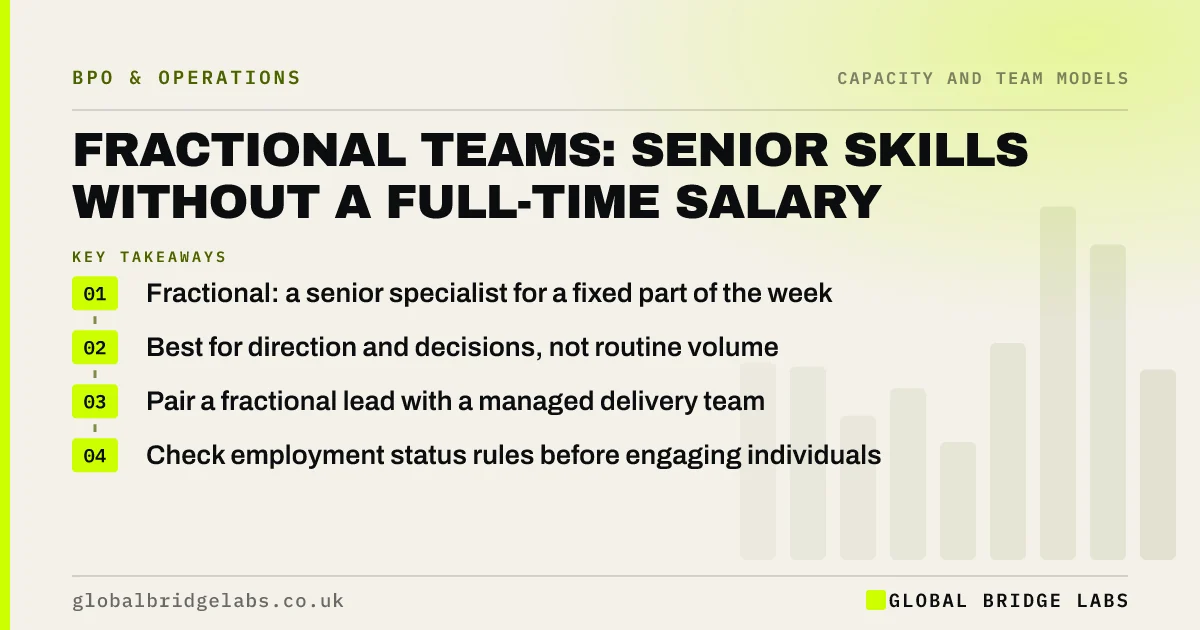
A fractional team gives a small business senior skills for a day or two a week, paid by the day or month, without a full-time salary. It suits roles where the business needs direction more than hours: finance, marketing, operations, technology. Fractional leaders set the plan. A managed team or junior staff carry out the volume.
- Fractional: a senior specialist for a fixed part of the week.
- Best for direction and decisions, not routine volume.
- Pair a fractional lead with a managed delivery team.
- Check employment status rules before engaging individuals.
Wondering which roles could be fractional in your firm? Message us on WhatsApp with your gaps.
Chat on WhatsApp →What is a fractional team?
A fractional team is a group of senior specialists who each work for a business part-time on an ongoing basis, typically one to three days a week, alongside other clients. Unlike a consultant on a project, a fractional leader holds a continuing role, such as finance director or head of marketing, at a fraction of full-time cost.
Which roles work well as fractional?
Roles work well as fractional when the value lies in judgement and a few hours of it go a long way. A 15-person firm rarely needs a full-time finance director, but benefits greatly from one for two days a month. The same applies to marketing leadership, HR, operations design and technical oversight.
- Finance director or controller.
- Head of marketing.
- Operations or process lead.
- HR adviser.
- Technical lead or chief technology officer.
How does a fractional team differ from outsourcing?
A fractional specialist supplies senior thinking for a few days. Outsourcing supplies a managed team to run a process every day. They solve different problems and work best together: the fractional marketing lead sets the plan and the outsourced team produces and publishes the content.
What does a fractional role cost?
A fractional role is usually priced by the day or as a monthly retainer. Rates vary widely with seniority and field. As an illustration only, two days a month at £500 a day is £12,000 a year, against a full-time senior salary several times that once employer costs are added. Ask what is included between the paid days.
Want a mix of senior direction and managed delivery outlined? Send us your requirements on WhatsApp.
Chat on WhatsApp →What should you check before engaging one?
Check three things. First, employment status: HM Revenue & Customs publishes guidance on off-payroll working, and the right treatment depends on how the person actually works with you. Second, availability on the days you need. Third, who does the work between visits, because a plan with no one to carry it out changes nothing.
When is a fractional role the wrong fit?
A fractional role is the wrong fit when the business needs daily presence, when the function is central to what customers buy, or when the workload already fills a week. It also disappoints when the owner wanted an extra pair of hands, not advice. In those cases hire, or use a managed team.
What does this look like in practice?
A pattern we see in UK firms of 10 to 25 people: the owner acts as finance director, marketing director and operations director, and none of the three gets proper attention. Two fractional leads for a few days a month, with bookkeeping, content production and admin run by managed teams, give each function an owner without adding a single employee.
Fractional team checklist
Settle these before the first day.
- The outcomes the role is responsible for.
- Days per month and how to reach them in between.
- Who carries out the work they specify.
- Employment status assessed and documented.
- Access to systems and data, with a contract.
- A review after three months.
Next step
Tell us which functions the owner is currently covering. We will suggest where senior part-time direction would help and what a delivery team behind it would do.
Message us on WhatsApp to map your fractional and managed roles, or book a 30-minute consultation.
Chat on WhatsApp →Sources and further reading
- Understanding off-payroll working (IR35) · HM Revenue & Customs
- Rates and thresholds for employers 2026 to 2027 · HM Revenue & Customs
Frequently asked questions
What does fractional mean in business?
Fractional means a senior professional works for a business for a fraction of the week on an ongoing basis, often one to three days, while also serving other clients. The business gets experienced leadership in a function such as finance or marketing without the cost of a full-time executive.
Is a fractional role the same as a consultant?
Not quite. A consultant is usually engaged for a defined project and then leaves. A fractional leader holds a continuing role, attends regular meetings, owns outcomes and manages people or suppliers, just for fewer days than a full-time employee would work.
Does IR35 apply to fractional workers?
It can. Whether off-payroll working rules apply depends on the working relationship and on the size of the client. HM Revenue & Customs provides guidance and a status tool. Small businesses should assess each engagement, keep a record of the reasoning and take advice where the position is unclear.
When should a small business hire full-time instead of fractional?
Hire full-time when the function needs daily attention, the workload fills a week, or it is central to what customers pay for. A fractional arrangement that has grown to four days a week for a year is usually a sign that a permanent role is now justified.
Written by

Global Bridge Labs (GBL) is a UK–Sri Lanka partner for social media, websites and BPO. Everything here comes from client delivery, not theory.