On this page
- 01Key takeaways
- 02Why is service delivery hard to scale?
- 03How much capacity is hidden in non-billable time?
- 04Which work should come off fee earners?
- 05How do you standardise a service?
- 06What does delivery support cost?
- 07When do you simply need more fee earners?
- 08What does this look like in practice?
- 09Service delivery checklist
- 10Next step
- 11Sources and further reading
- 12Frequently asked questions
Key takeaways
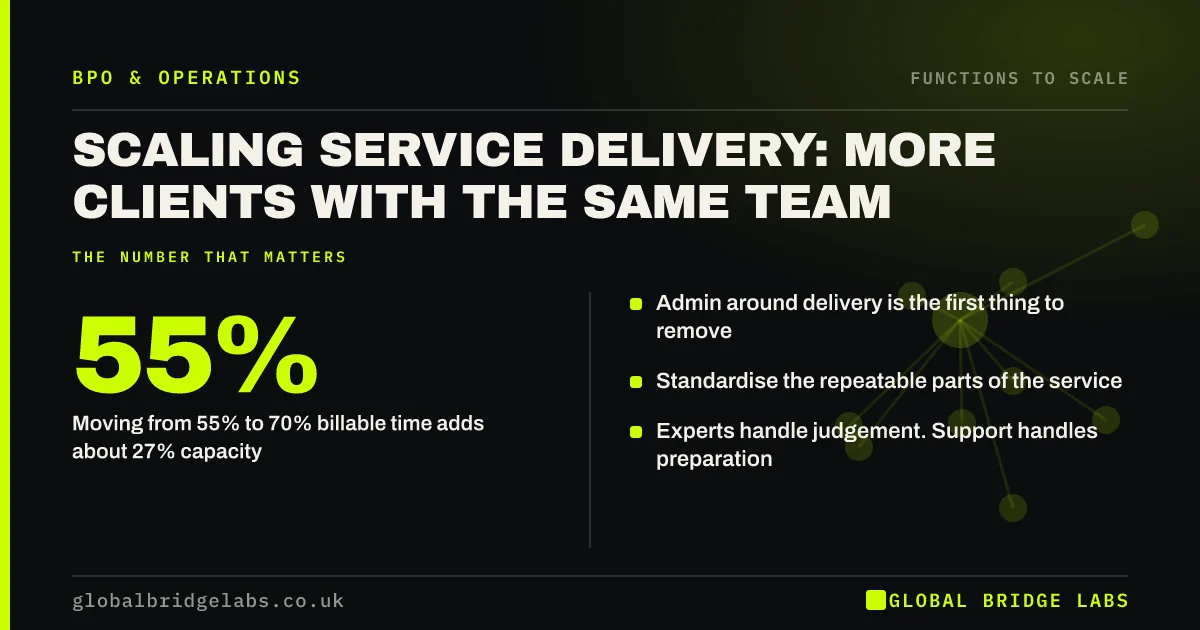
To scale service delivery without more fee earners, raise the share of each fee earner's week spent on client work. Strip out the admin around delivery, standardise the repeatable parts of the service, and give those parts to trained support. A team that moves from 55% to 70% billable time has added more than a quarter to its capacity.
- Moving from 55% to 70% billable time adds about 27% capacity.
- Admin around delivery is the first thing to remove.
- Standardise the repeatable parts of the service.
- Experts handle judgement. Support handles preparation.
Fee earners buried in admin? Message us on WhatsApp with your team size and billable rate.
Chat on WhatsApp →Why is service delivery hard to scale?
Service delivery is hard to scale because revenue depends on skilled people's hours, and those hours are finite. The usual answer is to hire more fee earners, which is slow and expensive. The overlooked answer is that existing fee earners spend a large part of each week on work that does not need their skill.
How much capacity is hidden in non-billable time?
A great deal. If six fee earners each work 37.5 hours and bill 55% of them, the firm delivers about 124 client hours a week. At 70% it delivers about 158. That is 34 more hours, close to an extra fee earner, with no recruitment. The figures are illustrative, but the arithmetic applies to any people business.
Which work should come off fee earners?
Take away anything that could be done to a written instruction. That includes scheduling, document collection, formatting, data entry, first drafts of standard documents, time recording support, billing preparation and routine client updates. Each is a few minutes, and together they are often a day a week per person.
- Diary management and meeting preparation.
- Document collection and chasing.
- Standard reports and first drafts.
- Billing preparation and time capture.
- Routine client status updates.
How do you standardise a service?
Standardise a service by separating what is the same for every client from what is different. Templates, checklists and standard stages cover the first. Expert judgement covers the second. Most professional and technical services are more repeatable than their practitioners believe, typically in the preparation and follow-up around the expert work.
Want to discuss your requirements for delivery support? Send us a typical client workflow on WhatsApp.
Chat on WhatsApp →What does delivery support cost?
Delivery support from a managed team is indicatively £9–£18 per hour offshore and £20–£35 per hour onshore. Set that against the fee earner's charge-out rate: an hour moved from admin to client work is worth the difference between the two. Check that there is client demand to fill the freed hours.
When do you simply need more fee earners?
You need more fee earners when billable time is already high, quality is at risk and demand is still unmet. No amount of support creates a 45-hour billable week. Hire then. Supported fee earners are also easier to recruit and keep, because the job is the work they trained for.
What does this look like in practice?
A pattern we see in UK accountancy, legal and consultancy practices: qualified staff chase documents, format reports and book their own meetings. Partners conclude the firm needs another associate. A managed support team taking the preparation and chasing usually lifts billable hours enough to postpone that hire and to make it better when it comes.
Service delivery checklist
Run this before approving a fee-earner hire.
- Calculate billable percentage per person.
- Log non-billable tasks for two weeks.
- Mark tasks that follow a written instruction.
- Create templates for standard deliverables.
- Move preparation and chasing to support.
- Re-measure billable percentage after 60 days.
Next step
Tell us how many fee earners you have and their typical billable percentage. We will estimate the capacity hidden in non-billable time and what support would release it.
Message us on WhatsApp for a delivery capacity review, or book a 30-minute consultation.
Chat on WhatsApp →Sources and further reading
- Labour productivity · Office for National Statistics
- Multitasking: switching costs · American Psychological Association
- Employee earnings in the UK (Annual Survey of Hours and Earnings) · Office for National Statistics
Frequently asked questions
How do you scale a service business?
Scale a service business by increasing the share of skilled staff time spent on client work, standardising the repeatable parts of the service, and using support staff or a managed team for preparation and admin. Hire additional fee earners once existing ones are consistently near full billable capacity.
How can I take on more clients without hiring?
Take on more clients by freeing existing staff from non-client work. Remove admin around delivery, use templates and checklists for standard work, and delegate preparation and follow-up to support. Moving billable time from 55% to 70% adds roughly a quarter more client capacity.
What is a good billable utilisation rate?
It varies by role and sector. As a working guide, many professional firms aim for about 65% to 75% of contracted hours for fee earners, lower for partners and managers. Sustained rates far above that leave no time for training, development or supervision.
Can a service be standardised without losing quality?
Yes, when the standard covers preparation, structure and follow-up, and expert judgement is kept for the parts that differ by client. Templates and checklists reduce errors and free experts to think. Quality suffers only when standardisation is applied to the judgement itself.
Written by

Global Bridge Labs (GBL) is a UK–Sri Lanka partner for social media, websites and BPO. Everything here comes from client delivery, not theory.