On this page
- 01Key takeaways
- 02Why does content production stall?
- 03What is a content production process?
- 04How does one idea become many pieces?
- 05Who should do the production?
- 06How do you keep quality as volume rises?
- 07When is more content the wrong goal?
- 08What does this look like in practice?
- 09Content production checklist
- 10Next step
- 11Sources and further reading
- 12Frequently asked questions
Key takeaways
To scale content production, separate knowing from making. Your experts supply the ideas and raw material in short, scheduled sessions. A production team turns each idea into several formats and publishes on a calendar. One 30-minute recorded conversation can produce a month of posts when the process is set up properly.
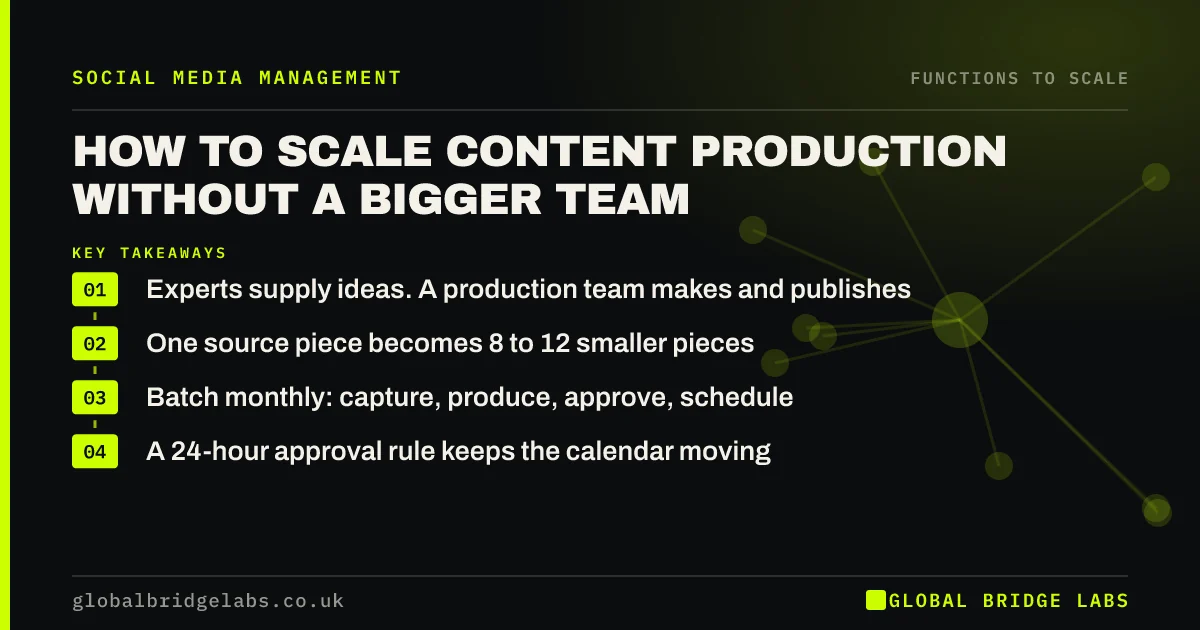
- Experts supply ideas. A production team makes and publishes.
- One source piece becomes 8 to 12 smaller pieces.
- Batch monthly: capture, produce, approve, schedule.
- A 24-hour approval rule keeps the calendar moving.
Content drying up when work gets busy? Message us on WhatsApp with your current output.
Chat on WhatsApp →Why does content production stall?
Content production stalls because the people who know the subject are the busiest people in the business. Writing, design and editing are slow for non-specialists, so content is the first thing dropped in a busy week. The result is bursts of activity followed by silence, which suits neither audiences nor algorithms.
What is a content production process?
A content production process is a repeatable sequence that turns a subject expert's knowledge into published material without relying on that expert to write it. It has four stages: capture, produce, approve and publish. Each stage has an owner and a deadline in the month.
- Capture: a recorded call, voice note or site photos.
- Produce: writing, design and editing by a production team.
- Approve: one person, within one working day.
- Publish: scheduled to a calendar across channels.
How does one idea become many pieces?
One idea becomes many pieces by being cut into formats. A 30-minute recorded answer to a common customer question can become an article, three or four short videos, a carousel, several text posts and an email. The thinking is done once. The production team does the multiplication.
Who should do the production?
Production is best done by people who do it all day. A managed team supplies a writer, designer and editor for part of a month each, which no small business could employ separately. In-house staff are better used supplying material and judging whether the result sounds like the business.
Want to discuss your requirements for monthly content production? Send us your channels on WhatsApp.
Chat on WhatsApp →How do you keep quality as volume rises?
Keep quality with a brand guide, examples of approved work and a single approver. Check facts and claims carefully: advertising rules apply to marketing on your own channels, and the Advertising Standards Authority (ASA) expects claims to be accurate and substantiated. Volume should never come from publishing things you cannot stand behind.
When is more content the wrong goal?
More content is the wrong goal when existing content is not reaching the right buyers or not leading to enquiries. Doubling output of something that does not work doubles the waste. Fix the message, the audience and the call to action first, then scale what performs.
What does this look like in practice?
A pattern we see in UK professional services firms: partners agree content matters, and none has written anything in three months. A half-hour monthly call in which one partner answers five client questions, recorded and handed to a production team, replaces the blank page. Output becomes regular because the experts only have to talk.
Content production checklist
Set up the monthly cycle with these.
- A list of the 20 questions customers ask most.
- A fixed monthly capture session in the diary.
- A brand and tone guide with examples.
- A production team with writing, design and editing.
- One approver and a 24-hour rule.
- A calendar scheduled a month ahead.
- A monthly review of what led to enquiries.
Next step
Send us your channels and how often you publish now. We will outline a monthly production cycle and what your team would need to supply.
Message us on WhatsApp for a content production plan, or book a 30-minute consultation.
Chat on WhatsApp →Sources and further reading
Frequently asked questions
How do you scale content creation?
Scale content creation by building a process: capture ideas from subject experts in short sessions, have a production team turn each into several formats, approve quickly, and schedule to a calendar. Reusing one source idea across formats is what allows output to grow without more expert time.
How much content can a small team produce?
With a monthly batch process and production support, a small business can sustain three to five posts a week across two channels from about two hours of expert time a month. Without a process, the same team often manages a handful of posts a month.
Should content be produced in-house or outsourced?
Ideas, expertise and approval should come from inside the business. Writing, design, editing and scheduling can be outsourced to a production team. This split keeps the content authentic while removing the slow, specialist work from people whose time is better spent on customers.
How do I keep outsourced content on brand?
Give the team a short guide covering tone, words to use and avoid, visual style and examples of content you like. Appoint one approver, give feedback consistently for the first month, and keep a shared file of approved pieces. Quality settles quickly once the team has references.
Written by

Global Bridge Labs (GBL) is a UK–Sri Lanka partner for social media, websites and BPO. Everything here comes from client delivery, not theory.