On this page
- 01Short answer
- 02Does influencer marketing work for small businesses?
- 03How do you choose a creator?
- 04What should you pay?
- 05What are the UK disclosure rules?
- 06What should the agreement cover?
- 07How do you measure it?
- 08How do you brief a creator without ruining the content?
- 09Next step
- 10Sources and further reading
- 11Frequently asked questions
Short answer
For a small UK business, local micro-creators with 2,000-20,000 engaged followers usually outperform larger accounts, cost between £100 and £600 per piece of content, and must label the post as an ad under the CAP Code. Choose on audience overlap and comment quality, never on follower count.
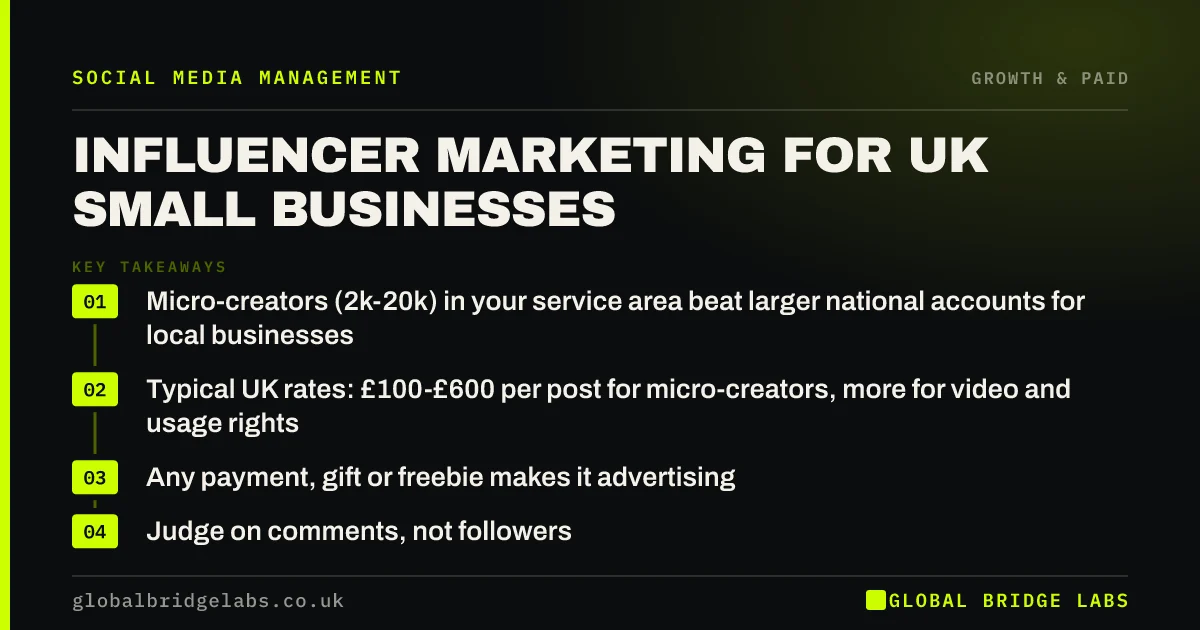
- Micro-creators (2k-20k) in your service area beat larger national accounts for local businesses.
- Typical UK rates: £100-£600 per post for micro-creators, more for video and usage rights.
- Any payment, gift or freebie makes it advertising. It must be clearly labelled.
- Judge on comments, not followers. Read fifty comments before you contact anyone.
- Agree deliverables, usage rights and timing in writing before anything is produced.
Want help choosing and briefing local creators? Message us on WhatsApp.
Chat on WhatsApp →Does influencer marketing work for small businesses?
It works when the creator's audience overlaps with your service area and the recommendation is genuine. It fails when either condition is missing, which is most of the time, because businesses choose on follower count.
For a local UK business the realistic model is not influencer marketing as national brands practise it. It is paying a local person with a genuine audience to experience and describe your service honestly.
How do you choose a creator?
Read the comments before you look at the numbers. Fifty comments tell you whether an audience is real, whether it is local, and whether the creator has any credibility with it.
Then check three things: how many of their followers are plausibly in your area, whether they have promoted competing businesses recently, and whether their previous paid posts were labelled properly. The third is a compliance risk that becomes yours.
- Comment quality: real conversations, not emoji strings.
- Geography: audience genuinely inside your service area.
- Category fit: they talk about your world already.
- Disclosure history: they label paid content correctly.
- Recent promotions: not three competitors in two months.
What should you pay?
UK rates vary widely, but for planning purposes: micro-creators with 2,000-20,000 followers commonly charge £100-£600 per piece of content, rising with video production and with usage rights that let you run it as an advert.
Gifted-only arrangements work in hospitality and retail where the product has real value to the creator. They work poorly for services, where the creator is giving up time rather than receiving something they wanted. Expect to pay for anything requiring effort.
We will scope a creator campaign and rates for your market. Message us on WhatsApp.
Chat on WhatsApp →What are the UK disclosure rules?
If you give a creator payment, product, a free service or anything else of value in exchange for content, the resulting post is advertising and must be obviously identifiable as such before anyone engages with it.
The Advertising Standards Authority applies the CAP Code to influencer content and has been consistent that labels must be prominent rather than hidden in hashtags at the end of a caption. Use a clear ad label at the start. The Competition and Markets Authority has also pursued undisclosed endorsements under consumer protection law, so this is not a theoretical risk.
What should the agreement cover?
Keep it short but put it in writing. Deliverables, publication date, disclosure requirement, approval process, usage rights and duration, exclusivity if any, and what happens if the content is deleted.
Usage rights are the clause most small businesses forget. If you want to run the creator's video as a paid advert, that is a separate permission and usually a separate fee. Agreeing it upfront is far cheaper than negotiating after the content has performed well.
How do you measure it?
Use a creator-specific discount code or landing page, and ask every enquiry where they heard about you for the duration of the campaign.
Judge on enquiries and sales rather than on the post's reach. A creator post with 40,000 views and no attributable enquiries has told you the audience was not yours, which is useful but expensive information if you have not set up the tracking to see it.
How do you brief a creator without ruining the content?
Brief the message and the boundaries, not the script. Creators outperform your own content because their audience trusts their voice, and a word-for-word script removes precisely the thing you are paying for.
A good brief is one page: what the product or service does, the one message that must land, three things that must not be said, the disclosure requirement, the deliverables and dates, and the usage rights. Everything else is theirs.
Approve on substance rather than style. If you find yourself rewriting their phrasing, you have either chosen the wrong creator or written the wrong brief, and the fix is at selection rather than in the edit.
- Brief the message and the boundaries, never the script.
- Three things that must not be said, stated explicitly.
- Disclosure requirement in writing, in the brief.
- Approve substance, not style. Heavy rewriting means wrong creator.
Next step
Creator work is cheap to test and easy to get wrong. The difference is almost entirely in selection and in what you agree beforehand.
Message us on WhatsApp for help selecting, briefing and measuring local creators.
Chat on WhatsApp →Sources and further reading
Frequently asked questions
How much do UK micro-influencers charge?
Commonly £100-£600 per piece of content for creators with 2,000-20,000 followers, rising with video production and with usage rights that let you run the content as a paid advert. Agree usage rights upfront, as they are the most commonly forgotten cost.
Do influencers have to declare paid posts in the UK?
Yes. Any payment, gift, free service or other value in exchange for content makes the post advertising under the CAP Code, and the label must be prominent rather than buried in hashtags. The Competition and Markets Authority has also pursued undisclosed endorsements.
Are micro-influencers better than large accounts?
For local businesses, usually yes. A creator with 5,000 engaged followers in your service area produces more enquiries than a national account with 200,000, because reach outside the area you serve has no commercial value regardless of its size.
How do I measure influencer marketing?
Use a creator-specific discount code or landing page, and ask every enquiry where they heard about you during the campaign. Judge on attributable enquiries and sales, not on the post's view count, which frequently bears no relationship to commercial outcome.
Written by

Global Bridge Labs (GBL) is a UK–Sri Lanka partner for social media, websites and BPO. Everything here comes from client delivery, not theory.