On this page
- 01Key takeaways
- 02What decides how long a website lasts?
- 03How long do different types of website last?
- 04What shortens a website's life?
- 05How can you extend the life of a website?
- 06When is a long-lived website a problem?
- 07Which parts of a website last longest?
- 08What does this look like in practice?
- 09Website lifespan checklist
- 10Next step
- 11Sources and further reading
- 12Frequently asked questions
Key takeaways
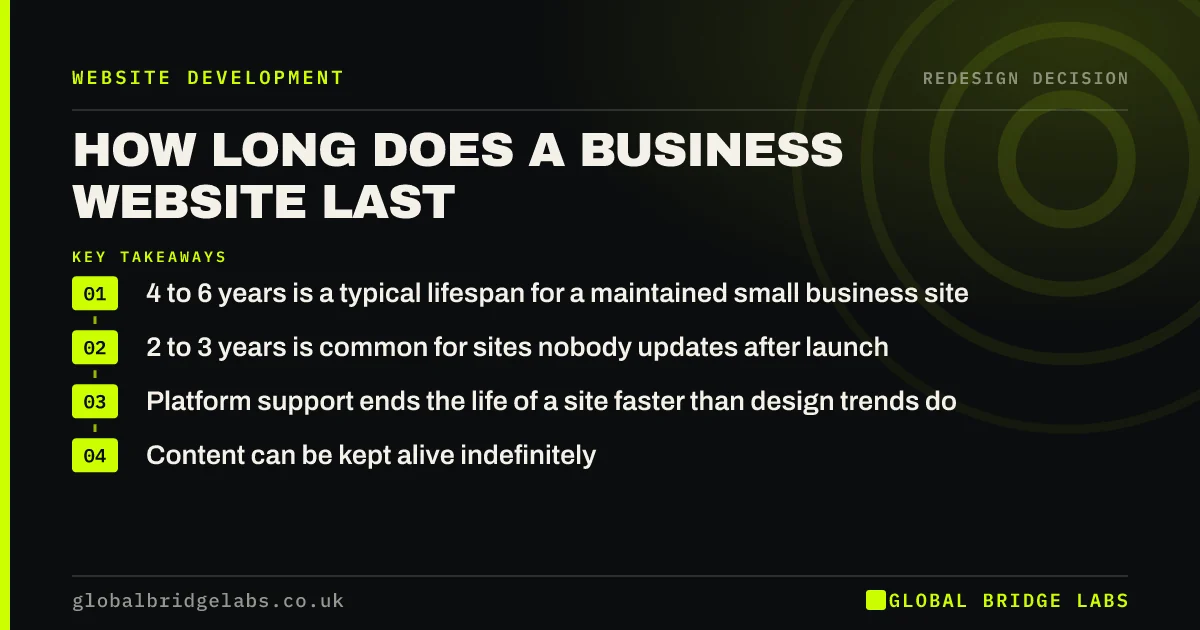
A well-maintained business website typically lasts 4 to 6 years before its platform or structure needs replacing. An unmaintained one can become a liability in 2 to 3 years. The lifespan is set far more by maintenance and platform choice than by design fashion.
- 4 to 6 years is a typical lifespan for a maintained small business site.
- 2 to 3 years is common for sites nobody updates after launch.
- Platform support ends the life of a site faster than design trends do.
- Content can be kept alive indefinitely. Themes and plugins cannot.
Want an estimate of how long your site has left? Send us the URL on WhatsApp.
Chat on WhatsApp →What decides how long a website lasts?
Website lifespan is the period during which a site stays secure, fast, editable and aligned with the business. Three factors decide it: whether the platform keeps receiving updates, whether someone maintains the site, and how much the business changes. Design style is a distant fourth.
A five-year-old site on a supported platform with current content can still be doing its job well. A two-year-old site built on an abandoned theme may already need replacing.
How long do different types of website last?
The platform sets the outer limit. These ranges come from our audit and delivery work with UK SMEs and assume basic maintenance is being done.
- Hosted builders (Squarespace, Wix, Shopify themes): 3 to 5 years, then templates date.
- WordPress with a commercial theme: 4 to 6 years, limited by theme and plugin support.
- Custom-coded sites: 5 to 8 years, limited by how expensive changes become.
- Sites on a former supplier's proprietary system: as long as that supplier stays in business.
What shortens a website's life?
Neglect shortens it most. Skipped updates turn into incompatible plugins, old server software and security exposure, and at some point it becomes cheaper to rebuild than to catch up. Heavy page builders and bespoke features that only one developer understands shorten it too.
- Running software past its end of life, such as PHP 8.1, which lost security support on 31 December 2025.
- Plugins or themes abandoned by their developers.
- Edits made directly to theme files, so updates overwrite them.
- No documentation of how the site was built or who has access.
How can you extend the life of a website?
Keep the platform updated, keep content current and avoid building the business's future on features only one person understands. A basic care plan, typically £50 to £150 a month in the UK, costs far less than an early rebuild.
Use a mainstream platform, a supported theme and as few plugins as possible. Keep a record of accounts, access and customisations so a new supplier can take over without starting again.
Want to know whether your site can be extended rather than replaced? Ask us on WhatsApp.
Chat on WhatsApp →When is a long-lived website a problem?
When age hides decline. A site that has run for eight years without problems can feel safe while it quietly loses ground: slower than competitors on mobile, missing the services added since launch, and describing a business that no longer exists.
Age alone is not the issue. The question is whether the site still meets current standards for speed, security and clarity, and whether it describes the business you run today.
Which parts of a website last longest?
The domain, the URL structure and good content last longest, and they carry most of a site's long-term value. The theme, plugins and design have the shortest lives. That is why a well-planned rebuild keeps the first group and replaces the second.
Search engines build up trust in a domain and its pages over years. A page that has ranked for your main service for five years is an asset, and a rebuild that changes its URL without a redirect throws that asset away. Treat URLs and proven content as permanent, and the platform as replaceable.
- Domain: decades, if renewed and owned by the business.
- URL structure and ranking content: as long as you protect them.
- Platform and theme: typically 4 to 6 years.
- Plugins and integrations: often 2 to 4 years before replacement.
What does this look like in practice?
A pattern we see in UK trades businesses: a WordPress site launched seven years ago, still ranking for local searches, but running an abandoned theme and an unsupported version of PHP. The content is valuable; the foundation is not.
The right move there is a rebuild that keeps every ranking URL and the best content, on a supported platform, rather than a fresh start that throws away seven years of search history.
Website lifespan checklist
Five checks that tell you roughly how much life your site has left.
- Check the platform, theme and plugin versions against their supported releases.
- Check the server's PHP version against the official support dates.
- Test key pages on mobile in PageSpeed Insights.
- Try editing a page and adding a new one yourself.
- Compare the services on the site with the services you actually sell.
Next step
If you are not sure whether your website has a year left or five, we will run these checks with you in 30 minutes and tell you what to plan for.
Message us on WhatsApp for a website lifespan check, or book a 30-minute consultation.
Chat on WhatsApp →Sources and further reading
- Supported PHP versions and end-of-life dates · The PHP Group
- Updating WordPress · WordPress.org
- Understanding Core Web Vitals and Google search results · Google Search Central
Frequently asked questions
What is the average lifespan of a business website?
A maintained small business website typically lasts 4 to 6 years before its platform or structure needs replacing. Unmaintained sites often become a security or speed liability in 2 to 3 years. Maintenance and platform choice matter far more than design trends.
Can a website last 10 years?
The content and URLs can, and often should. The underlying platform, theme and plugins rarely last that long without a rebuild, because software reaches end of life and standards for speed and security move on. A rebuild that keeps ranking URLs and good content preserves most of the value.
Does an old website hurt SEO?
Age itself does not. Slow mobile performance, outdated content, broken pages and security problems do, and they are more common on old, unmaintained sites. An older site that is fast, accurate and secure can rank very well because it has years of links and history behind it.
How do I make my website last longer?
Keep the platform, theme and plugins updated, use a mainstream platform with a supported theme, avoid unnecessary plugins, keep content current, and document access and customisations. A basic care plan usually costs far less than rebuilding two years early. Review the site yearly against the business plan as well.
Written by

Global Bridge Labs (GBL) is a UK–Sri Lanka partner for social media, websites and BPO. Everything here comes from client delivery, not theory.