On this page
- 01Key takeaways
- 02What does website maintenance include?
- 03What does in-house maintenance cost?
- 04What does outsourced maintenance cost?
- 05Which maintenance tasks can stay in-house?
- 06What is the risk of doing it yourself?
- 07When is in-house maintenance enough?
- 08What should a maintenance report show each month?
- 09What does this look like in practice?
- 10Maintenance checklist
- 11Next step
- 12Sources and further reading
- 13Frequently asked questions
Key takeaways
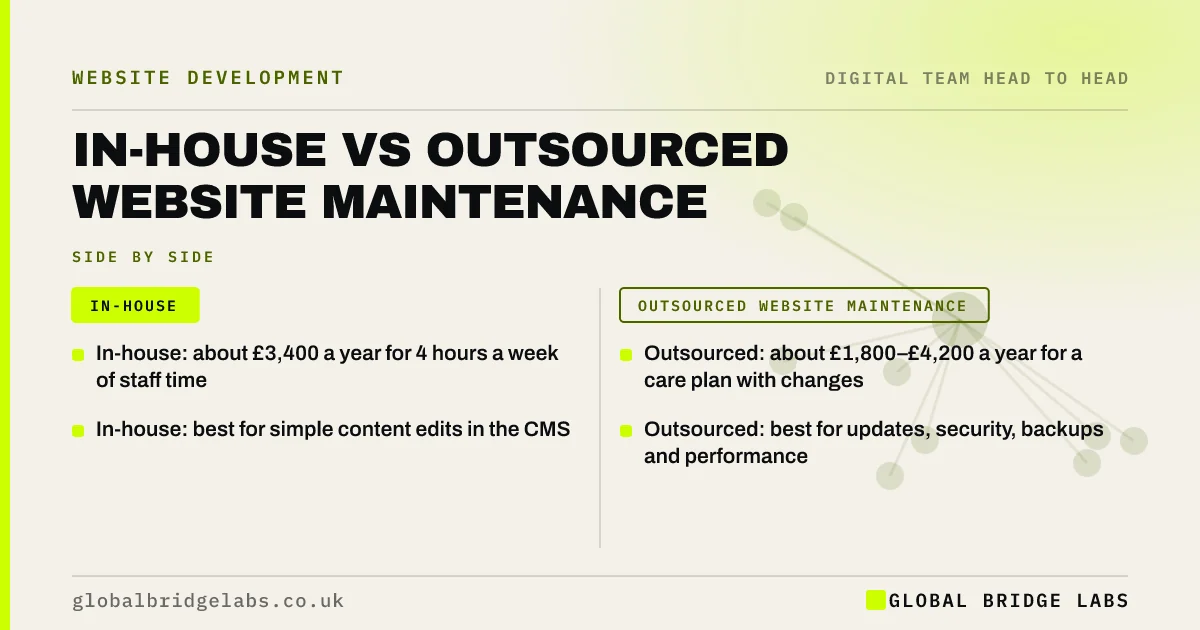
In-house vs outsourced website maintenance is closer on cost than on risk. Four hours a week of a £28,000 employee's time costs about £3,400 a year; a UK care plan with regular changes costs about £1,800–£4,200. The difference is skill: updates, backups and security fixes done wrong can take a site offline.
- In-house: about £3,400 a year for 4 hours a week of staff time.
- Outsourced: about £1,800–£4,200 a year for a care plan with changes.
- In-house: best for simple content edits in the CMS.
- Outsourced: best for updates, security, backups and performance.
Want your website upkeep costed both ways? Message us on WhatsApp.
Chat on WhatsApp →What does website maintenance include?
Website maintenance is the ongoing work that keeps a site secure, fast and current: software and plugin updates, backups, security monitoring, uptime checks, fixing broken pages, performance tuning and content changes. Some of it is routine editing; some of it needs technical skill and fast response when something breaks.
What does in-house maintenance cost?
If a £28,000 employee spends 4 hours a week on the website, at about £18.45 per worked hour, that is roughly £3,400 a year, plus any plugin licences and backup tools. The hidden cost is when something breaks: hours lost to troubleshooting, or an outage nobody notices until a customer calls.
What does outsourced maintenance cost?
As typical UK ranges, a basic care plan costs about £50–£150 a month for updates, backups and monitoring, and £150–£350 a month with regular edits. That is about £1,800–£4,200 a year with changes included. Ad hoc support is often £50–£100 an hour.
Want a care plan scoped for your site? Send us the address on WhatsApp.
Chat on WhatsApp →Which maintenance tasks can stay in-house?
Content edits in the CMS, such as updating prices, adding news, swapping images and editing team pages, are easy to keep in-house with a short guide. Technical tasks such as core and plugin updates, server changes, security incidents and performance work are better outsourced.
- In-house: text, image and page edits in the CMS.
- Outsourced: software and plugin updates with testing.
- Outsourced: backups, monitoring and security fixes.
- Outsourced: speed and Core Web Vitals work.
What is the risk of doing it yourself?
The main risks are skipped updates and untested ones. Skipping updates leaves known security holes open; applying them without a backup or test can break the site. Outdated plugins are one of the most common routes into small business sites.
When is in-house maintenance enough?
On a hosted website builder, where the platform handles software updates and security, in-house content editing is usually enough. For self-hosted WordPress or custom sites, the technical side needs someone with the skills, either a trained staff member or a care plan.
What should a maintenance report show each month?
Whoever maintains the site, a short monthly report keeps it honest. It should show what was done, what was found, and whether the site is doing its job.
- Updates applied and anything that failed.
- Backups taken and a recent restore test.
- Uptime and any security alerts.
- Speed checks and changes made.
- Enquiries or sales from the site that month.
What does this look like in practice?
A pattern we see in UK hospitality businesses: the manager updates menus on the site but nobody applies plugin updates. After a hack or a failed update, the site is down on a busy weekend. A care plan handles the technical side and the manager keeps editing menus.
Maintenance checklist
Use these steps to decide.
- List maintenance tasks and who does them now.
- Log hours spent each month.
- Check when updates and backups last ran.
- Get care plan quotes with response times.
- Keep content edits in-house with a short guide.
Next step
Send us your site and who looks after it now. We will cost in-house and outsourced maintenance in a 30-minute call.
Message us on WhatsApp for a maintenance comparison, or book a 30-minute consultation.
Chat on WhatsApp →Sources and further reading
- Updating WordPress · WordPress.org
- Small Business Guide: cyber security · National Cyber Security Centre
- Understanding Core Web Vitals and Google search results · Google Search Central
Frequently asked questions
Should I maintain my website myself?
Keep content edits in-house if someone is comfortable with the CMS. Outsource technical maintenance, such as updates, backups, security monitoring and performance, unless someone on the team has those skills and the time to test updates properly before applying them to the live site.
How much does outsourced website maintenance cost?
As typical UK ranges, about £50–£150 a month for a basic care plan covering updates, backups and monitoring, £150–£350 with regular edits, and £350–£500 or more for growth retainers or e-commerce sites. Ad hoc support is often charged at £50–£100 an hour.
What happens if website updates are skipped?
Known security holes stay open and the site becomes harder to update later, as more updates pile up. Outdated plugins are a common way small business sites are hacked. Apply updates regularly, with a fresh backup and a quick test first, or use a care plan that does this.
How often should a business website be backed up?
At least daily for sites that change often or take orders, and weekly for simple brochure sites, with backups stored away from the hosting server. Test a restore every few months, because a backup that cannot be restored gives no protection when something goes wrong.
Written by

Global Bridge Labs (GBL) is a UK–Sri Lanka partner for social media, websites and BPO. Everything here comes from client delivery, not theory.