On this page
Key takeaways
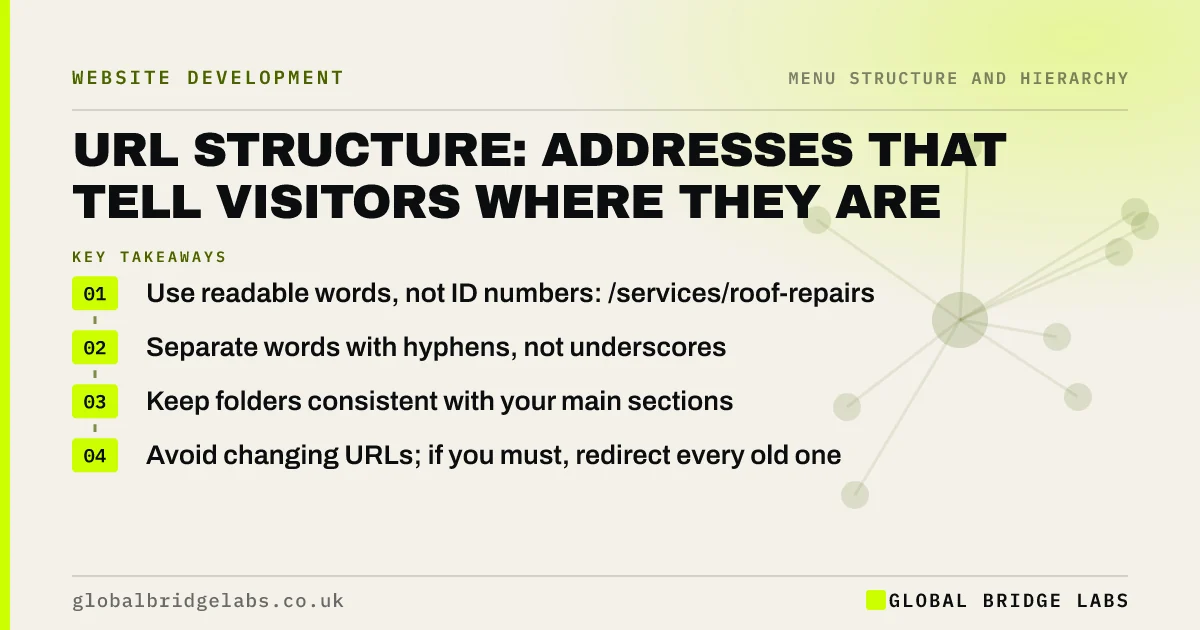
A good URL structure uses readable words, hyphens between them and a logical folder pattern that mirrors your sections, such as /services/loft-conversions. Visitors read URLs in search results and when sharing links, and search engines use them as a hint about content. Choose the pattern carefully, because changing URLs later needs redirects.
- Use readable words, not ID numbers: /services/roof-repairs.
- Separate words with hyphens, not underscores.
- Keep folders consistent with your main sections.
- Avoid changing URLs; if you must, redirect every old one.
Planning a new URL structure? Message us on WhatsApp first.
Chat on WhatsApp →Why does URL structure matter for navigation?
Visitors see URLs in search results, in the browser bar and in shared links. A readable URL tells them what the page is and where it sits before they click. Some visitors edit URLs to move up a level. Google's URL structure guidance recommends simple, descriptive URLs that people can understand.
What makes a good URL?
A good URL is short, readable and stable. These are the habits that help visitors and search engines alike.
- Lowercase words separated by hyphens.
- Words that describe the page, not database IDs.
- A folder for each main section, such as /services/.
- No dates or campaign words in evergreen pages.
- No unnecessary parameters for normal pages.
- One URL per page, with a canonical where needed.
Should URLs mirror the menu?
They should follow the main sections, so /services/ pages sit together and /locations/ pages sit together. They do not need to mirror every level of the menu, and short URLs are easier to share. Avoid baking in labels you might change, such as /solutions/, if the menu may later say 'Services'.
What happens if you change URLs?
Old links from search results, other sites, emails and bookmarks break unless you set up permanent (301) redirects from every old URL to its new one. Google's site move guidance treats URL changes as a migration. Plan them with a full redirect map and only change URLs when the benefit is clear.
Changing URLs as part of a navigation update? Message us on WhatsApp and we will discuss your requirements.
Chat on WhatsApp →What does this look like in practice?
A pattern we see: a site built on an old platform has URLs such as /page.php?id=47. Visitors cannot tell pages apart in search results. Moving to /services/boiler-repair with redirects from every old address keeps existing rankings and makes each result readable.
URL structure checklist
- Readable, hyphenated, lowercase words.
- A folder per main section.
- No dates or IDs in evergreen URLs.
- One canonical URL per page.
- Redirect map before any change.
Next step
Look at your URLs in Search Console and flag any that a customer could not read aloud.
Message us on WhatsApp for a URL review, or book a 30-minute consultation.
Chat on WhatsApp →Sources and further reading
- URL structure best practices for Google Search · Google Search Central
- Site moves with URL changes · Google Search Central
- SEO Starter Guide · Google Search Central
Frequently asked questions
What is a good URL structure?
A good URL structure uses short, readable, hyphenated words, groups pages under folders that match the main sections, avoids IDs and dates in evergreen pages, and stays stable over time. It should tell a visitor what the page is about before they open it.
Should I use hyphens or underscores in URLs?
Hyphens. Google's guidance recommends hyphens to separate words in URLs, because they are treated as word separators and are easier for people to read.
Do URLs affect rankings?
URLs are a minor signal. Their bigger value is clarity for visitors in search results and shared links. Do not change existing URLs just to add keywords, because the redirects carry risk for little gain.
Written by

Global Bridge Labs (GBL) is a UK–Sri Lanka partner for social media, websites and BPO. Everything here comes from client delivery, not theory.