On this page
Key takeaways
An HTML sitemap is a page that lists links to a site's pages for visitors; an XML sitemap is a file that lists URLs for search engines. Few visitors use HTML sitemaps when the menu is clear, so most small business sites do not need one. They help on large sites as a second way to find pages, which WCAG 2.2 asks for.
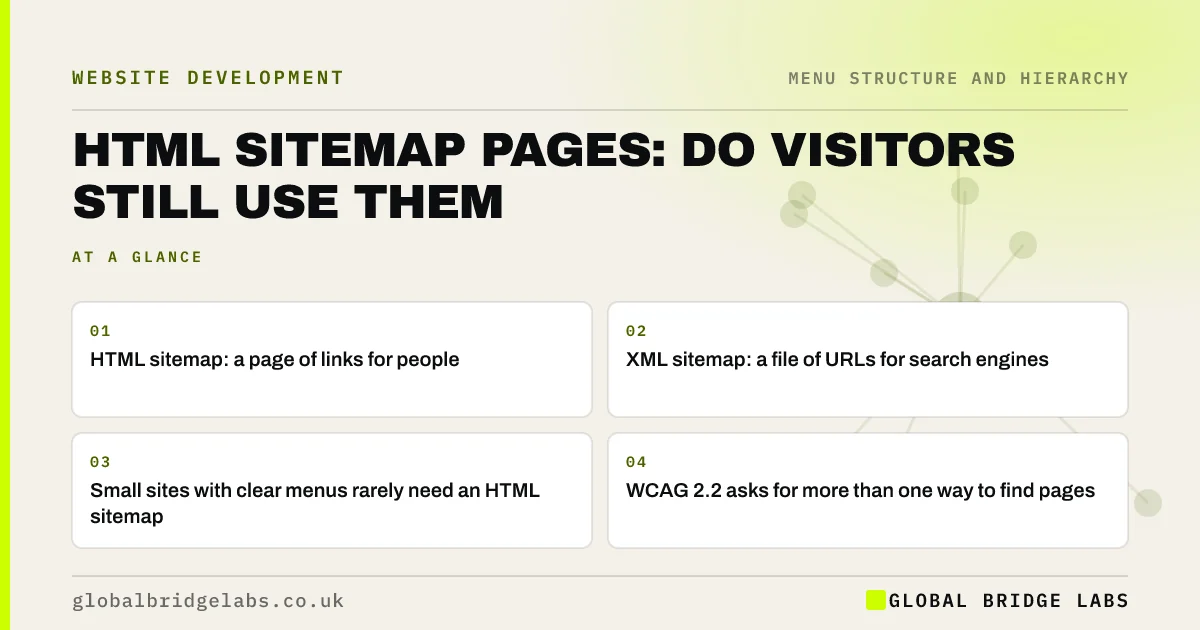
- HTML sitemap: a page of links for people.
- XML sitemap: a file of URLs for search engines.
- Small sites with clear menus rarely need an HTML sitemap.
- WCAG 2.2 asks for more than one way to find pages.
Unsure whether your site needs a sitemap page? Message us on WhatsApp.
Chat on WhatsApp →What is an HTML sitemap?
An HTML sitemap is a web page that lists links to the main pages of a site, usually grouped by section, so visitors can see the whole structure at once. It is different from an XML sitemap, which is a machine-readable file submitted to search engines to help them discover URLs.
Do visitors use HTML sitemaps?
Very few, on most sites. Visitors who cannot find something usually try the menu again, use search or leave. A sitemap page helps a small group: people who prefer an overview, some assistive technology users and visitors on very large sites. If many visitors need it, the menu is probably failing.
What does WCAG say?
WCAG 2.2 success criterion 2.4.5, Multiple Ways, asks that there is more than one way to locate a page within a set of pages, unless the page is a step in a process. Options include site search, a sitemap page, a table of contents or links between related pages. A clear menu plus search or a sitemap satisfies it.
Does an HTML sitemap help SEO?
It can help search engines find pages on sites with weak internal linking, but it is a patch rather than a fix. Google's guidance says a well-linked site of about 500 pages or fewer may not need an XML sitemap at all. Fix the internal linking first; an HTML sitemap will not rescue orphan pages for visitors.
Want your internal linking checked before adding a sitemap? Message us on WhatsApp and we will discuss your requirements.
Chat on WhatsApp →When is an HTML sitemap worth adding?
Add one on large sites with many sections, on sites where search is not available, and as an accessibility aid where there is no other second route. Link it from the footer, group links by section, and keep it updated automatically from the site's page list.
What does this look like in practice?
A pattern we see: a small service site has an HTML sitemap that lists 12 pages, including some that were deleted. Nobody visits it. Removing it and adding contextual links between services gives visitors and search engines better routes.
Sitemap checklist
- Keep an up-to-date XML sitemap for search engines.
- Add an HTML sitemap only if the site is large or lacks search.
- Group sitemap links by section.
- Link it from the footer.
- Generate it automatically so it stays current.
Next step
Check analytics for visits to your sitemap page. If there are almost none, focus on the menu instead.
Message us on WhatsApp for a navigation review, or book a 30-minute consultation.
Chat on WhatsApp →Sources and further reading
- What is a sitemap · Google Search Central
- Understanding WCAG 2.2 success criterion 2.4.5: Multiple Ways · W3C
- Web page footers 101: design patterns and when to use each · Nielsen Norman Group
Frequently asked questions
What is the difference between an HTML and XML sitemap?
An HTML sitemap is a page of links designed for people. An XML sitemap is a structured file listing URLs, designed for search engines and submitted through tools such as Google Search Console. They serve different audiences and can coexist.
Do I need an HTML sitemap?
Most small business sites with clear menus do not. Larger sites, sites without search and sites needing a second way to find pages for accessibility can benefit. Check whether visitors actually use it before maintaining one.
Does Google need an XML sitemap?
It helps on larger or newer sites and sites with pages that are hard to discover. Google notes that small, well-linked sites may not need one, though it rarely does harm. Submit it in Search Console and keep it current.
Written by

Global Bridge Labs (GBL) is a UK–Sri Lanka partner for social media, websites and BPO. Everything here comes from client delivery, not theory.