On this page
Why many websites look good but underperform
A polished interface does not guarantee business outcomes. Many websites fail because messaging is unclear, page speed is inconsistent, and conversion paths are not designed around real user intent.
When this happens, teams keep investing in traffic while the website quietly leaks opportunities. The fix is not cosmetic redesign alone. It is a development approach that treats performance, clarity, and conversion as one system.
Start with conversion architecture, not pages
Before writing code, define the primary journeys: discovery, evaluation, and action. Every important page should have one dominant objective and one clear next step.
This reduces friction, improves decision speed, and makes analytics more meaningful because each step in the funnel has a clear role.
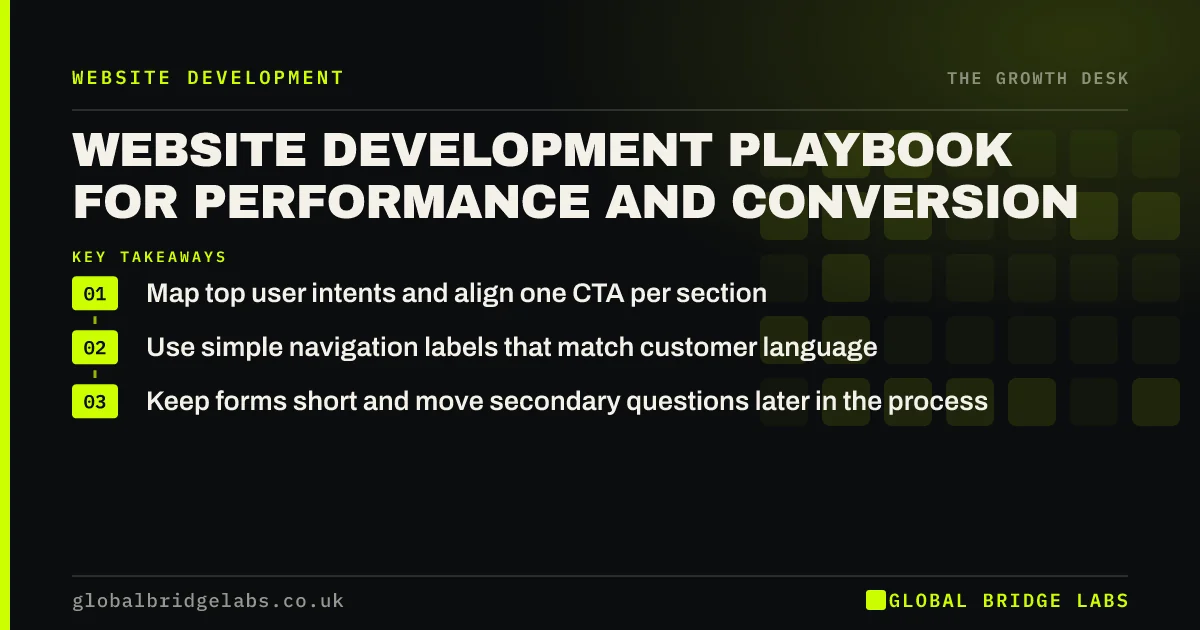
- Map top user intents and align one CTA per section.
- Use simple navigation labels that match customer language.
- Keep forms short and move secondary questions later in the process.
Performance is a conversion feature
Speed directly affects trust and completion rates. Slow pages increase bounce, reduce engagement depth, and weaken lead quality because users abandon before understanding your value proposition.
A reliable development playbook treats performance budgets as non-negotiable from the first build, not as a post-launch cleanup task.
- Optimise images and media by default.
- Reduce third-party script weight and audit tag usage regularly.
- Prioritise above-the-fold rendering and defer non-critical assets.
Build for maintainability from day one
Websites evolve quickly: new services, campaigns, landing pages, and SEO updates. If your codebase is hard to update, growth slows and teams avoid improvements because each release feels risky.
A maintainable architecture uses reusable components, predictable content patterns, and deployment workflows that make frequent iteration safe.
Post-launch operating rhythm that drives results
Launch is the start of optimisation, not the finish line. High-performing teams review behaviour data weekly, test small changes, and improve conversion steps continuously.
This rhythm compounds over time: better page relevance, stronger lead intent, and lower acquisition waste.
- Weekly: monitor funnel drop-offs and page speed regressions.
- Monthly: run messaging and CTA experiments on high-traffic pages.
- Quarterly: refresh content architecture based on demand and search trends.
Next step
If your website attracts traffic but does not convert at the level you need, we can assess the full journey and build a conversion-focused development roadmap.
Discuss your website performance goals with Global Bridge Labs.
Chat on WhatsApp →Frequently asked questions
Why does a good-looking website not convert?
Because appearance is not the same as clarity. Sites underperform when messaging is vague, page speed is inconsistent and conversion paths are not designed around what visitors actually came to do. The fix is treating performance, clarity and conversion as one system, not a cosmetic redesign.
What is conversion architecture?
Conversion architecture means defining the primary journeys (discovery, evaluation, action) before any page is built, then giving every important page one dominant objective and one clear next step. It reduces friction, speeds up decisions and makes analytics meaningful because each step has a role.
How fast should a business website be?
Fast enough that key pages load within a couple of seconds on a real UK mobile connection, with Core Web Vitals in the green. That means image, font and script budgets from day one and managed hosting with monitoring, not optimisation bolted on after launch.
What should happen after a website launches?
Measurement and iteration. Track forms, calls and WhatsApp clicks to their source, review the numbers monthly, and keep testing headlines, layouts and forms. A site that is never touched after launch loses conversion rate as content, offers and competitors change.
Written by

Global Bridge Labs (GBL) is a UK–Sri Lanka partner for social media, websites and BPO. Everything here comes from client delivery, not theory.