On this page
- 01Key takeaways
- 02Who actually makes a B2B buying decision?
- 03What makes content forwardable?
- 04Why do senior decision makers never engage publicly?
- 05How do you reach each member of the committee?
- 06Where does LinkedIn fall short with senior buyers?
- 07What does this look like in practice?
- 08How long is a B2B buying cycle?
- 09Next step
- 10Sources and further reading
- 11Frequently asked questions
Key takeaways
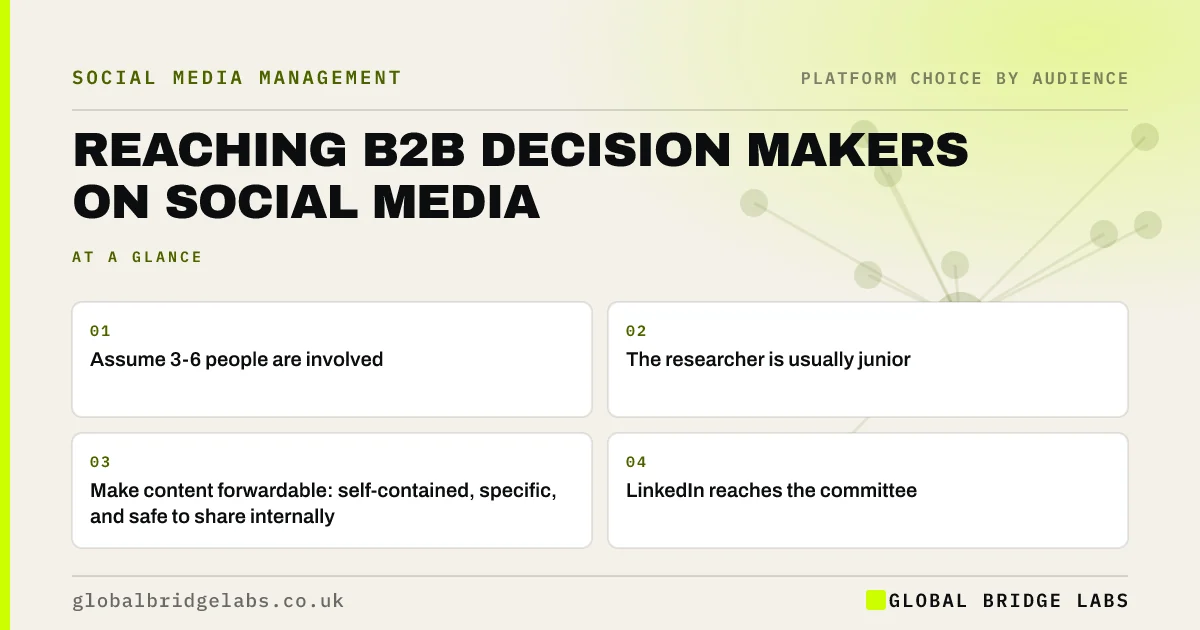
The person who finds you is rarely the person who signs. UK B2B purchases typically involve three to six people, so your content has to work when it is forwarded to someone who has never heard of you and will not ask.
- Assume 3-6 people are involved. Write for the one who was not in the room.
- The researcher is usually junior. The signer usually never engages publicly.
- Make content forwardable: self-contained, specific, and safe to share internally.
- LinkedIn reaches the committee. YouTube convinces the technical sceptic.
- Publish price ranges. Someone has to justify the spend internally.
Selling into buying committees? We will plan content for all of them on WhatsApp.
Chat on WhatsApp →Who actually makes a B2B buying decision?
Usually several people with different concerns: someone researching options, someone who will use the service, someone worried about risk, and someone who signs. In UK SMEs this may be three people; in larger organisations it is commonly more.
Your social content is almost always read first by the researcher, who then has to persuade the others. That means the most valuable property of a B2B post is not persuasiveness but forwardability: can it be sent to a finance director with no explanation and still make sense?
What makes content forwardable?
Five properties, and they are different from what makes content engaging.
- Self-contained: it makes sense without the previous five posts or any context.
- Specific: numbers, timescales and named constraints rather than general claims.
- Safe to share: nothing that would embarrass the person forwarding it.
- Answers an objection the forwarder expects to face internally.
- Includes the commercial information, so nobody has to ask what it costs.
Why do senior decision makers never engage publicly?
Because a public like from a director is a signal to their market, their staff and their competitors. Many read extensively and engage with nothing, which is entirely rational and completely invisible in your analytics.
This is the strongest argument against judging B2B social on engagement. The correct measure is what arrives in your inbox and what people mention on first calls. We regularly see UK firms discover that a silent reader of two years is the person who eventually signs.
We will set B2B measures that capture silent readers. Ask on WhatsApp.
Chat on WhatsApp →How do you reach each member of the committee?
By writing for their specific worry rather than for a generic buyer, and rotating across them over a quarter.
The researcher needs comparison information and criteria. The user needs to know what changes day to day. The risk owner needs your process, insurance, data handling and references. The signer needs the commercial case in one paragraph. Four content types, one channel, rotated over a quarter, covers the whole committee.
Where does LinkedIn fall short with senior buyers?
In depth. A feed post cannot carry the detail a risk owner needs, which is why the channel works best as a route to something more substantial: a long article, a recorded walkthrough, or a document.
This is also why YouTube pairs well with LinkedIn for technical B2B. A sceptical engineer or operations lead will watch twenty minutes of you explaining how something actually works, and that content keeps convincing people long after the feed post has gone.
What does this look like in practice?
A UK managed IT provider wrote consistently for technical readers and won their approval routinely, then lost deals at the final stage because finance directors could not see the commercial case.
Adding one post a month written explicitly for the person signing, covering what the spend replaces and what happens if nothing changes, closed the gap. The technical content kept doing its job. The difference was that the researcher finally had something to forward upwards.
How long is a B2B buying cycle?
Three to twelve months for most UK business services, and longer where a contract is being replaced rather than created. That length is the reason B2B social media gets abandoned: the effort and the result are two quarters apart.
It also changes what content should do. Content published today is not trying to produce an enquiry today; it is trying to be what someone finds when they start looking in March. That argues for durable, searchable, specific material over reactive posting.
Ask your last five clients how long they had known about you before they made contact. The answer is usually longer than anyone in the business expected, and it makes the case for patience better than any argument.
It also explains why consistency matters more than volume here. Being visible in a small way every month for a year beats a burst of activity, because you cannot know which month your buyer starts looking.
Next step
Take your last ten posts and ask whether any could be forwarded to a finance director with no explanation. If none could, you are writing for the researcher only, and the researcher is not the person who decides.
Message us on WhatsApp and we will map content to every member of your buying committee.
Chat on WhatsApp →Sources and further reading
- LinkedIn Pages best practices · LinkedIn
- Business population estimates for the UK and regions 2025 · Department for Business and Trade
Frequently asked questions
How many people are involved in a B2B buying decision?
Typically three to six, with different concerns: someone researching, someone who will use it, someone assessing risk, and someone who signs. Your content is usually read first by the researcher, who then has to persuade the others.
Why do senior decision makers not engage on social media?
Because a public like is a signal to their market, staff and competitors. Many read extensively and engage with nothing, which is rational and invisible in analytics. Judge B2B channels on inbox and first-call mentions instead.
What makes B2B content forwardable?
Being self-contained, specific, safe to share, answering an objection the forwarder expects to face internally, and including the commercial information. Forwardability matters more than persuasiveness, because the actual decision happens in a room you are not in.
How do you reach a finance director on social media?
Write one post a month explicitly for them: what the spend replaces, what it costs in ranges, and what happens if nothing changes. They will rarely engage, but the researcher now has something they can forward upwards.
Written by
Global Bridge Labs (GBL) is a UK–Sri Lanka partner for social media, websites and BPO. Everything here comes from client delivery, not theory.