On this page
- 01Short answer
- 02What counts as a crisis?
- 03What happens in the first hour?
- 04What should a holding statement say?
- 05What should you never do?
- 06How do you close it out?
- 07What does this look like in practice?
- 08How do you prepare before anything happens?
- 09Who else needs to know?
- 10Next step
- 11Sources and further reading
- 12Frequently asked questions
Short answer
A small business crisis plan needs four things written down before anything happens: what counts as a crisis, who decides, what gets paused, and the holding statement. One page, agreed in advance, reviewed annually. Nobody makes good decisions about this at nine on a Friday evening.
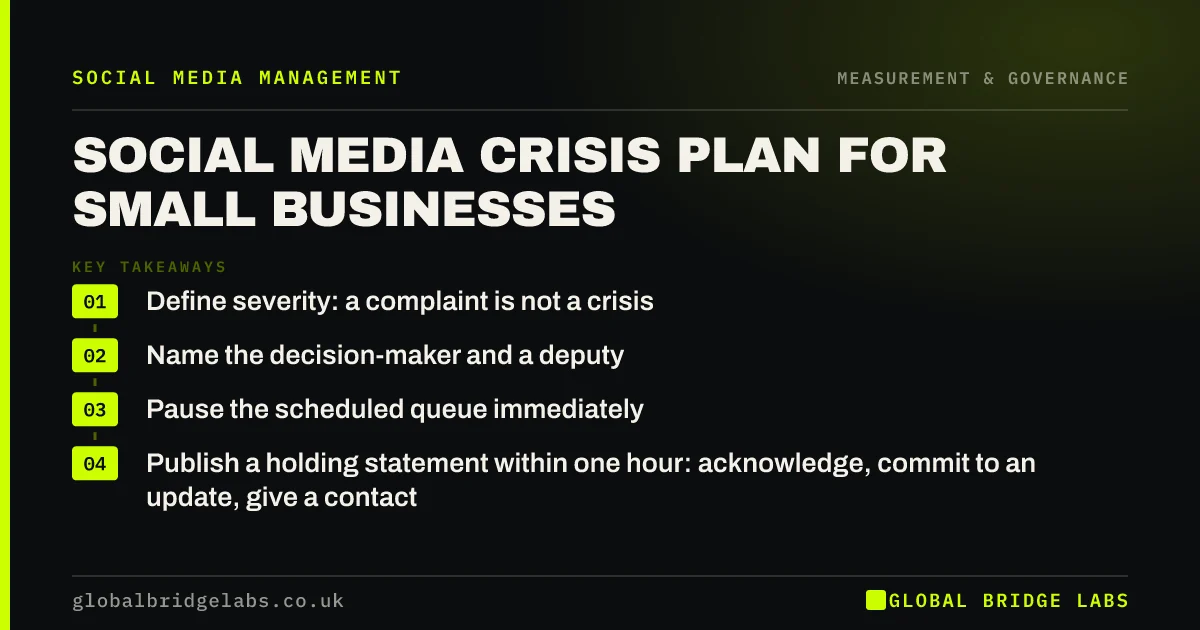
- Define severity: a complaint is not a crisis. Sustained attention, safety issues or media interest are.
- Name the decision-maker and a deputy. One person decides, not a group.
- Pause the scheduled queue immediately. Cheerful automation into a bad moment makes it worse.
- Publish a holding statement within one hour: acknowledge, commit to an update, give a contact.
- Never argue in public, never delete genuine criticism, never go silent.
Dealing with something live? Message us on WhatsApp and we will help you draft the response.
Chat on WhatsApp →What counts as a crisis?
Not every negative comment. Most complaints are routine community management and should be handled as such, quickly and without escalation.
A crisis is sustained negative attention, anything involving safety, anything involving a protected characteristic, anything attracting media enquiries, or anything where the volume exceeds your ability to respond individually. Define these thresholds in advance, because the temptation in the moment is either to over-react or to hope it passes.
What happens in the first hour?
Four actions, in order.
- Pause all scheduled content across every channel.
- Notify the decision-maker and confirm who is handling responses.
- Establish the facts internally before saying anything about them publicly.
- Publish a holding statement acknowledging the issue and committing to an update.
What should a holding statement say?
Three sentences. That you are aware, that you are establishing the facts, and when you will say more. Include a contact route for anyone directly affected.
For example: we are aware of the issue raised this afternoon and are looking into it now. We will post an update by 10am tomorrow. If you have been affected, please contact Sarah directly on the number in our bio.
What it must not contain: an explanation, a defence, a minimisation, or a promise about the outcome before you know the facts.
What should you never do?
Four things that reliably make small business situations worse.
Arguing in public, which extends the story and is screenshotted. Deleting genuine criticism, which becomes the story itself. Going silent, which is read as an admission. And responding personally and emotionally from a director's account, which converts a business issue into a personal one.
We provide UK-hours community and escalation cover for clients. Message us on WhatsApp for how it works.
Chat on WhatsApp →How do you close it out?
Publish what you found, what you changed, and how to raise it with you directly. Then stop. Continued posting about it keeps it visible longer than the audience's attention would have.
Afterwards, review honestly: what caused it, what warning signs existed, and what changes in process would have prevented it. Most small business social media incidents originate offline, in a service failure that was already known internally.
What does this look like in practice?
A pattern that turns a complaint into an incident: something escalates over a weekend, nobody is monitoring, and the scheduled queue keeps publishing promotional content into an increasingly hostile comment section.
The plan that prevents a repeat is one page: a weekend monitoring rota, a pause anyone can trigger, a named decision-maker with a deputy, and a pre-approved holding statement. Businesses that have one generally defuse the next situation within a day.
How do you prepare before anything happens?
Four preparations, each taking under an hour, all of which are useless if attempted during an incident.
Write the holding statement now, with blanks for the specifics. Agree who the decision-maker and deputy are, in writing, including out of hours. Confirm that more than one person can pause the scheduled queue. And set up brand-name monitoring so you find out from an alert rather than from a customer.
Then run a fifteen-minute tabletop once a year: take a plausible scenario for your business, and walk through who does what in the first hour. It consistently surfaces one missing thing, usually an access problem or an assumption about who is contactable at the weekend.
- Pre-write the holding statement with blanks.
- Name the decision-maker and deputy, including out of hours.
- Ensure two people can pause the queue.
- Brand-name monitoring with alerts.
- One fifteen-minute tabletop exercise a year.
Who else needs to know?
Your own team, first and quickly. Staff finding out about an incident from a customer or from social media is a reliable way to turn a contained problem into a second one, because people improvise answers when nobody has given them one.
Send a short internal note at the same time as the holding statement: what has happened, what we are saying publicly, what to do if you are asked, and who to direct enquiries to. Three sentences and a name.
Then consider who else has a legitimate interest: key clients who might be asked about you, suppliers, and anyone with a contractual right to be informed. A brief direct message before they see it elsewhere is almost always better received than an explanation afterwards.
- Tell your team at the same time as the public statement.
- Give staff the exact wording to use if asked.
- Name one person all enquiries go to.
- Contact key clients directly before they hear it elsewhere.
Next step
The whole plan is one page and takes an hour to write. It is only ever written by businesses that have either had a crisis or have thought carefully about having one.
Message us on WhatsApp for a one-page social media crisis plan for your business.
Chat on WhatsApp →Sources and further reading
- Publishing consumer reviews and complying with consumer protection law · Competition and Markets Authority
- Google Business Profile Help · Google
Frequently asked questions
What counts as a social media crisis for a small business?
Sustained negative attention, anything involving safety or a protected characteristic, media enquiries, or volume beyond your ability to respond individually. Individual complaints are routine community management and should be handled quickly without escalation.
What should I post first during a crisis?
A three-sentence holding statement within an hour: that you are aware, that you are establishing the facts, and when you will update. Include a direct contact for anyone affected. Do not explain, defend or promise an outcome before you know the facts.
Should I pause scheduled posts during a problem?
Immediately, across every channel. Promotional content publishing automatically into a hostile comment section makes the situation worse and is one of the most common avoidable escalations in small business social media.
Should I delete negative posts during a crisis?
No, unless the content is abusive, discriminatory or contains personal data. Deleting genuine criticism reliably becomes the story itself, usually with screenshots. Respond calmly instead, and take the detail into a private channel.
Written by

Global Bridge Labs (GBL) is a UK–Sri Lanka partner for social media, websites and BPO. Everything here comes from client delivery, not theory.