On this page
- 01Key takeaways
- 02What is a content gap?
- 03How do you run the analysis in an hour?
- 04Which gaps appear most often?
- 05How do you choose which gap to claim?
- 06How do you fill a gap convincingly?
- 07What should you not copy from competitors?
- 08What does this look like in practice?
- 09Content gap checklist
- 10Next step
- 11Sources and further reading
- 12Frequently asked questions
Key takeaways
A social media content gap analysis compares what buyers ask with what you and your competitors actually post. The gaps, questions nobody answers well, are where a small business can stand out. In most sectors they are price, process and what goes wrong.
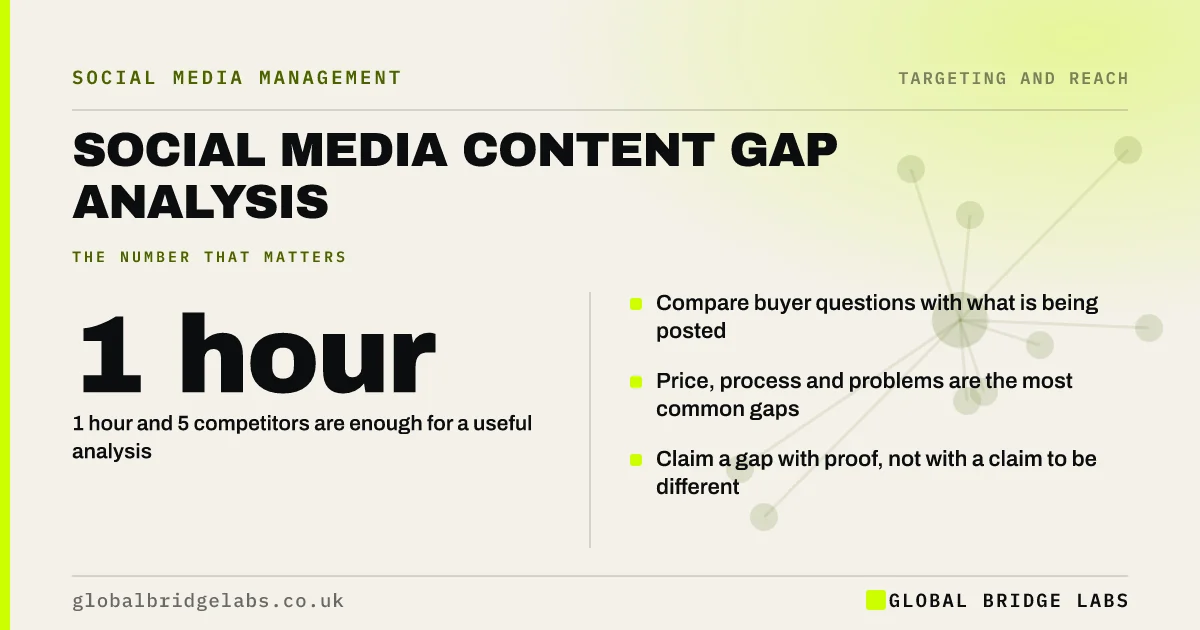
- 1 hour and 5 competitors are enough for a useful analysis.
- Compare buyer questions with what is being posted.
- Price, process and problems are the most common gaps.
- Claim a gap with proof, not with a claim to be different.
Want a gap analysis run for your sector? Message us on WhatsApp.
Chat on WhatsApp →What is a content gap?
A content gap is a topic or question your buyers care about that is not being answered, or not answered well, by the accounts they see. It is defined by demand, not by novelty. A gap nobody wants filled is simply an unpopular topic.
How do you run the analysis in an hour?
List your buyers' top 15 questions down a page. Across the top, put yourself and five competitors. Look at each account's last 20 posts and tick which questions they address. Rows with few or no ticks are gaps. Columns show what each rival is known for.
- List 15 buyer questions.
- Pick five competitors your buyers see.
- Review each account's last 20 posts.
- Tick the questions each answers.
- Mark the rows with the fewest ticks.
Which gaps appear most often?
Three gaps appear in almost every sector. Few businesses talk about price. Few explain their process in detail. And almost none discuss what can go wrong and how they handle it. These are the questions buyers most want answered before they commit.
- Price: ranges, starting points and what drives cost.
- Process: what happens, in order, and how long it takes.
- Problems: what goes wrong and how it is put right.
- Fit: who the service does not suit.
Want help choosing which gap to claim? Message us on WhatsApp and we will discuss your requirements.
Chat on WhatsApp →How do you choose which gap to claim?
Choose the gap where buyer demand is high, you have real proof, and the topic leads towards your service. One or two gaps are enough. A gap you cannot support with examples is not yours to claim, however empty the field.
How do you fill a gap convincingly?
Fill it with a small series, not a single post. Four to six posts on the one topic, each with an example, make you the account that covers it. Pin the best one. Return to the topic every month so the association holds.
What should you not copy from competitors?
Do not copy their posts, images or wording, which are protected by copyright, and do not disparage them. Comparative claims in marketing must be fair and verifiable. The purpose of the analysis is to find what is missing, not to imitate what is there.
What does this look like in practice?
A pattern we see across UK local service sectors: every competitor posts finished work and seasonal greetings, and nobody explains cost or timescale. The first firm to publish a clear 'what this costs and why' series tends to become the one buyers quote back to the others.
Content gap checklist
Run this twice a year.
- Fifteen buyer questions are listed.
- Five competitors are reviewed.
- Gaps are ranked by buyer demand.
- You have proof for the gap you choose.
- A series of four to six posts is planned.
- Nothing is copied or disparaging.
Next step
Draw the grid on one sheet this week. An hour of looking at competitors with your buyers' questions in hand is usually enough to find your gap.
Message us on WhatsApp for the gap analysis grid, or book a 30-minute consultation.
Chat on WhatsApp →Sources and further reading
- How copyright protects your work · GOV.UK
- Recognising ads: brand-owned and paid social media · ASA / CAP
- Creating helpful, reliable, people-first content · Google Search Central
Frequently asked questions
What is a content gap analysis?
It is a comparison of the questions your buyers ask with the content you and your competitors publish. Topics that buyers care about and nobody answers well are gaps you can fill to stand out. An hour is usually enough.
How do I find content gaps on social media?
List your buyers' top 15 questions, review the last 20 posts from five competitors and from your own account, and mark which questions each addresses. Questions with few or no answers are your gaps. Rank the gaps by how often buyers ask.
What content do competitors usually miss?
Price, process and problems. Most businesses avoid saying what things cost, what happens step by step and what can go wrong. These are precisely the things buyers want to know before enquiring. Choose one you can support with real examples from your own work.
How often should I repeat the analysis?
Twice a year is enough for most small businesses, or sooner if a new competitor appears. Gaps close as others notice them, so keep adding proof to the topics you have claimed. Put the next review in the diary.
Written by

Global Bridge Labs (GBL) is a UK–Sri Lanka partner for social media, websites and BPO. Everything here comes from client delivery, not theory.