On this page
- 01Key takeaways
- 02What is an objection, and why answer it in public?
- 03Which objections come up most often?
- 04How do you turn an objection into a post?
- 05How do you handle the price objection?
- 06How do you handle trust and risk?
- 07When should you not try to overcome an objection?
- 08What does this look like in practice?
- 09Objection content checklist
- 10Next step
- 11Sources and further reading
- 12Frequently asked questions
Key takeaways
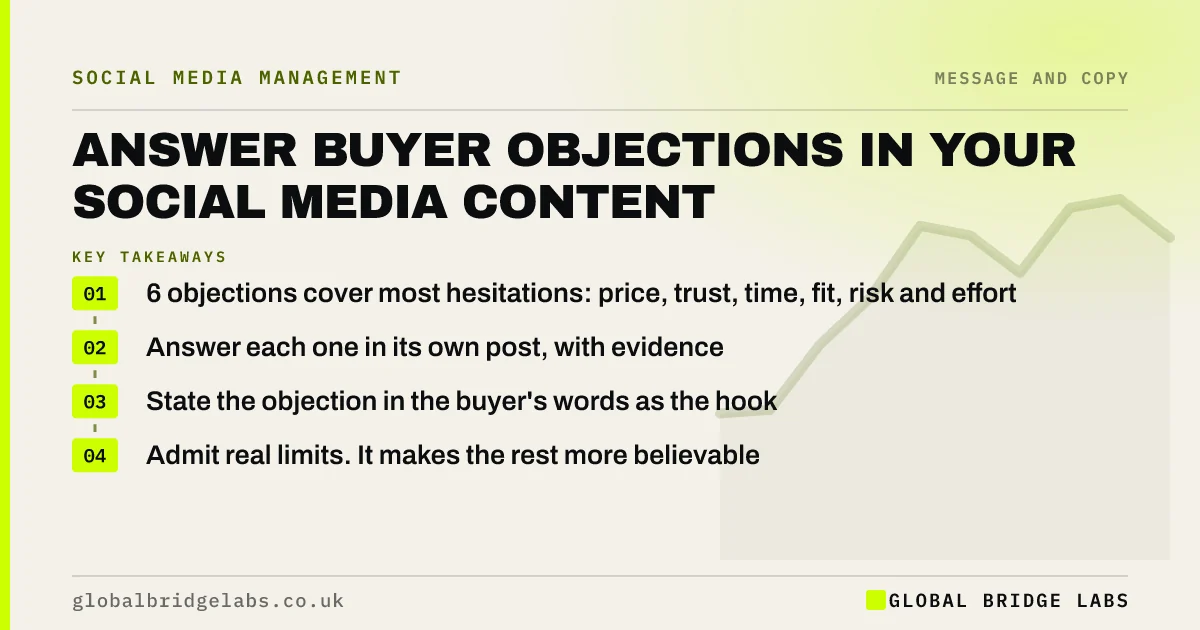
Objection handling in social media content means answering the doubts that stop a buyer enquiring, before they have to ask. Most businesses hear the same six objections repeatedly. Turn each into a post with a straight answer and evidence, and buyers arrive with fewer reasons to hesitate.
- 6 objections cover most hesitations: price, trust, time, fit, risk and effort.
- Answer each one in its own post, with evidence.
- State the objection in the buyer's words as the hook.
- Admit real limits. It makes the rest more believable.
Want your sales objections turned into posts? Message us on WhatsApp.
Chat on WhatsApp →What is an objection, and why answer it in public?
An objection is a reason a buyer gives, or silently holds, for not going ahead. Answering it in public content reaches the many buyers who never voice it. They simply do not enquire. A post that names the doubt and resolves it does the work of a sales conversation in advance.
Which objections come up most often?
Six come up in almost every business: it costs too much, I am not sure I can trust you, it will take too long, it is not right for my situation, what if it goes wrong, and it sounds like a lot of hassle. Ask whoever handles quotes which three they hear most.
- Price: 'It is more than I expected.'
- Trust: 'How do I know you are any good?'
- Time: 'How long will this take?'
- Fit: 'Do you work with businesses like mine?'
- Risk: 'What if it goes wrong?'
- Effort: 'How much will I have to do?'
How do you turn an objection into a post?
Use the objection as the hook, acknowledge that it is reasonable, give a direct answer, then show evidence. End with what to do next. Do not argue. The tone is a knowledgeable person answering a fair question.
- Hook: 'Worried a rewire means weeks without power?'
- Acknowledge: 'It is the question we are asked most.'
- Answer: 'Power is off for parts of two days, not weeks.'
- Evidence: 'Here is last month's schedule for a three-bed house.'
Send us your most common objection on WhatsApp and we will draft the post. Let us discuss your requirements.
Chat on WhatsApp →How do you handle the price objection?
Handle price by showing what the money buys and what cheaper options leave out. Break a typical job into its parts, show a real example with its cost, and be clear about who a lower-cost alternative would suit. Explaining value works. Defending the figure does not.
How do you handle trust and risk?
Handle trust and risk with evidence others can check: named reviews, accreditations, insurance, guarantees and examples of what you did when something went wrong. A post describing a problem and how you put it right is often more persuasive than ten posts of perfect results.
When should you not try to overcome an objection?
Do not try to overcome an objection that is correct. If the buyer's budget is too small or the service does not suit them, say so and suggest an alternative. Persuading a poor fit to buy produces a poor customer, and usually a poor review.
What does this look like in practice?
A pattern we see with UK service firms: the same three questions are answered on every sales call, and none of them appears anywhere on the firm's social media. Publishing the three answers as posts shortens calls, because buyers have already read them.
Objection content checklist
Build this set once and reuse it.
- The top six objections are listed.
- Each has its own post.
- Each uses the buyer's wording.
- Each includes evidence.
- Real limits are admitted.
- The set is reposted every few months.
Next step
Ask whoever takes sales calls for the three doubts they hear most. Write one post for each this month.
Message us on WhatsApp for the objection post template, or book a 30-minute consultation.
Chat on WhatsApp →Sources and further reading
- Recognising ads: social media and influencer marketing · ASA / CAP
- Publishing consumer reviews and complying with consumer protection law · Competition and Markets Authority
- The 95-5 rule: most B2B buyers are out of market · LinkedIn B2B Institute
Frequently asked questions
How do you handle objections in social media content?
Name the objection in the buyer's words, acknowledge it is reasonable, answer it directly and show evidence. Give each objection its own post. Buyers who read them arrive with fewer doubts and better questions. Start with the three you hear most often.
What are the most common sales objections?
Price, trust, time, fit, risk and effort. In words: it costs too much, can I trust you, how long will it take, do you work with people like me, what if it goes wrong, and how much will I have to do.
Should I mention negatives about my own service?
Yes, where they are real. Saying who the service does not suit, or what it cannot do, makes your other claims more believable and discourages buyers who would have been disappointed. One honest limitation per post is enough to earn that credibility.
How often should I post objection content?
Build a set of about six posts and repeat each every few months, since new followers will not have seen them. One objection post every week or two is a reasonable rhythm for a small account. Refresh the examples each time.
Written by

Global Bridge Labs (GBL) is a UK–Sri Lanka partner for social media, websites and BPO. Everything here comes from client delivery, not theory.