On this page
- 01Key takeaways
- 02Is competitor presence a reason to join a platform?
- 03What in a competitor's channel is worth reading?
- 04What does a competitor's absence tell you?
- 05When is following competitors onto a platform right?
- 06How do you avoid copying the content as well?
- 07What does this look like in practice?
- 08What can you learn from a competitor's silence?
- 09Next step
- 10Sources and further reading
- 11Frequently asked questions
Key takeaways
Competitor presence tells you where competitors decided to be, not where buyers are. Treat it as a hypothesis to test, never as evidence. The signal worth acting on is competitors getting results, which is visible in comments and reviews rather than in follower counts.
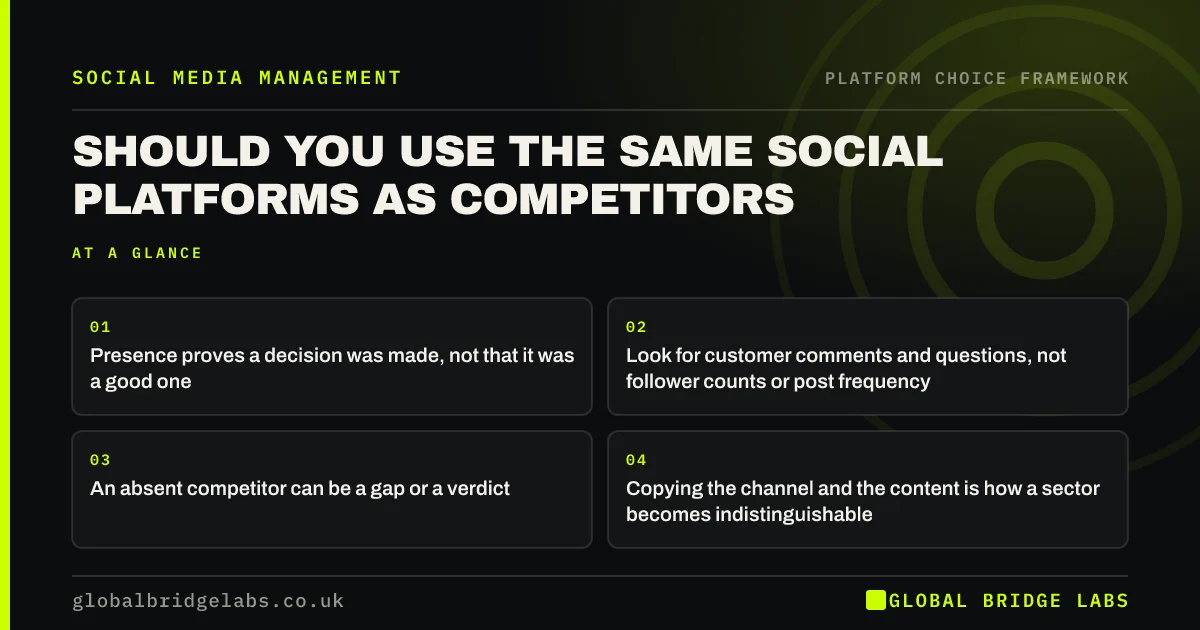
- Presence proves a decision was made, not that it was a good one.
- Look for customer comments and questions, not follower counts or post frequency.
- An absent competitor can be a gap or a verdict. Find out which before you commit.
- Copying the channel and the content is how a sector becomes indistinguishable.
- Check 5 competitors, not 1. One competitor's choice is noise.
Want a read on your sector's channels before you commit? Message us on WhatsApp.
Chat on WhatsApp →Is competitor presence a reason to join a platform?
On its own, no. It proves a competitor made a decision, and decisions in small businesses are frequently made for reasons that have nothing to do with evidence: a marketing hire arrived with a preference, a director's child suggested it, or an agency sold a package.
Whole sectors regularly inherit a channel choice this way. Every firm is present because every other firm is present, and none of them can point at an enquiry that came from it. Copying that is copying an error at scale.
What in a competitor's channel is worth reading?
Evidence of customers, which is different from evidence of activity. Four things to look for on each competitor profile.
- Comments from obvious customers asking about price, availability or process.
- Direct message prompts in captions, and whether people appear to use them.
- Reviews and recommendation tags, the strongest signal of real local demand.
- Sustained posting over 18 months, which suggests something justifies the effort.
- Recent silence after heavy activity, which usually means it stopped justifying it.
What does a competitor's absence tell you?
Either a genuine gap or a verdict already reached, and the two look identical from outside. The way to tell them apart is to check whether anyone in an adjacent market serves the same buyer on that platform successfully.
If a platform works for a similar buyer in a neighbouring sector and nobody in yours is there, that is a gap worth a quarter's trial. If nobody selling to that buyer anywhere is getting traction there, your competitors have probably already run the experiment you are about to run.
We will tell you whether the gap in your sector is an opportunity. Ask on WhatsApp.
Chat on WhatsApp →When is following competitors onto a platform right?
When three or more competitors are visibly getting customer engagement there, and your own buyer research points the same way. Two independent signals pointing at the same channel is a reasonable basis for commitment. One is not.
There is also a defensive case. If your buyers routinely compare you against two named competitors and both appear on a platform while you do not, your absence becomes part of the comparison. That is worth a maintained presence even at low effort, judged on credibility rather than enquiries.
How do you avoid copying the content as well?
By deciding what you will not do before you start. Sector feeds converge quickly because everyone studies everyone else, and within two years the same five post formats appear across every account, which makes all of them forgettable.
The practical defence is to pick one thing your competitors consistently avoid and make it your pillar: real pricing ranges, the failures and what you learned, the process in detail, or the people doing the work. It is usually the subject that feels slightly uncomfortable, which is exactly why nobody else has claimed it.
What does this look like in practice?
Across UK professional services we repeatedly see the same pattern: every firm in a town present on the same two channels, all posting award announcements and team photographs, none able to attribute an enquiry to either.
The firm that breaks out usually does one thing differently rather than adding a channel. Publishing genuine fee ranges, or answering the questions clients ask on a first call, produces enquiries within a quarter because it is the only content in the sector doing a job for the reader. The channel was never the problem.
What can you learn from a competitor's silence?
Check when their posting stopped and what happened around it. A channel that ran hard for eighteen months and then went quiet usually means the effort stopped justifying itself, which is a finding they paid for and you can have free.
Look at whether they moved somewhere else at the same time. A business that stops on one platform and starts on another has made a considered decision and is worth paying attention to. A business that simply stopped everywhere has a capacity problem rather than a channel insight, and tells you nothing about the platform.
Next step
Open five competitor profiles and count customer comments rather than followers. If the customer evidence is thin across all five, the sector has inherited a habit rather than found a channel, and you are free to choose on your own evidence instead.
Message us on WhatsApp and we will review five competitor profiles with you.
Chat on WhatsApp →Sources and further reading
- Online Nation: how the UK uses online services · Ofcom
- Publishing consumer reviews and complying with consumer protection law · Competition and Markets Authority
Frequently asked questions
Should I use the same social media platforms as my competitors?
Only if at least three of them show real customer engagement there and your own buyer research agrees. Presence alone proves a decision was made, not that it worked. Whole sectors inherit channel choices that nobody can attribute an enquiry to.
What does it mean if no competitor uses a platform?
Either a genuine gap or a verdict already reached. Check whether the platform works for a similar buyer in a neighbouring sector. If it does and nobody in yours is there, trial it. If nobody anywhere gets traction with that buyer, your competitors probably already tested it.
How many competitors should I check before deciding?
Five, and look at customer comments rather than follower counts. One competitor's channel choice is noise, since it may reflect a marketing hire's preference or an agency package rather than any evidence. Patterns across five profiles carry information that no single profile can.
How do I stop my social media looking like my competitors?
Claim the subject your sector consistently avoids: real pricing ranges, failures and lessons, the process in detail, or the people doing the work. It is usually the topic that feels slightly uncomfortable, which is precisely why it is still available.
Written by

Global Bridge Labs (GBL) is a UK–Sri Lanka partner for social media, websites and BPO. Everything here comes from client delivery, not theory.