On this page
- 01Key takeaways
- 02Which channel should a solo owner choose?
- 03Why does posting as yourself work better?
- 04What weekly rhythm actually survives?
- 05What should a solo owner ignore?
- 06How do you handle the feast and famine cycle?
- 07What does this look like in practice?
- 08What do you do when you miss a month?
- 09Next step
- 10Sources and further reading
- 11Frequently asked questions
Key takeaways
One channel, one weekly rhythm, and personal rather than corporate. A solo owner's single biggest advantage is being a named person rather than a brand, and the most common mistake is hiding behind a logo.
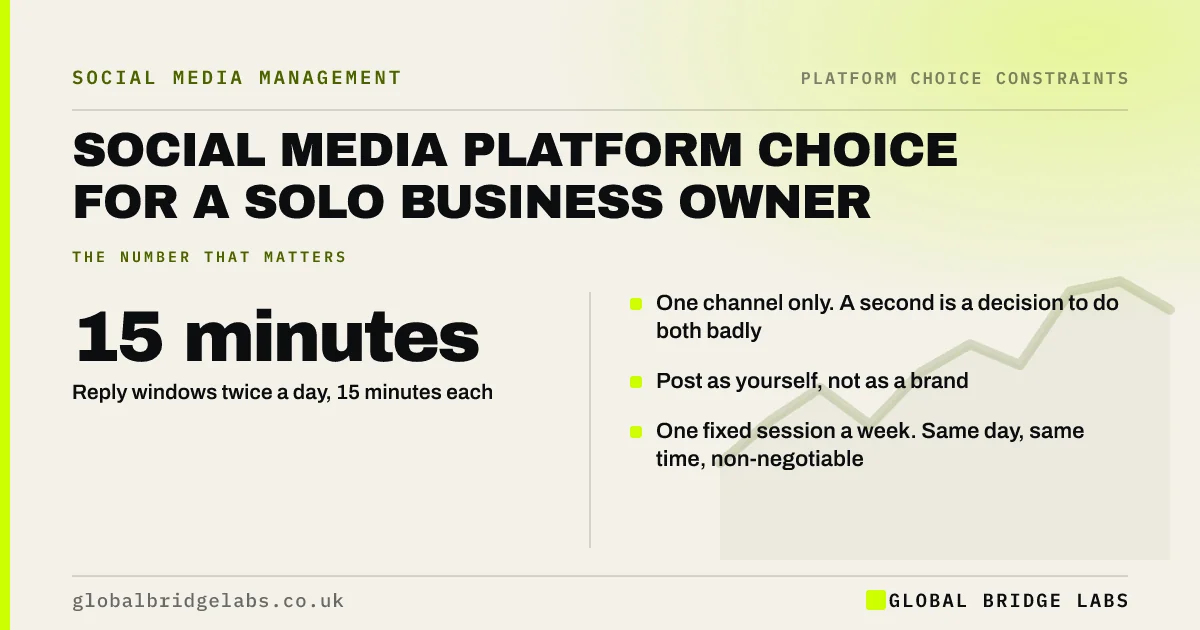
- One channel only. A second is a decision to do both badly.
- Post as yourself, not as a brand. People buy from the person.
- One fixed session a week. Same day, same time, non-negotiable.
- Reply windows twice a day, 15 minutes each. Not constant checking.
- Expect to stop during busy periods. Plan for the restart, not for perfection.
Running everything yourself? We will keep the channel going for you on WhatsApp.
Chat on WhatsApp →Which channel should a solo owner choose?
The one your buyers use that you can produce for in an hour a week from the work you already do. For most solo UK service businesses that is a single photo or text channel, plus a Google Business Profile.
The decisive constraint is not audience size but sustainability. A solo owner has weeks where the channel gets nothing, and the plan has to survive that rather than assume it will not happen.
Why does posting as yourself work better?
Because it is your actual advantage. A one-person business cannot compete with a larger competitor on volume or budget, but it can offer something no larger firm can: the buyer knows exactly who they are dealing with.
Hiding behind a logo and corporate language throws that away and competes on the ground where you are weakest. Use your name, show your face, and write the way you speak on the phone to a customer.
What weekly rhythm actually survives?
One fixed session and two short reply windows, with everything else captured as you go rather than produced deliberately.
- One 60-90 minute session weekly, same day and time. Protect it like a client job.
- Two 15-minute reply windows daily, morning and late afternoon.
- Photograph work as you do it. Never plan a separate photography session.
- Keep a note of every question a customer asks. That is your content list.
- Accept missed weeks. Restart without a catch-up post or an apology.
We will keep your channel consistent through your busy periods. Ask on WhatsApp.
Chat on WhatsApp →What should a solo owner ignore?
Most of what is written for marketing teams. Content calendars spanning quarters, multi-platform strategies, engagement pods, trend-chasing and elaborate analytics are all designed for people whose job this is.
Ignore follower counts entirely. A solo business with 300 local followers and a full diary is succeeding; one with 9,000 and no work is not. The only numbers that matter are enquiries and whether you can keep it up.
How do you handle the feast and famine cycle?
By posting hardest when you are busiest, which is the opposite of what happens naturally. Most solo owners market when work is scarce, which means enquiries arrive three months later when they are busy again, and the cycle continues.
The fix is a small buffer: batch four posts when you have a quiet afternoon and hold them for a week when you do not. Two posts a week maintained through a busy month is worth more than eight posts in a quiet one.
What does this look like in practice?
A UK sole-trader gardener posted heavily in January and February when work was quiet, then vanished from March to October. Enquiries arrived in spring, when the diary was already full, and dried up in autumn when he needed them.
Shifting to two posts a week year round, photographed on jobs and written in fifteen minutes on a Friday, smoothed the enquiry flow within a season. The total annual effort was similar. The timing was what changed, and the timing was the whole problem.
What do you do when you miss a month?
Start again on the next scheduled day and say nothing about it. The apology post is the most common way a solo owner turns a gap into two gaps, because writing it is harder than simply posting normally.
Nobody was tracking your absence. Followers do not notice a missing month the way the person responsible does, and a return post that draws attention to the gap only informs people who had not noticed.
The one thing worth doing is a short review: what was happening in that month, and what would have to be different for it to survive the next one. Usually the answer is a smaller commitment, held reliably, rather than better discipline.
Reduce the commitment rather than promising to try harder, because the plan has just told you what it cannot carry.
Next step
Put a recurring 60-minute slot in your diary for the same time each week and treat it as a client appointment. That single act does more for a solo owner's marketing than any strategy document, because the constraint was never knowledge.
Message us on WhatsApp and we will set a weekly rhythm that fits around your work.
Chat on WhatsApp →Sources and further reading
- Business population estimates for the UK and regions 2025 · Department for Business and Trade
- Meta Business Help Centre · Meta
Frequently asked questions
How should a solo business owner do social media?
One channel, one fixed weekly session, and two short daily reply windows. Post as yourself rather than as a brand, and capture content from the work you are already doing rather than setting aside separate time to produce it.
Should a one-person business post under their own name?
Yes. Knowing exactly who they will be dealing with is a solo business's genuine advantage over larger competitors. Hiding behind a logo and corporate language throws that away and competes on the ground where you are weakest.
What should solo owners ignore in social media advice?
Quarterly content calendars, multi-platform strategies, engagement tactics and elaborate analytics, all of which are written for people whose whole job this is. Ignore follower counts entirely as well: 300 local followers and a full diary beats 9,000 followers and no work.
How do you keep posting when work gets busy?
Build a small buffer: batch four posts on a quiet afternoon and hold them for a busy week. Most solo owners market only when work is scarce, which delivers enquiries three months later when they are already full.
Written by

Global Bridge Labs (GBL) is a UK–Sri Lanka partner for social media, websites and BPO. Everything here comes from client delivery, not theory.