On this page
- 01Short answer
- 02What is the difference between repurposing and cross-posting?
- 03How do you turn one idea into five posts?
- 04What has to change per channel?
- 05How often can you reuse the same content?
- 06What should never be repurposed?
- 07What does this look like in practice?
- 08How do you keep a repurposing ladder running?
- 09What should you not repurpose across audiences?
- 10Next step
- 11Sources and further reading
- 12Frequently asked questions
Short answer
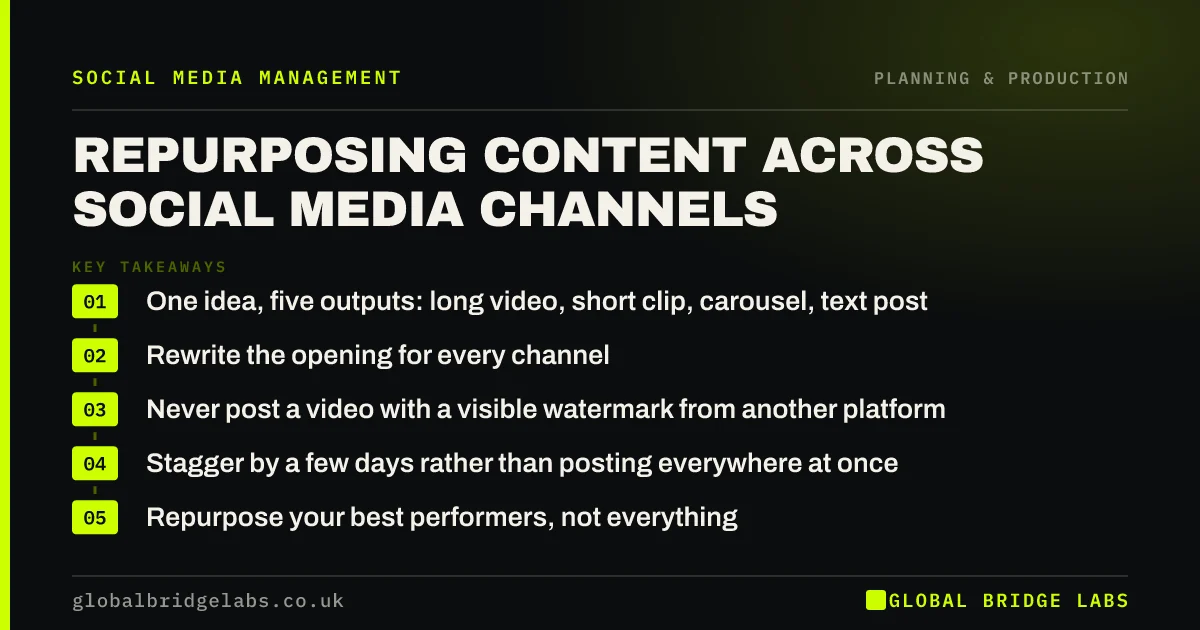
Repurposing is adapting one idea to several channels, not posting the same file everywhere. Keep the idea constant and change the format, the opening and the length. Automatic cross-posting is the version that damages results, because each platform demotes content that carries another platform's signature.
- One idea, five outputs: long video, short clip, carousel, text post, still image with quote.
- Rewrite the opening for every channel. The first line is channel-specific.
- Never post a video with a visible watermark from another platform.
- Stagger by a few days rather than posting everywhere at once.
- Repurpose your best performers, not everything. The bar is evidence, not effort.
Want your best-performing post turned into five? Send it to us on WhatsApp.
Chat on WhatsApp →What is the difference between repurposing and cross-posting?
Cross-posting publishes the identical asset to multiple channels, usually automatically. Repurposing rebuilds the same idea to suit each channel's format and audience expectations.
The distinction is commercially significant. Cross-posted content is recognisably foreign on arrival, and platforms consistently give less distribution to content that appears to originate elsewhere, particularly video carrying another platform's watermark.
How do you turn one idea into five posts?
Start with the heaviest asset you have, usually a video or a completed job, and work down in production cost.
- The full thing: a two-minute explanation or full job walkthrough.
- The clip: the best 30 seconds, re-opened with a stronger first line.
- The carousel: the same points as images, for feeds where people read.
- The text post: the argument alone, no media, for LinkedIn.
- The still: one sentence from it over a photo, for stories and quick slots.
What has to change per channel?
Three things always: the opening line, the length, and the call to action.
LinkedIn audiences will read a longer opening and expect a professional framing of the same story. Instagram needs the visual to carry the first two seconds. TikTok needs the hook spoken, not written. The underlying point does not change, which is why the expensive part of content only has to be done once.
We repurpose for UK clients as standard. Message us on WhatsApp to see how it would work for you.
Chat on WhatsApp →How often can you reuse the same content?
A genuinely evergreen post can be republished roughly every six months, and should be, because a fraction of your audience saw it the first time and your audience has changed since.
Change the opening and the media when you do. Republishing the identical asset reads as automation; republishing the same argument with a new example reads as a point of view held consistently, which is a different signal entirely.
What should never be repurposed?
Anything time-bound, anything referencing a platform-specific feature, and anything whose value depended on the moment. A post about a job completed last week does not repurpose in March.
Also avoid repurposing content that failed. Poor performance on the original channel is usually about the idea rather than the format, and running it four more times multiplies the wasted slots rather than rescuing it.
What does this look like in practice?
A pattern in professional services: one long article a month and nothing else, followed by confusion about why social is quiet.
Building a repurposing ladder around the article fixes both problems at once: one video answering its central question, three carousels from its sections, four text posts from its arguments, and a still quote. The month's content comes from work already being done, and the article itself usually starts ranking too, because it finally has links and traffic pointing at it.
How do you keep a repurposing ladder running?
Attach it to the monthly batching session rather than treating it as separate work. When a piece performs well it goes on a list, and at the next session the top two items on that list are rebuilt into their other formats.
The discipline that makes this sustainable is refusing to repurpose on merit alone. Only content with evidence behind it earns the extra four outputs, which keeps the workload proportional to the return and stops the ladder becoming a second production line.
Keep a record of what came from what. After two quarters you can see which original formats produce the most usable derivatives, and that usually changes what you choose to make first.
- Only repurpose proven performers, never everything.
- Rebuild two items per month at the batching session.
- Stagger derivatives across a fortnight.
- Record the lineage so you learn which formats generate the most reuse.
What should you not repurpose across audiences?
Content aimed at one buyer type should not be pushed to another simply because you have both audiences. A recruitment post written for candidates does not belong in the feed your commercial buyers read, and the reverse is worse.
The failure is not embarrassment, it is dilution. Every post teaches the platform who your content is for, and mixing two unrelated audiences in one feed makes your distribution less accurate for both.
Where you genuinely serve two audiences, separate them by channel rather than by post. That is the argument for a recruitment presence on one platform and a commercial presence on another, and it is why the split works when it is deliberate and fails when it is accidental.
- Do not push audience-specific content to the other audience.
- Mixed audiences make platform distribution less accurate for both.
- Separate audiences by channel, not by alternating posts.
- Deliberate splits work. Accidental ones dilute everything.
Next step
Repurposing is the difference between producing six pieces of content a week and producing one idea a week that becomes six.
Message us on WhatsApp and we will build a repurposing ladder from your existing content.
Chat on WhatsApp →Sources and further reading
- Meta Business Help Centre · Meta
- Create a YouTube channel · YouTube Help
Frequently asked questions
Is cross-posting the same content bad?
Posting the identical file everywhere performs poorly, particularly video carrying another platform's watermark, which most platforms demote. Adapt the opening, length and format per channel. The idea stays the same, which is where the actual work was.
How many posts can one piece of content produce?
Five is realistic from a substantial piece: the full version, a short clip, a carousel, a text post and a still quote. Stagger them across a fortnight rather than publishing everywhere on the same day.
Can I repost old content?
Yes, roughly every six months for genuinely evergreen posts, with a new opening and different media. Most of your audience did not see it the first time, and repetition of a consistent point of view builds recognition rather than boring people.
Should I repurpose blog posts into social content?
Yes, and it works in both directions. An article gives you a month of social posts, and the social posts drive the links and traffic that help the article rank. Lead with the article's most contested claim rather than its introduction.
Written by

Global Bridge Labs (GBL) is a UK–Sri Lanka partner for social media, websites and BPO. Everything here comes from client delivery, not theory.