On this page
- 01Key takeaways
- 02What makes an industry 'boring'?
- 03Why is an unglamorous sector an advantage?
- 04Which content angles work?
- 05Do you need to be funny or follow trends?
- 06Which platforms and formats suit these sectors?
- 07What are the limits?
- 08What does this look like in practice?
- 09Unglamorous sector checklist
- 10Next step
- 11Sources and further reading
- 12Frequently asked questions
Key takeaways
Social media for boring industries works because the audience is small, specific and under-served. Nobody needs your content to be entertaining. They need it to be useful when they have the problem you solve. Clarity, proof and reliability are the whole strategy.
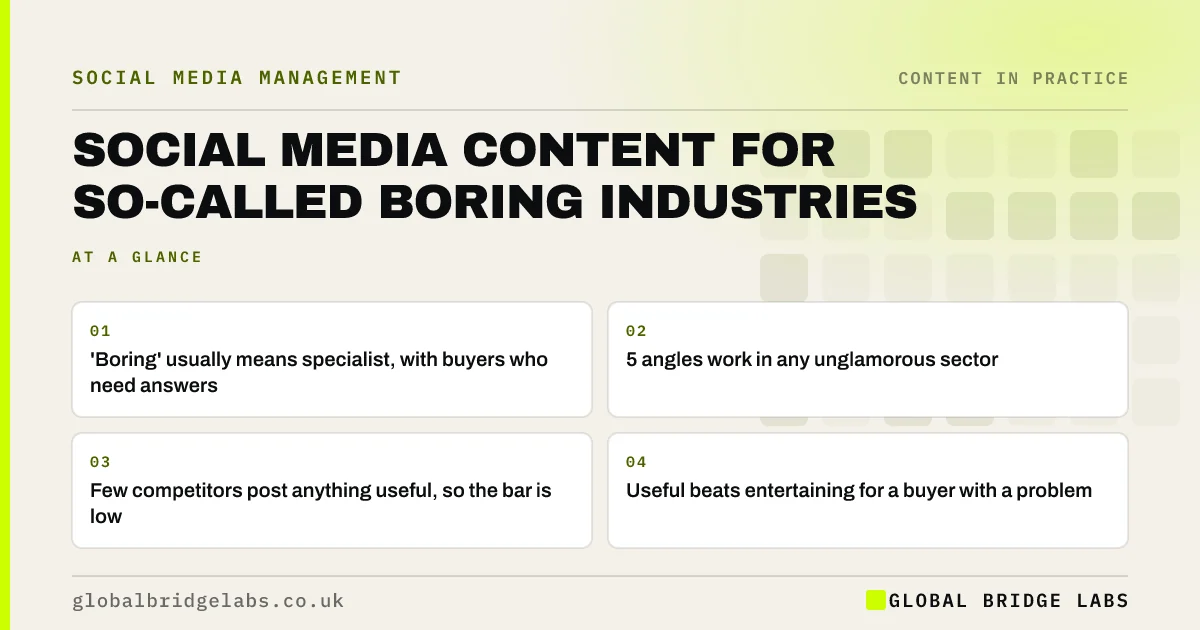
- 'Boring' usually means specialist, with buyers who need answers.
- 5 angles work in any unglamorous sector.
- Few competitors post anything useful, so the bar is low.
- Useful beats entertaining for a buyer with a problem.
Think your sector is too dull for social media? Message us on WhatsApp.
Chat on WhatsApp →What makes an industry 'boring'?
An industry is called boring when its work is technical, routine or invisible to the public: drainage, payroll, pallet storage, insurance broking, industrial fixings. To the person who needs it, none of it is boring. It is urgent, expensive or risky, and they want a competent supplier.
Why is an unglamorous sector an advantage?
It is an advantage because competition for attention is thin. Few rivals post, and those that do share stock images and seasonal greetings. A firm that explains costs, timescales and common problems in plain English stands out immediately, and the audience it reaches is almost entirely relevant.
Which content angles work?
Five angles work in almost any unglamorous sector: how it works, what it costs, what goes wrong, what the rules say, and what a good job looks like. Each answers a question a buyer would otherwise have to ring round to ask.
- How it works: the process most people never see.
- What it costs: ranges and what drives them.
- What goes wrong: failures and how to prevent them.
- What the rules say: regulations, explained simply.
- What good looks like: standards a buyer can check.
- Turn customer questions into FAQ posts on social media
- Behind-the-scenes content that builds buyer confidence
Send us your sector on WhatsApp and we will suggest five angles. Let us discuss your requirements.
Chat on WhatsApp →Do you need to be funny or follow trends?
No. Humour is welcome if it comes naturally, but a logistics firm dancing to trending audio attracts people who like the video, not people with freight to move. Plain competence is the tone buyers of technical services trust. Save the effort for accuracy.
Which platforms and formats suit these sectors?
LinkedIn suits most business-facing sectors, and YouTube suits explanations people search for. Short process videos do well because the machinery and methods are unfamiliar and satisfying to watch. Carousels suit regulations and cost breakdowns. One channel done properly is enough to start.
What are the limits?
The limits are scale and speed. Audiences are small, likes are few and sales cycles can be long. Social media in these sectors supports sales and reputation more than it generates volume. Measure it by the enquiries and conversations it warms, not by reach.
What does this look like in practice?
A pattern we see with UK industrial and back-office firms: a 40-second video of a routine process, filmed on a phone, is watched and shared by exactly the engineers and buyers the firm wants to reach, because nobody else in the sector shows it.
Unglamorous sector checklist
Start with these.
- Ten buyer questions are listed.
- One post explains what the service costs.
- One post shows the process.
- One post explains a regulation simply.
- No trend content for its own sake.
- Success is measured in enquiries.
Next step
Film 40 seconds of the most routine part of your work this week and add one sentence explaining why it is done that way.
Message us on WhatsApp for five content angles fitted to your sector, or book a 30-minute consultation.
Chat on WhatsApp →Sources and further reading
- LinkedIn Pages best practices · LinkedIn
- Create a YouTube channel · YouTube Help
- Writing to GOV.UK standards: writing guidelines · GOV.UK
Frequently asked questions
Can social media work for a boring industry?
Yes. Specialist sectors have small, relevant audiences and few competitors posting anything useful. Content that explains costs, processes, rules and common problems reaches buyers when they need a supplier. The bar is low, so clear and regular posts are enough to stand out.
What should a boring business post on social media?
Post how the work is done, what it costs, what goes wrong, what regulations require and what a good job looks like. These are the questions buyers have and rarely find answered. Write each one in plain English and show the real work wherever you can.
Do I need to be entertaining?
No. Buyers of technical or routine services want competence and clarity. Entertainment attracts a general audience. If humour suits your team it can help, but it is not required. A calm, accurate explanation is what a buyer with a costly problem wants to find.
Which platform is best for an industrial or B2B business?
LinkedIn is usually the starting point, with YouTube for longer explanations people search for. Choose the one where your buyers already spend time and do it consistently before adding another. Add a second channel only when the first is running without strain on the team.
Written by

Global Bridge Labs (GBL) is a UK–Sri Lanka partner for social media, websites and BPO. Everything here comes from client delivery, not theory.