On this page
- 01Short answer
- 02Why is logistics different?
- 03What should you post for B2B?
- 04Why does recruitment content often matter more?
- 05How do you measure it in a long cycle?
- 06What about confidentiality?
- 07What does this look like in practice?
- 08How do you win work from a tender-led buyer?
- 09Next step
- 10Sources and further reading
- 11Frequently asked questions
Short answer
Logistics social media has two jobs: supporting a long B2B sales cycle where the decision happens elsewhere, and recruiting drivers and warehouse staff. LinkedIn for the first, Facebook and short video for the second. Content should demonstrate operational reliability, which is the only thing the buyer is actually assessing.
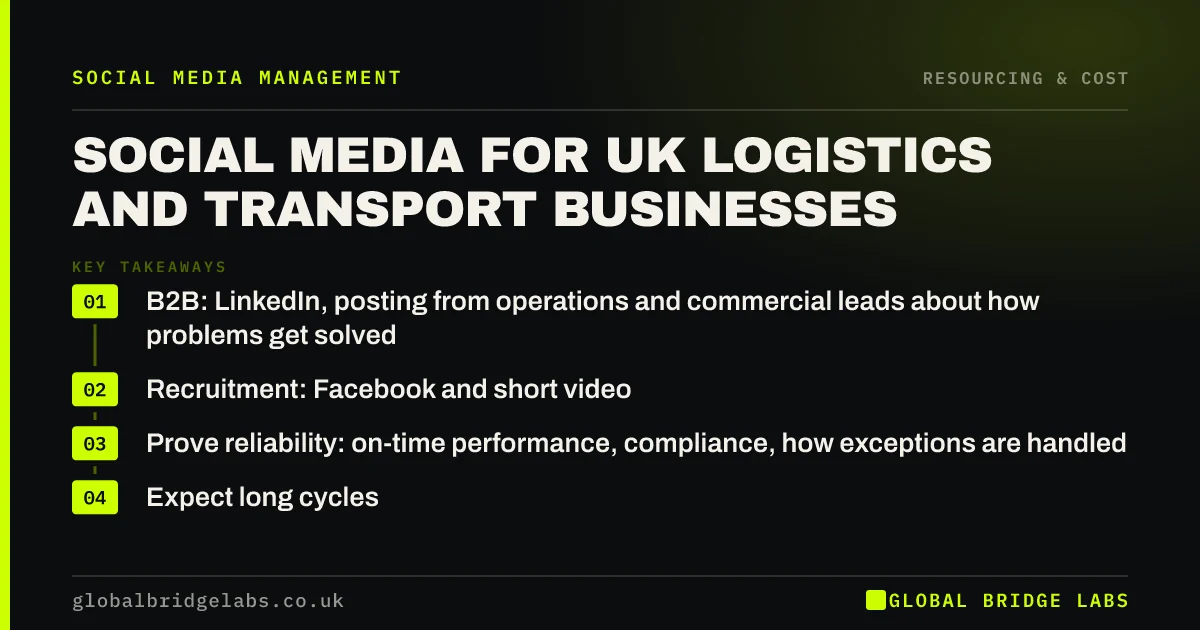
- B2B: LinkedIn, posting from operations and commercial leads about how problems get solved.
- Recruitment: Facebook and short video. Show the vehicles, the depot and the people.
- Prove reliability: on-time performance, compliance, how exceptions are handled.
- Expect long cycles. Social supports tender and referral processes rather than replacing them.
- Recruitment content frequently returns more than sales content in this sector.
Want a logistics content plan covering sales and recruitment? Message us on WhatsApp.
Chat on WhatsApp →Why is logistics different?
Because the buying decision is usually procedural. Contracts are won through tenders, framework agreements, referrals and relationships, not through a click from a post.
That does not make social media pointless. It makes its role specific: to be the evidence that someone finds when they check you out before a tender decision or a referral conversation, and to keep you visible with the small number of people who make those decisions.
What should you post for B2B?
Operational specifics, from named people. The content that lands with logistics buyers is not about your fleet size; it is about how you handle the things that go wrong, because that is what they are buying insurance against.
- How you handled a disruption: weather, breakdown, port delay, missed slot.
- Compliance and standards, explained in terms of what it means for a customer.
- On-time performance data, with the context that makes it meaningful.
- New capability: a depot, a certification, a temperature-controlled capacity.
- A specific customer problem solved, anonymised.
Why does recruitment content often matter more?
Because driver and warehouse recruitment is a persistent constraint in UK logistics, and agency fees for filling those roles are substantial.
Social media recruitment content is measurable in a way B2B content is not: applications, cost per hire, and the saving against agency fees. For many logistics firms, that is where the clearest return sits, and it justifies the channel on its own.
- The vehicles, the equipment and the depot, shown honestly.
- A driver talking about the routes, the shifts and the pay structure.
- What the shift pattern actually is, stated plainly.
- Progression: someone who started on nights and is now a planner.
- Current vacancies with the practical detail people want before applying.
We will build the recruitment content and measure it against agency fees. Message us on WhatsApp.
Chat on WhatsApp →How do you measure it in a long cycle?
Separate the two jobs and measure them differently. Recruitment is measured conventionally: applications, cost per hire, time to fill.
B2B is measured on leading indicators: whether decision-makers at target accounts engage, whether prospects mention content in meetings, and whether you are being found when checked. Applying enquiry-based targets to B2B logistics social media produces the wrong conclusion within two quarters.
What about confidentiality?
Significant in this sector. Client names are frequently contractually confidential, sites have security requirements, and load details can be commercially sensitive or a security risk.
Agree the rules before filming: no client branding without permission, no site security arrangements, no load details, no vehicle registrations where it matters, and no filming at customer premises without written approval. Write it into your social media policy so it is a rule rather than a judgement call on the day.
What does this look like in practice?
A pattern in logistics: company updates posted to a page nobody reads, while the business spends heavily on agency fees for driver recruitment.
Splitting the strategy is what works: LinkedIn posting from the operations director about disruption handling and compliance, and a separate Facebook and short-video recruitment stream showing the depot, the vehicles and the shift patterns honestly. The recruitment side produces a measurable saving against agency fees. The B2B side takes longer and shows up first as prospects referencing posts in meetings.
How do you win work from a tender-led buyer?
Content cannot win the tender, but it can change who gets invited and what is assumed about you before the submission is read.
Two things do that work. Visible evidence of operational competence, so that when a procurement lead searches your name they find specifics rather than a dormant page. And a named person who is recognisably part of the industry conversation, because invitations to tender frequently follow relationships rather than searches.
Set expectations accordingly. The measurable outcome here is being on the list, not receiving enquiries, and it is worth agreeing that with whoever holds the budget before the first quarter of results arrives and gets misread.
- Content changes who gets invited, not who wins.
- Make operational competence findable by name.
- Invest in one or two recognisable named people.
- Agree that the outcome is invitations, not inbound enquiries.
Next step
In logistics, social media is two programmes with one budget. Measure them separately or you will misjudge both.
Message us on WhatsApp for a logistics social media plan covering B2B credibility and recruitment.
Chat on WhatsApp →Sources and further reading
- LinkedIn Pages best practices · LinkedIn
- Employee earnings in the UK (Annual Survey of Hours and Earnings) · Office for National Statistics
Frequently asked questions
Does social media work for B2B logistics companies?
Yes, but as support for a long tender and referral-driven cycle rather than as a direct lead source. Its job is to be the evidence someone finds when checking you before a decision, and to keep you visible with a small number of buyers.
What should a haulage company post on social media?
How disruptions were handled, compliance explained in customer terms, on-time performance with context, new capability, and anonymised customer problems solved. Buyers are assessing operational reliability, not fleet size.
Is social media good for driver recruitment?
It is frequently the clearest return in the sector, because applications, cost per hire and the saving against agency fees are all directly measurable. Show the vehicles, the depot, the shift pattern and the pay structure honestly.
What confidentiality rules apply to logistics content?
Client names are often contractually confidential, sites have security requirements, and load details can be commercially sensitive. Agree filming rules in advance and write them into your social media policy so they are not judgement calls made on site.
Written by

Global Bridge Labs (GBL) is a UK–Sri Lanka partner for social media, websites and BPO. Everything here comes from client delivery, not theory.