On this page
- 01Key takeaways
- 02Why do published demographics mislead small businesses?
- 03How do you ask customers which platforms they use?
- 04What can you learn from your own data for free?
- 05What does the follower audit usually reveal?
- 06How do you check where buyers research suppliers?
- 07When is the answer not a social platform at all?
- 08What does this look like in practice?
- 09What do you do when the answers conflict?
- 10Next step
- 11Sources and further reading
- 12Frequently asked questions
Key takeaways
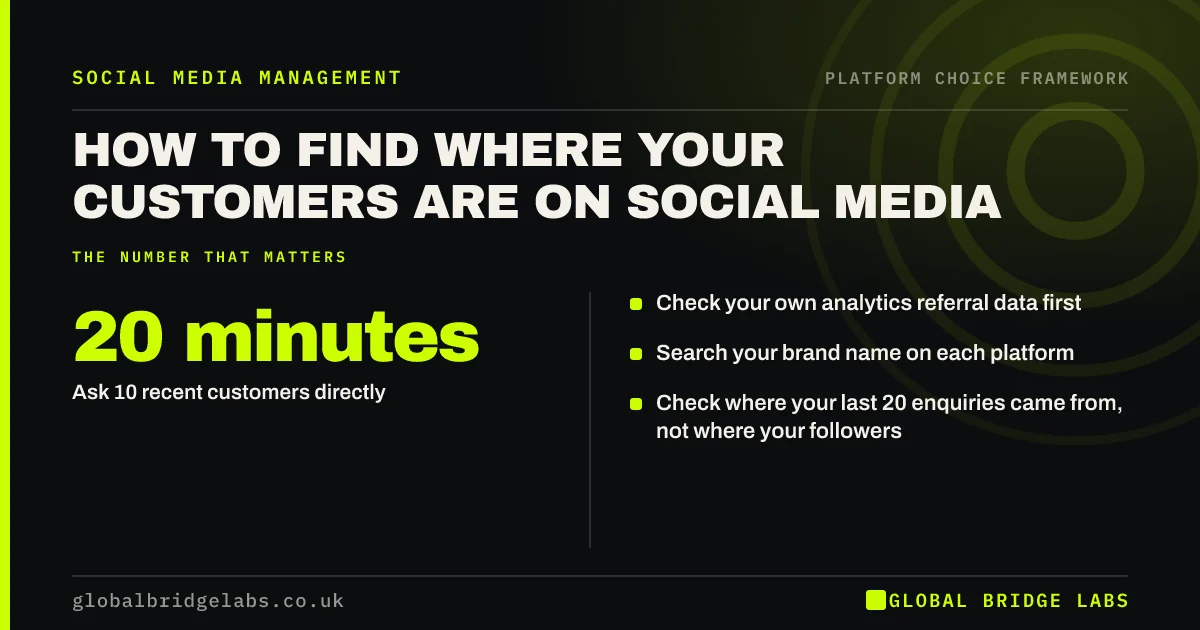
Ask 10 recent customers which platforms they opened yesterday. That single question beats every demographic report, because published data describes the UK population and you need to know about the few hundred people who actually buy from you.
- Ask 10 recent customers directly. 20 minutes of calls beats a week of desk research.
- Check your own analytics referral data first. It is free and it is about your buyers.
- Search your brand name on each platform. Where people mention you is a strong signal.
- Check where your last 20 enquiries came from, not where your followers are.
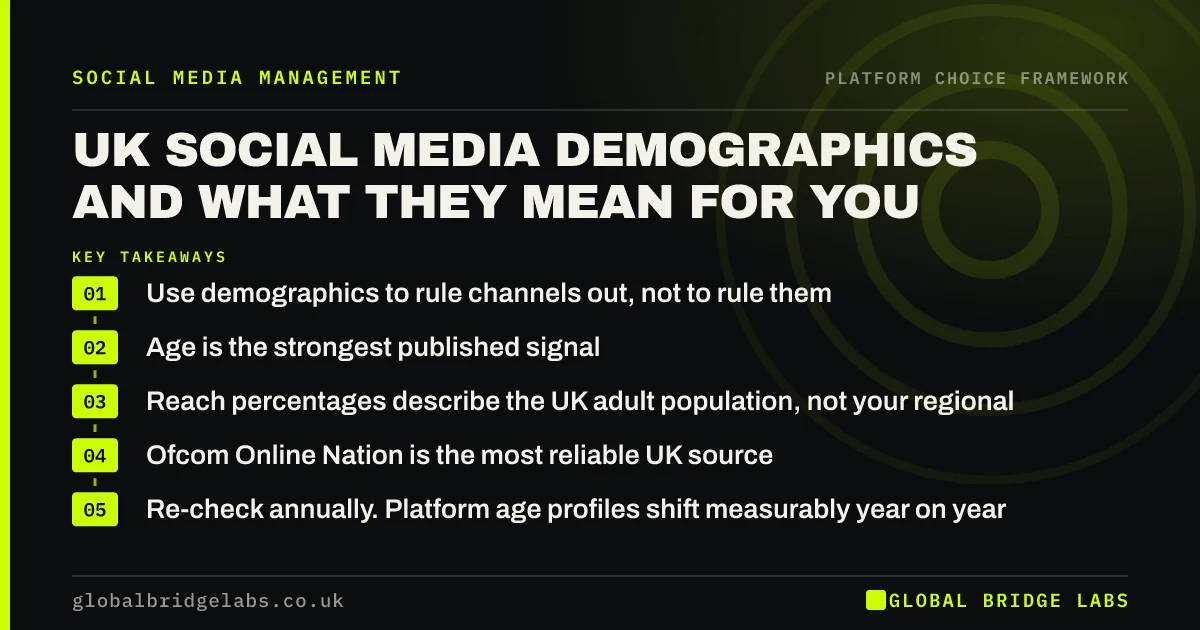
- Published demographics are a tiebreaker, never the decision.
Want help reading your referral data? Send us a screenshot on WhatsApp and we will interpret it.
Chat on WhatsApp →Why do published demographics mislead small businesses?
Because they describe a national population and you sell to a segment of it, usually within one region and one narrow buying role. A chart showing that a platform reaches most UK adults is true and useless if your buyers are practice managers at veterinary surgeries in the North West.
Demographic data answers the question can I reach people here. It never answers the question can I reach my people here, and that is the question platform selection actually turns on.
How do you ask customers which platforms they use?
Call 10 customers who bought in the last 90 days and ask three questions in this order. Which social apps did you open yesterday? Where do you look when you need to check out a supplier? And how did you first hear about us?
Ask about yesterday rather than in general, because in general produces the answer people think sounds right and yesterday produces the truth. The third question is the one that usually surprises people, because the answer is frequently a recommendation rather than a platform at all.
What can you learn from your own data for free?
More than most businesses realise, and it costs nothing. Five sources, in order of usefulness.
- Website referral traffic in GA4: which social domains send visits, and which of those convert.
- Your enquiry form's how did you hear about us field. If you do not have one, add it today.
- Your inbox: count the last 20 enquiries by origin, including calls that mention a platform.
- Platform search: search your business name on each channel to see where you are discussed.
- Your follower lists: how many followers are actual customers rather than other suppliers?
What does the follower audit usually reveal?
That a large share of a small UK business's followers are competitors, suppliers, agencies and staff. It is a deflating exercise and an extremely useful one.
Take your most recent 50 followers on each channel and categorise them: customer, potential customer, supplier, competitor, agency, irrelevant. A channel where under a fifth are customers or potential customers is not reaching your market, whatever the follower count says. We have seen accounts with several thousand followers where fewer than one in ten could ever buy.
We will audit your follower base and tell you who is actually there. Message us on WhatsApp.
Chat on WhatsApp →How do you check where buyers research suppliers?
Separately from where they spend leisure time, because they are rarely the same place. Someone can spend an hour a day on a video platform and still check every supplier on a professional network or a review site.
The practical test is to ask customers what they looked at between first hearing your name and contacting you. For UK service businesses the honest answer is usually your website, your Google Business Profile reviews, and one social profile used as a credibility check rather than a discovery channel. That changes which platform deserves investment and which simply needs to be current.
When is the answer not a social platform at all?
Often, and it is worth saying plainly. For many UK trades, clinics and local services, the honest finding from this research is that customers arrive through search, recommendation and Google Business Profile, and that social media is where they check you afterwards.
That is not an argument for abandoning social. It is an argument for demoting it from lead source to credibility asset, which changes the budget, the effort and the metric you judge it on. Judging a credibility asset on enquiry volume will always make it look like a failure.
What does this look like in practice?
A UK equipment hire business we worked with was convinced its customers were on a video-first platform, because that is where the sector's content was being made. Ten customer calls produced a different answer: site managers used a messaging app all day, checked the website on a phone in a van, and never opened the video platform during working hours.
The plan changed from video production to a click-to-chat messaging setup and a faster mobile site. Content output fell by around two thirds and enquiries rose, because the effort finally landed where the decision was being made.
What do you do when the answers conflict?
Trust the enquiry data over what customers say, and what customers say over published demographics. People misremember their own behaviour, particularly about time spent on their phones, so an answer that contradicts your own referral data is usually the answer that is wrong.
Where the conflict is genuine, it normally means you have two customer segments rather than one. A business hearing two different answers from two clearly different groups has learned something more useful than a single clean result: it now knows which segment is worth more and can choose the channel that serves that one.
Next step
Block 90 minutes this week. Sixty minutes for 10 customer calls, 30 minutes in your analytics and inbox. You will finish with a better answer than any agency deck built from national demographic data, because it will be about your buyers rather than the country.
Message us on WhatsApp and we will give you the 10-question customer script to use.
Chat on WhatsApp →Sources and further reading
- Online Nation: how the UK uses online services · Ofcom
- Google Search Console · Google
Frequently asked questions
How do I find out what social media my customers use?
Ask 10 recent customers which apps they opened yesterday and where they check out suppliers, then cross-check against your website referral data and your last 20 enquiries. Direct answers from real buyers beat national demographic charts every time.
Are social media demographics reports useful for small businesses?
Only as a tiebreaker. They describe the UK population, not your buyers. Use them when two platforms score equally on your own customer research, and ignore them when they contradict what your actual customers have told you.
How many customers should I ask before deciding?
Ten is usually enough to see a pattern, and twenty removes most doubt. If eight of ten name the same platform, you have your answer. If the answers scatter across five platforms, that itself tells you social is not the main route to you.
What if my customers are not really on social media?
Then demote social to a credibility asset and invest in search, Google Business Profile and referrals instead. Keep one profile current so prospects who check you find a business that clearly still trades, and judge it on that job rather than on enquiries.
Written by

Global Bridge Labs (GBL) is a UK–Sri Lanka partner for social media, websites and BPO. Everything here comes from client delivery, not theory.