On this page
- 01Key takeaways
- 02What is a shared services model?
- 03What does shared services save?
- 04How does outsourcing compare?
- 05When should shared services stay in-house?
- 06When should the central team be outsourced?
- 07What makes centralisation fail?
- 08Which functions suit shared services first?
- 09What does this look like in practice?
- 10Shared services checklist
- 11Next step
- 12Sources and further reading
- 13Frequently asked questions
Key takeaways
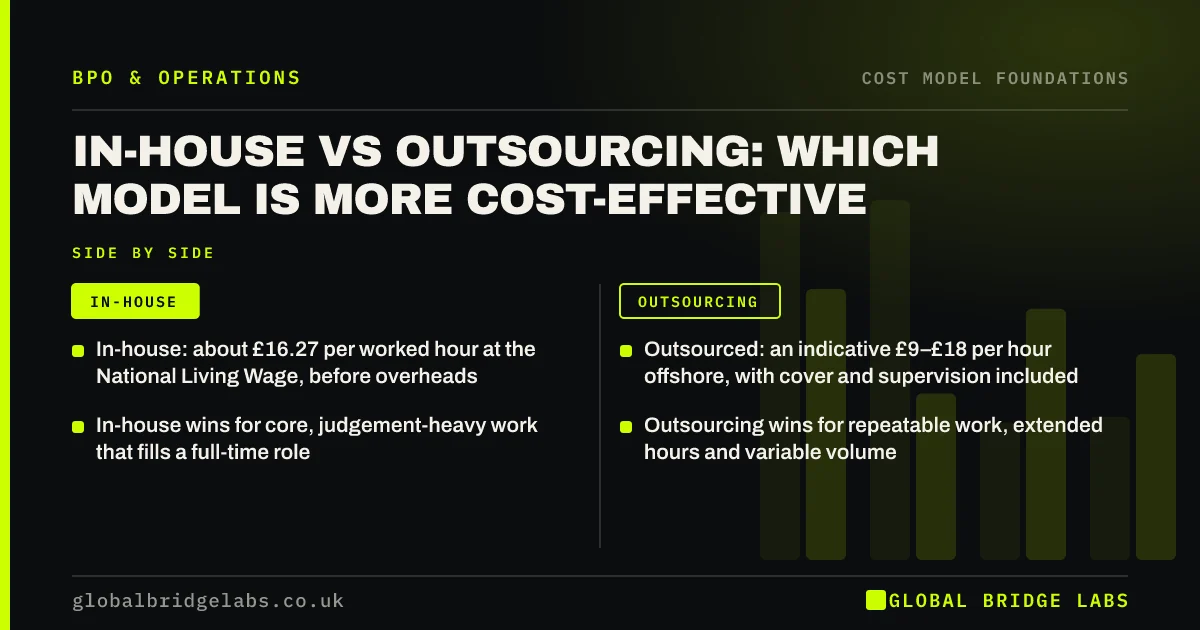
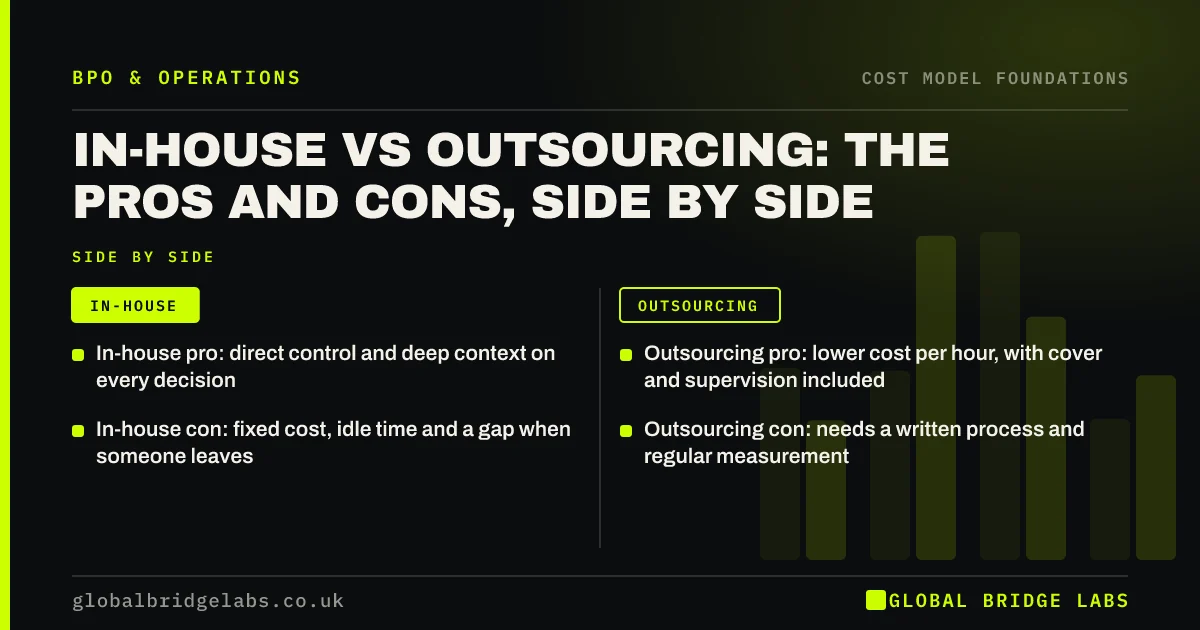
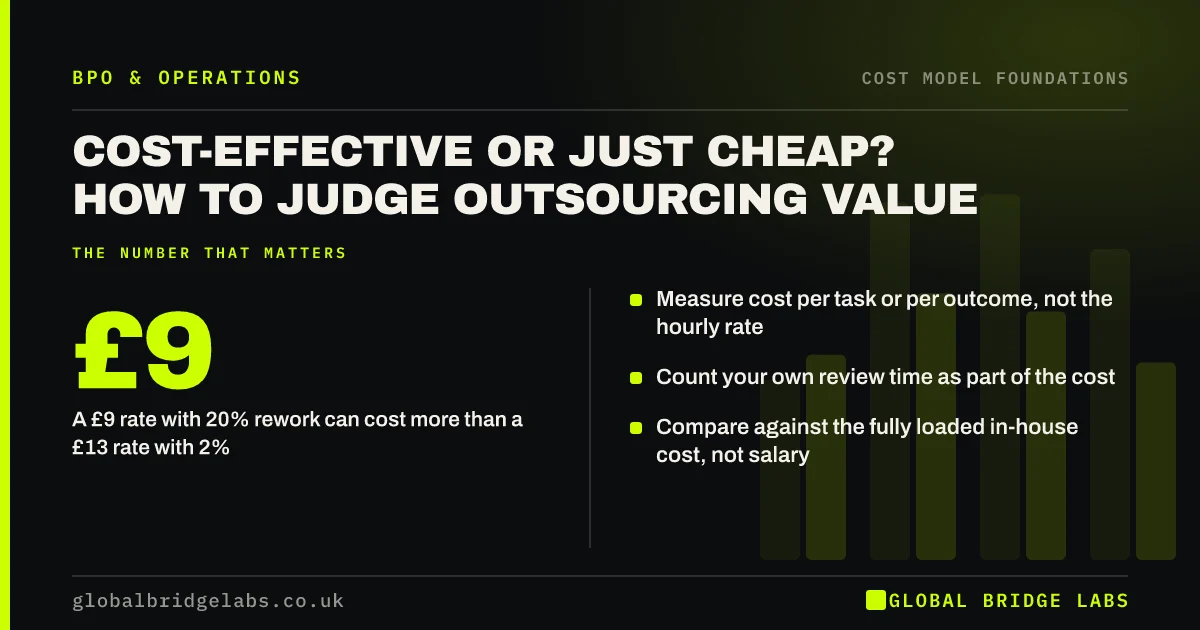
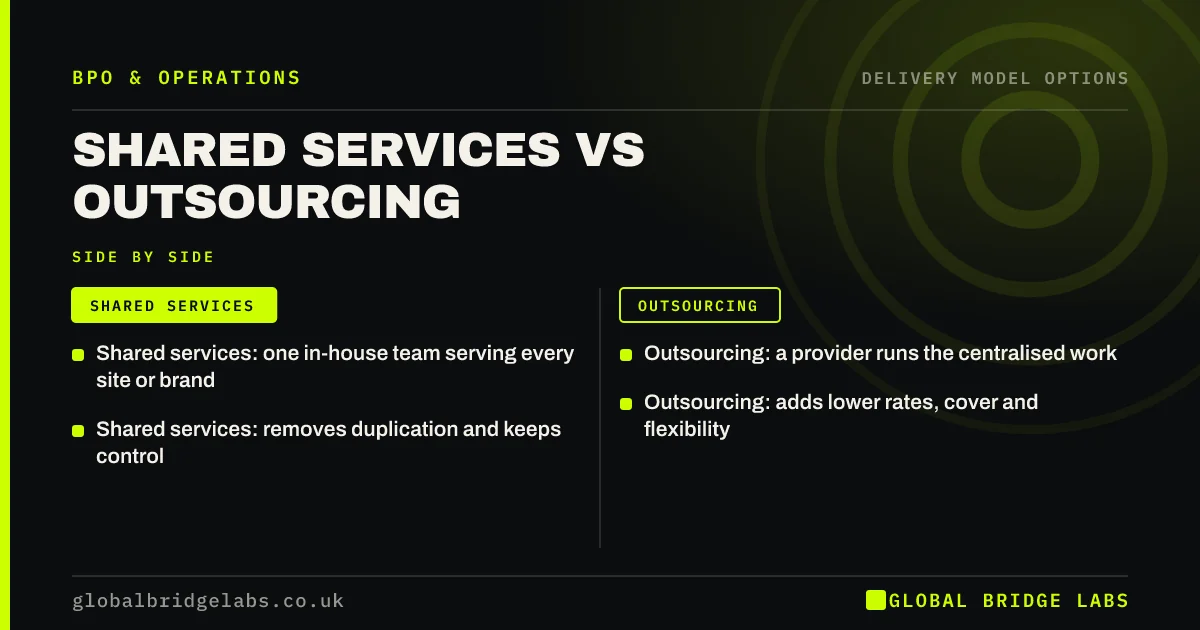
Shared services vs outsourcing is a choice between centralising back-office work inside your own business and handing it to a provider. For multi-site or multi-brand SMEs, a shared service team removes duplicate admin at each site. Outsourcing goes further on cost and cover. Many businesses centralise first, then outsource the standardised parts.
- Shared services: one in-house team serving every site or brand.
- Outsourcing: a provider runs the centralised work.
- Shared services: removes duplication and keeps control.
- Outsourcing: adds lower rates, cover and flexibility.
Running admin across several sites? Message us on WhatsApp to compare options.
Chat on WhatsApp →What is a shared services model?
A shared services model moves common back-office work, such as finance admin, HR admin, purchasing and customer service, out of individual sites or brands into one central team that serves them all. The team stays in-house; the gain comes from standard processes and removing duplicated roles.
What does shared services save?
Savings come from removing part-time admin at each site and running one standard process. If four sites each carry 15 hours a week of admin, 60 hours in total, a central team with standard processes may do it in 45. That saves about 780 hours a year, around £14,400 at £18.45 per worked hour, before any change of location.
How does outsourcing compare?
Outsourcing the same centralised 45 hours a week at an indicative £12 per hour costs about £28,100 a year, against about £43,200 for the in-house shared team at £18.45 per worked hour, before overheads. It also brings cover and flexibility. The cost of outsourcing is a little less direct control over the central team.
Want shared services and outsourcing costed for your sites? Send us your admin hours on WhatsApp.
Chat on WhatsApp →When should shared services stay in-house?
When central work needs deep knowledge of each site, such as complex job costing, or when regulation or client contracts require the work to stay within your own organisation. It is also a sensible first step before outsourcing, because it forces processes to be standardised.
When should the central team be outsourced?
When processes are standard and documented, volumes vary between sites or seasons, and you need extended hours. Outsourcing the shared team, or parts of it, adds the rate saving and cover on top of the centralisation gain.
What makes centralisation fail?
Sites that keep their own ways of working, unclear service levels between the central team and sites, and no single system. Agree standard processes and response times with site managers before moving work, and measure them monthly.
Which functions suit shared services first?
Start with functions that are similar at every site and easy to standardise. Leave site-specific work, such as local supplier relationships or on-site staff management, with the sites until the central team is working well.
- Supplier invoice processing and payments admin.
- Payroll collation and HR admin.
- Customer email and booking admin.
- Management reporting across sites.
What does this look like in practice?
A pattern we see in UK hospitality groups: each venue manager handles supplier invoices, rotas and bookings admin. Centralising these into one process, run by a managed team, frees managers for the floor and gives head office one view of costs.
Shared services checklist
Use these steps to plan.
- List admin tasks and hours at each site.
- Standardise the process across sites.
- Agree service levels with site managers.
- Cost an in-house central team and an outsourced one.
- Move one process first and measure it.
Next step
Tell us your sites and the admin each carries. We will cost shared services in-house and outsourced in a 30-minute call.
Message us on WhatsApp to plan centralisation, or book a 30-minute consultation.
Chat on WhatsApp →Sources and further reading
- The Sourcing and Consultancy Playbooks · Cabinet Office
- Rates and thresholds for employers 2026 to 2027 · HM Revenue & Customs
- Contracts and liabilities between controllers and processors · Information Commissioner's Office
Frequently asked questions
What is the difference between shared services and outsourcing?
Shared services centralises common back-office work into one in-house team that serves all sites or brands. Outsourcing hands that work to a provider. Many businesses centralise first to standardise processes, then outsource the standardised parts for lower cost and better cover.
Is shared services worth it for a small business?
For businesses with several sites or brands, often yes, because it removes duplicated part-time admin at each site and standardises processes. Single-site businesses gain more from outsourcing specific tasks directly, because there is no duplication to remove. Start by listing admin tasks at each site.
Should I centralise before outsourcing?
It helps. Centralising forces processes to be standardised and documented, which makes outsourcing faster and cheaper to set up. You can also outsource the central function straight away if processes are already consistent across your sites or brands. Either way, document the process first.
How do sites keep control in a shared services model?
Agree service levels between the central team and each site, such as how quickly invoices are processed or queries answered, and review them monthly with site managers. Sites keep decisions; the central team handles processing, and both see the same numbers.
Written by

Global Bridge Labs (GBL) is a UK–Sri Lanka partner for social media, websites and BPO. Everything here comes from client delivery, not theory.