On this page
Key takeaways
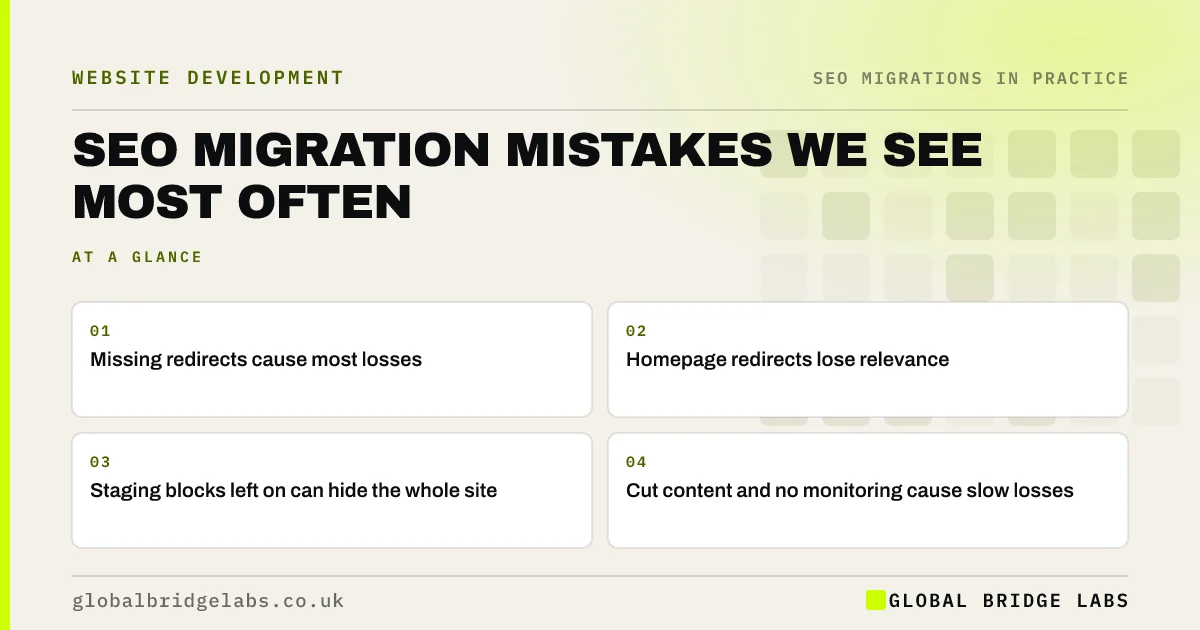
Most migration losses come from a short list of avoidable mistakes: no redirect map, everything redirected to the homepage, staging blocks left on at launch, ranking content cut in the redesign, redirect chains, forgotten blog posts and files, broken tracking and no monitoring after launch. Each is cheap to prevent before launch and expensive to fix afterwards.
- Missing redirects cause most losses.
- Homepage redirects lose relevance.
- Staging blocks left on can hide the whole site.
- Cut content and no monitoring cause slow losses.
Want us to check your plan for these mistakes? Message us on WhatsApp.
Chat on WhatsApp →Which mistakes cost the most?
These are the mistakes behind the biggest drops we see, in rough order of damage.
- No redirect map, so old URLs return 404s.
- Everything redirected to the homepage.
- Noindex or robots.txt blocks left from staging.
- Ranking pages cut or shortened in the redesign.
- Domain, platform and structure changed at once.
Which mistakes cause slow, quiet losses?
Some mistakes do not cause a dramatic drop, but steadily erode traffic and enquiries.
- Redirect chains built on old redirects.
- Blog posts, PDFs and old campaign pages forgotten.
- Titles replaced by template titles.
- Internal links still pointing at old URLs.
- Tracking broken, so nobody notices the losses.
- Monitoring stopped after the first week.
How do you avoid them?
Follow a staged method with an output for each stage, test redirects and templates on staging, run first-hour checks at launch and keep monitoring for 90 days. Write the mistakes above into your go-live criteria as explicit checks, so each one is confirmed rather than assumed.
- Record, map, mirror, move, monitor: the GBL method
- Go-live criteria: who approves the new site
- The SEO migration scorecard: 20 checks before go-live
Want a second opinion on your migration plan? Message us on WhatsApp.
Chat on WhatsApp →What does this look like in practice?
A pattern we see: one project combines three mistakes, a new domain, a homepage redirect for every old page and a staging noindex left on. Fixing all three in the first week still leaves months of recovery. Any one of them, caught before launch, would have taken minutes to put right. On the next project, the same business writes each mistake into its go-live criteria as a named check, and the launch passes with only a short, expected dip in traffic.
Migration mistakes checklist
- Build and test a full redirect map.
- Redirect to relevant pages, not the homepage.
- Clear staging blocks at launch.
- Keep ranking content.
- Monitor for 90 days.
Next step
Read the list of mistakes above against your current migration plan and mark any that are not yet covered. Each unmarked line is a task to add before launch.
Message us on WhatsApp about avoiding migration mistakes, or book a 30-minute consultation.
Chat on WhatsApp →Sources and further reading
- Site moves with URL changes · Google Search Central
- Redirects and Google Search · Google Search Central
- Block search indexing with noindex · Google Search Central
Frequently asked questions
What is the most common SEO migration mistake?
Missing redirects. When old URLs return 404 errors instead of redirecting to their new pages, search engines cannot transfer signals and visitors from old links hit dead ends. A complete, tested redirect map prevents most of the traffic losses we see after migrations.
Why is redirecting everything to the homepage a mistake?
Visitors looking for a specific page land somewhere generic and often leave, and Google may treat mass homepage redirects as soft 404s, so the old pages' value is not passed on. Redirect each old URL to its most relevant new page instead.
Can migration mistakes be fixed after launch?
Most can: redirects can be added, content restored and blocks removed. Recovery takes weeks to months, and enquiries lost in the meantime are not recovered. That is why checking for these mistakes before launch is always cheaper than fixing them afterwards.
Written by

Global Bridge Labs (GBL) is a UK–Sri Lanka partner for social media, websites and BPO. Everything here comes from client delivery, not theory.