On this page
Key takeaways
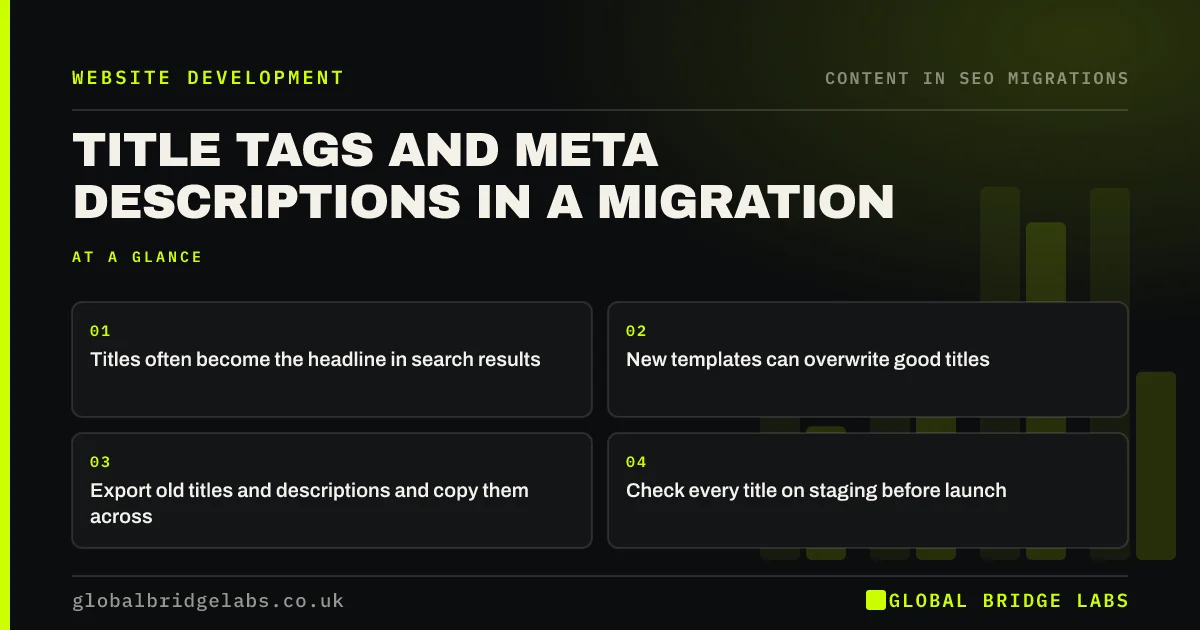
Title tags help search engines understand a page and often become the clickable headline in search results. In a migration, new templates sometimes replace carefully written titles with generic ones, such as the page name and business name. Export titles and meta descriptions from the old crawl, carry them across to the new pages, and check them on staging before launch.
- Titles often become the headline in search results.
- New templates can overwrite good titles.
- Export old titles and descriptions and copy them across.
- Check every title on staging before launch.
Want a quick check of your new page titles? Message us on WhatsApp.
Chat on WhatsApp →Why do titles change in a migration?
Most platforms generate titles from a template unless someone sets them page by page. A new theme might use the page name followed by the site name, dropping the words that matched what people search for. Plugins and apps that managed titles on the old platform may not exist on the new one, so the custom titles are not imported at all.
How do you carry titles across?
Treat titles and descriptions as content that moves with the page.
- Export titles and meta descriptions from the old crawl.
- Add them as columns in the redirect map.
- Paste or import them into the new pages.
- Keep titles that rank; fix only those that are clearly poor.
- Make sure each title is unique.
What should you check on staging?
Crawl staging and compare titles with the old crawl, row by row through the redirect map. Look for duplicate titles across pages, titles that are just the business name, and titles cut short by the template. Google's guidance on title links explains that it may rewrite titles that are vague or repeated, so clear, specific titles give you more control over how pages appear.
- Crawl the staging site before launch: what to check
- Impressions but no clicks? What Search Console is saying
Want us to compare your old and new titles? Message us on WhatsApp.
Chat on WhatsApp →What does this look like in practice?
A pattern we see: every page on the new site has a title in the form page name, then a separator, then the business name, because the SEO plugin from the old site was not reinstalled. Pages that used to show specific service and location titles now show vague ones. Importing the old titles from the crawl takes an hour.
Title tags checklist
- Export old titles and descriptions.
- Add them to the redirect map.
- Import them into the new pages.
- Check for duplicates and template titles.
- Compare with the old crawl on staging.
Next step
Add title and meta description columns to your redirect map from the old crawl. It turns carrying them across into a simple copy job.
Message us on WhatsApp about page titles, or book a 30-minute consultation.
Chat on WhatsApp →Sources and further reading
- Influencing your title links in search results · Google Search Central
- Control your snippets in search results · Google Search Central
- Site moves with URL changes · Google Search Central
Frequently asked questions
Should I keep the same title tags after a migration?
For pages that rank well, yes, at least at launch. Changing titles at the same time as URLs makes any drop hard to diagnose. Once rankings settle, you can improve titles one page at a time and watch the effect in Search Console.
Do meta descriptions affect rankings?
Meta descriptions do not directly affect rankings, but they can be shown as the snippet under your title in search results, which affects whether people click. Carry good descriptions across, and write new ones for pages that lack them, keeping each one specific to its page.
Why does Google show a different title from mine?
Google may rewrite a title if it is vague, repeated across pages, stuffed with keywords or does not match the page. Clear, specific, unique titles are more likely to be used as written. Check for template titles after a migration, because they often trigger rewrites.
Written by

Global Bridge Labs (GBL) is a UK–Sri Lanka partner for social media, websites and BPO. Everything here comes from client delivery, not theory.