On this page
Key takeaways
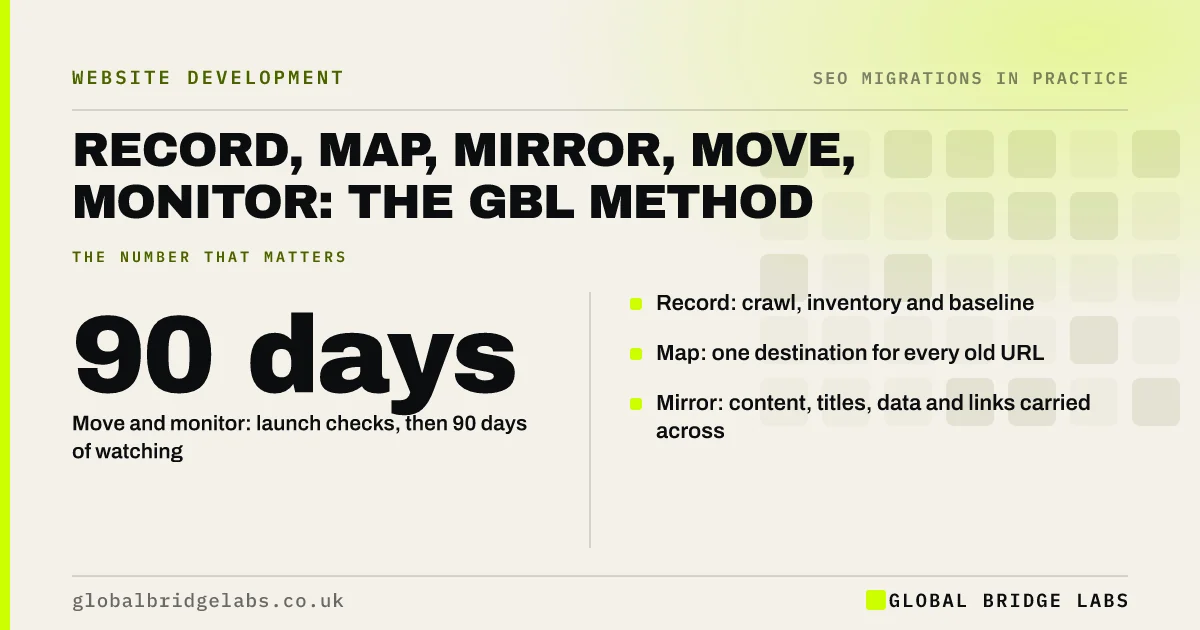
The GBL migration method has five stages, each with a clear output. Record the old site and a search baseline. Map every old URL to a new one. Mirror the content and settings that rank. Move with redirects live and launch checks done. Monitor for 90 days and fix issues fast. Skipping a stage is where most migration losses begin.
- Record: crawl, inventory and baseline.
- Map: one destination for every old URL.
- Mirror: content, titles, data and links carried across.
- Move and monitor: launch checks, then 90 days of watching.
Want us to run the method on your migration? Message us on WhatsApp.
Chat on WhatsApp →Why use a staged method?
Migrations involve several people and many small tasks, and the riskiest tasks sit between roles. A staged method makes each output visible: a crawl file, a redirect map, a parity check, a launch checklist and a monitoring log. The owner can see which stage is done, and nobody can skip one without it being obvious. It scales from a 20-page site to a large shop.
What does each stage produce?
Each stage ends with something you can check and sign off.
- Record: crawl export, URL inventory and saved baseline.
- Map: redirect map with a destination or decision for every URL.
- Mirror: parity check of titles, headings, content, schema and links.
- Move: tested redirects, cleared staging blocks, sitemap submitted.
- Monitor: weekly log of clicks, errors and fixes for 90 days.
How long does each stage take?
For a typical small business site, record takes a day, map one or two days, mirror happens alongside the build over a few weeks, move takes a launch day plus a day of crawling, and monitor runs for 90 days with short weekly reviews. Larger sites and shops scale up mainly in the map and mirror stages, where the number of URLs drives the effort.
Want a template for each stage? Ask us on WhatsApp.
Chat on WhatsApp →What does this look like in practice?
A pattern we see when the method is followed: the record stage finds old URLs nobody remembered, the map stage catches pages about to be cut that bring enquiries, and the move stage finds one staging setting left on in the first hour. None of these become problems, because each stage had an output someone checked.
GBL migration method checklist
- Record: crawl, inventory and baseline saved.
- Map: every old URL has a decision.
- Mirror: top pages pass the parity check.
- Move: first-hour checks done.
- Monitor: weekly reviews for 90 days.
Next step
Write the five stage names on your project plan with an owner and a date for each output. If a stage has no owner, that is where your migration is most at risk.
Message us on WhatsApp about your migration plan, or book a 30-minute consultation.
Chat on WhatsApp →Sources and further reading
- Site moves with URL changes · Google Search Central
- Redirects and Google Search · Google Search Central
- Page indexing report · Search Console Help
Frequently asked questions
What is the GBL migration method?
It is a five-stage approach to moving a website without losing search traffic: record the old site and a baseline, map every old URL to a new one, mirror the content and settings that rank, move with tested redirects and launch checks, and monitor for 90 days, fixing issues as they appear.
Does the method work for small websites?
Yes. On a small site each stage is short: an afternoon to record and map, a parity check of the top pages, an hour of launch checks and brief weekly reviews. The stages matter more than the size, because each one prevents a different common mistake.
Which stage do businesses most often skip?
Mirror and monitor are skipped most often. Teams set up redirects but let content shrink in the redesign, or stop watching after the first week. Both cause slow, quiet losses that are only noticed months later, when they are harder to trace back to the migration.
Written by

Global Bridge Labs (GBL) is a UK–Sri Lanka partner for social media, websites and BPO. Everything here comes from client delivery, not theory.