On this page
Key takeaways
This illustrative example follows a 60-page service business moving to a new platform with a new structure. The inventory finds 140 URLs, the redirect map covers all of them, staging tests catch two problems, launch-day checks find one more and traffic returns to the baseline within about five weeks. The figures are illustrative, not client data, but the steps are real.
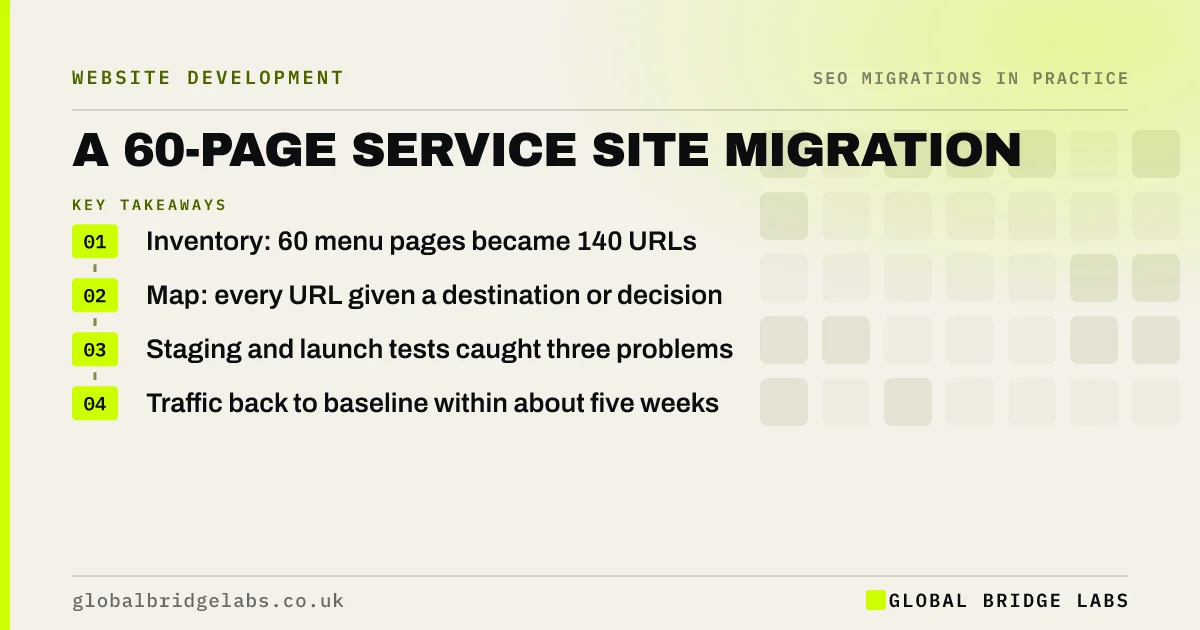
- Inventory: 60 menu pages became 140 URLs.
- Map: every URL given a destination or decision.
- Staging and launch tests caught three problems.
- Traffic back to baseline within about five weeks.
Planning a similar move? Message us on WhatsApp.
Chat on WhatsApp →Record and map
The business has 60 pages in its menu. The crawl finds 95 URLs; Search Console, analytics and old redirect rules add 45 more, including old blog posts, two PDFs and campaign pages: 140 in total. The baseline shows eight pages bring most of the enquiries from search. The redirect map gives 118 URLs a new page, merges 14 thin pages into stronger ones and lets 8 return 410.
Mirror and test
Content for the eight top pages is moved first, with titles and headings unchanged. A parity check flags two service pages that lost their pricing sections in the new design; both are restored. The staging crawl finds the blog template outputting canonicals to the blog index, which is fixed.
- 140 redirects tested on staging; 9 failed and were fixed.
- Two service pages restored to full content.
- Blog canonical template corrected.
- Forms and call tracking tested.
Move and monitor
Launch is on a Tuesday morning. First-hour checks find the contact form sending to an old address, fixed in minutes. In week one, clicks dip slightly and old URLs move into page with redirect. A handful of old URLs found in the 404 log get redirects in week two. By week five, clicks are back at the baseline, and enquiries never dropped noticeably.
- The first hour after a migration: checks in order
- The 90-day monitoring plan after a migration
- Found missing redirects weeks after launch?
Want us to plan your migration like this? Message us on WhatsApp.
Chat on WhatsApp →What does this look like in practice?
Every problem in this example was found by a planned check: the inventory found the forgotten URLs, the parity check found the cut pricing sections, the staging crawl found the canonical error and the first-hour checks found the form. None of them was unusual. What made the migration uneventful was that each check was actually done.
Worked example checklist
- Build the inventory from several sources.
- Map every URL, including merges and removals.
- Check parity on top pages.
- Test redirects and templates on staging.
- Run first-hour checks and weekly monitoring.
Next step
Count the pages in your menu, then count the URLs in Search Console. The gap between the two numbers is the part of your site most likely to be lost in a migration.
Message us on WhatsApp about your migration, or book a 30-minute consultation.
Chat on WhatsApp →Sources and further reading
- Site moves with URL changes · Google Search Central
- Performance report (Search results) · Search Console Help
- Page indexing report · Search Console Help
Frequently asked questions
How long does a 60-page website migration take?
The SEO work for a site of this size typically takes a few days spread across the build: a day or two for the inventory and redirect map, time for parity and staging checks, a launch day and short weekly reviews for three months. The build itself is separate.
How many redirects does a 60-page site need?
Usually more than 60, because old blog posts, PDFs, campaign pages and URL variations add up. In this illustrative example, 60 menu pages became 140 URLs. Build the inventory from several sources to find them all, then decide what happens to each.
Is it normal for traffic to dip after a well-planned migration?
A small dip for a few weeks is common while Google processes the redirects. In this example, clicks returned to the baseline within about five weeks. Larger or longer drops usually point to a missed step, such as missing redirects or lost content.
Written by

Global Bridge Labs (GBL) is a UK–Sri Lanka partner for social media, websites and BPO. Everything here comes from client delivery, not theory.