On this page
Key takeaways
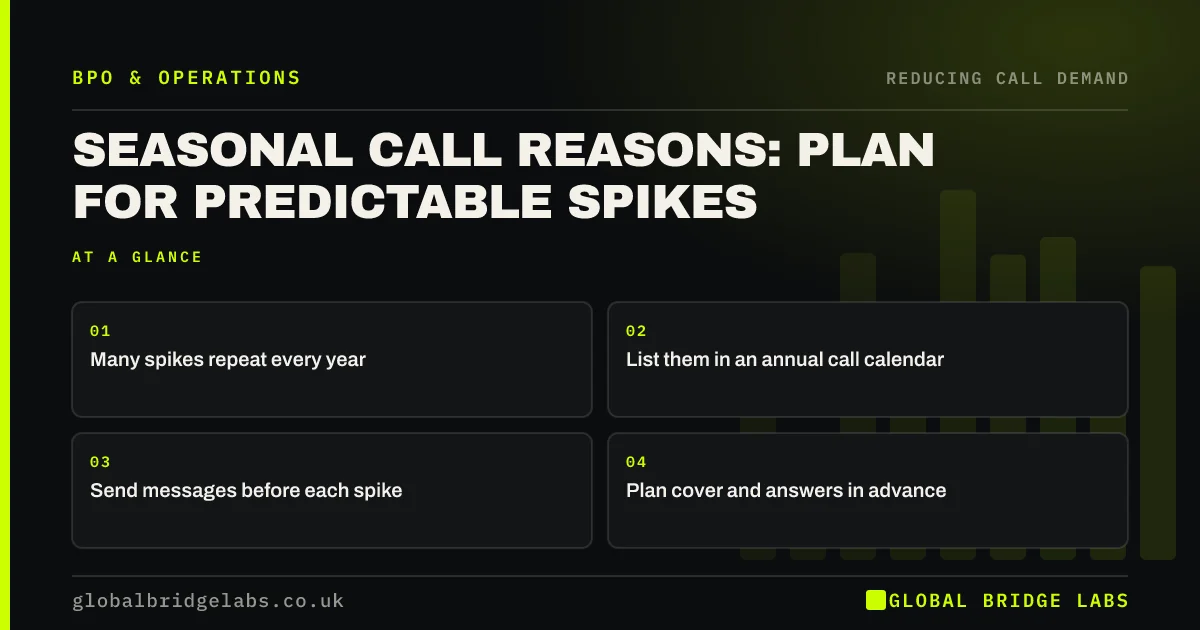
Many call spikes are predictable: renewals in January, heating faults in the first cold week, holiday bookings after Christmas, school-term changes and year-end deadlines. An annual call calendar lists these moments with the reasons they bring, so you can send messages early, prepare answers and plan cover before the queue grows.
- Many spikes repeat every year.
- List them in an annual call calendar.
- Send messages before each spike.
- Plan cover and answers in advance.
Want an annual call calendar for your business? Message us on WhatsApp.
Chat on WhatsApp →Which spikes are predictable?
Look at a year of call data by week and reason. Common patterns include bank holidays, the first cold or hot spell, school holidays, renewal months, price changes and tax or financial year deadlines. Sector events, such as January sales, add their own.
What goes in the calendar?
For each moment, note the date or trigger, the call reasons it brings, the expected rise and the actions to take beforehand. Keep it in a shared sheet and review it each quarter.
- Date or trigger.
- Expected call reasons.
- Expected rise in calls.
- Actions before the spike.
What can you do before each spike?
Send proactive messages answering the expected questions, update your website and queue message, refresh the answer library, book extra cover and avoid planned leave where you can do so fairly. Each action reduces either the size of the spike or its effect on waits.
- Proactive updates that stop calls before they start
- Seasonal customer service outsourcing for peak periods
Want help preparing for your next seasonal peak? Send us last year's call data on WhatsApp.
Chat on WhatsApp →How do you learn from each peak?
After each spike, compare actual calls with the plan, note which reasons appeared and which actions worked, and update the calendar. Over two or three years the calendar becomes a reliable plan.
What does this look like in practice?
A pattern we see: a heating business is overwhelmed every year in the first cold week. Sending a short boiler checklist by email in early autumn, preparing answers and booking extra cover in advance keeps service level steady when the cold arrives.
The checklist also brings in planned service bookings in quieter weeks, which smooths the workload for engineers as well as the phones.
Seasonal call checklist
- Review a year of calls by week.
- List predictable spikes.
- Note reasons and expected rises.
- Plan messages and cover beforehand.
- Review after each peak.
Next step
Look at last year's calls by week, list your three biggest predictable spikes and plan one action ahead of the next one.
Message us on WhatsApp to plan for seasonal call peaks, or book a 30-minute consultation.
Chat on WhatsApp →Sources and further reading
- UK bank holidays · GOV.UK
- School term and holiday dates · GOV.UK
Frequently asked questions
How do I predict seasonal call peaks?
Use at least a year of call data by week and reason, and note what happened each time: weather, holidays, renewals or campaigns. Most peaks repeat with similar triggers. If you lack history, ask staff when the phones are busiest and check sector events and public calendars.
Can I reduce seasonal peaks or only staff for them?
Both. Many seasonal calls are predictable questions that early messages or web updates can answer. Sending them before the peak reduces calls. The remaining demand needs cover, such as part-time staff, cross-training or overflow arranged well in advance. Plan both together.
How far ahead should I plan seasonal cover?
For major peaks, several weeks to a few months ahead, especially if you need to recruit, train or contract overflow. Messages and website updates can go out a week or two before. Review the calendar quarterly so nothing is left until the last minute.
Written by

Global Bridge Labs (GBL) is a UK–Sri Lanka partner for social media, websites and BPO. Everything here comes from client delivery, not theory.