On this page
Key takeaways
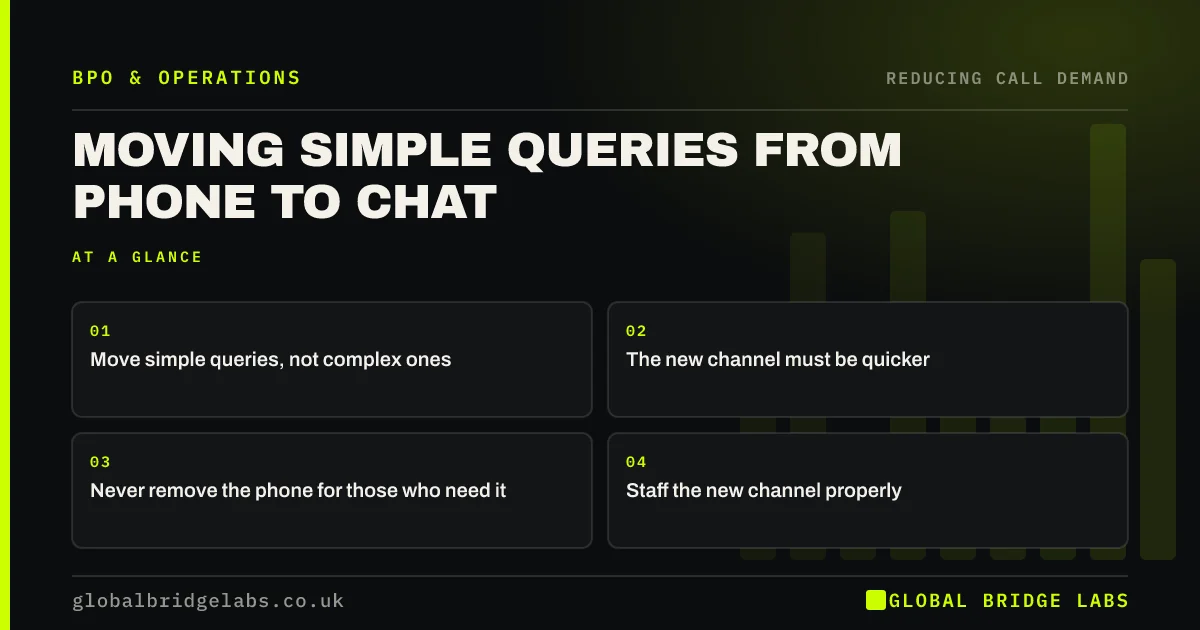
Channel shift means encouraging customers to use another channel, such as chat, WhatsApp or online forms, for simple queries that do not need a call. It can shorten phone queues and suit customers who prefer messaging. It works when the new channel is quick and complete, and fails when it is slower or simply a way to avoid talking to people.
- Move simple queries, not complex ones.
- The new channel must be quicker.
- Never remove the phone for those who need it.
- Staff the new channel properly.
Thinking about moving calls to chat or WhatsApp? Message us on WhatsApp.
Chat on WhatsApp →Which queries suit other channels?
Simple, factual queries that do not need a conversation: changing an address, sending a document, checking a status or booking a slot. Queries needing reassurance, negotiation or complex problem-solving usually work better by phone.
How do you encourage the shift?
Offer the alternative where it helps: in the queue message, on confirmation emails and on the contact page. Make it quick to start and answer promptly. Customers move when the new channel is easier, not when the phone is made harder.
- Mention it in the queue message.
- Link it from emails and the site.
- Answer quickly.
What can go wrong?
If messages go unanswered for hours, customers call instead, and you have two contacts for one query. If the chat team cannot resolve issues, customers are sent back to the phone. Staff the new channel with the same care as the phones, with response targets.
Want to estimate how many calls could move to messaging? Send us your call reasons on WhatsApp.
Chat on WhatsApp →How do you measure success?
Track total contacts per customer, not just calls. If calls fall and messages rise by a similar amount, you have shifted work, which is fine if it is quicker. If total contacts rise, customers are using both channels for the same issue, and the shift needs fixing.
What does this look like in practice?
A pattern we see: a business adds WhatsApp but replies only once a day. Customers message and then call. Setting a one-hour response target for messages during opening hours turns WhatsApp into a real alternative, and simple calls fall.
Total contacts per customer also drop, which confirms that customers are using one channel for each query rather than two.
Channel shift checklist
- Pick simple queries to shift.
- Offer the channel where it helps.
- Set response targets for messages.
- Keep the phone open.
- Track contacts per customer.
Next step
Pick one simple call reason, offer a messaging alternative for it with a clear response time and track calls and messages for a month.
Message us on WhatsApp to plan a channel shift, or book a 30-minute consultation.
Chat on WhatsApp →Sources and further reading
- Stop trying to delight your customers (Dixon, Freeman and Toman, 2010) · Harvard Business Review
- WhatsApp Business app · WhatsApp
Frequently asked questions
Should I force customers to use chat instead of calling?
No. Forcing a channel usually creates frustration and repeat contacts. Offer alternatives that are genuinely easier for simple queries, and keep the phone open for people who need it, including customers who find digital channels difficult. Most customers will choose the quicker option if it works.
Is WhatsApp good for customer service?
It can be, because many customers already use it and can reply when convenient. It needs prompt responses, clear ownership and care with personal data. If messages go unanswered, customers will call anyway, so set and meet a response target during opening hours.
Will channel shift save money?
It can, because one person can often handle several message conversations at once, and messages can be answered at quieter times. Savings only come if the new channel resolves issues without extra contacts. Measure total contacts per customer before assuming the shift is saving time.
Written by

Global Bridge Labs (GBL) is a UK–Sri Lanka partner for social media, websites and BPO. Everything here comes from client delivery, not theory.