On this page
- 01Key takeaways
- 02What is span of control?
- 03How many direct reports is too many?
- 04What are the signs the span is too wide?
- 05How do you reduce the span without layers?
- 06How does outsourcing change the span?
- 07When is a wide span the right design?
- 08What does this look like in practice?
- 09Span of control checklist
- 10Next step
- 11Sources and further reading
- 12Frequently asked questions
Key takeaways
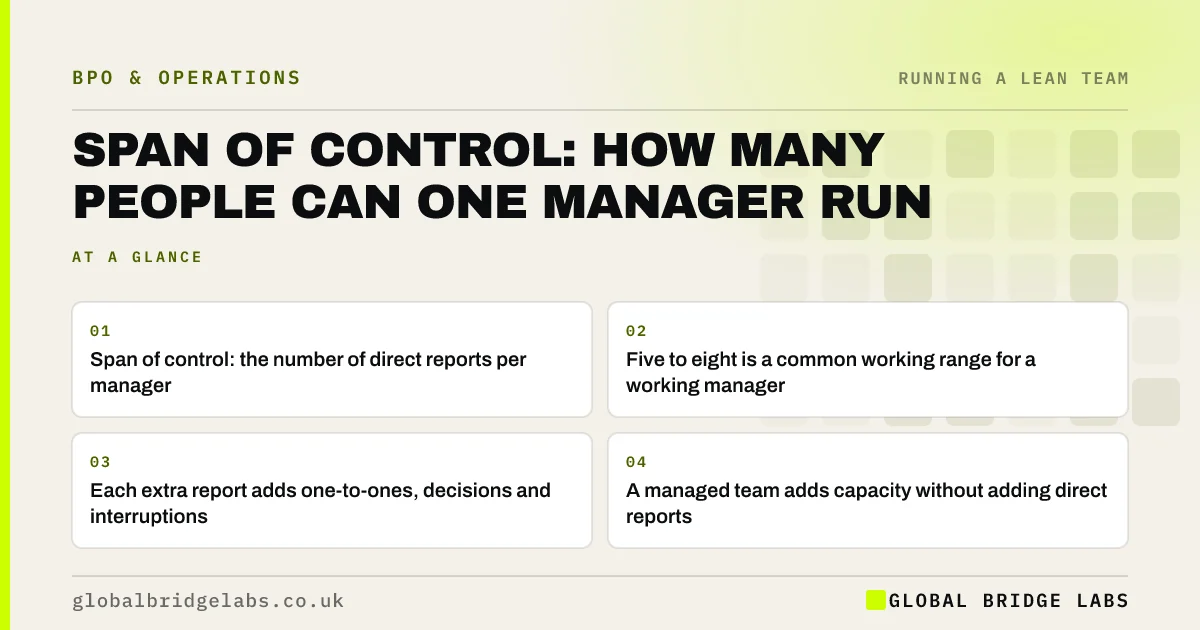
Span of control is the number of people who report directly to one manager. There is no legal or fixed limit, but five to eight direct reports is a common working range where the manager also has their own work to do. In a small business the owner often passes that number without noticing, and becomes the bottleneck.
- Span of control: the number of direct reports per manager.
- Five to eight is a common working range for a working manager.
- Each extra report adds one-to-ones, decisions and interruptions.
- A managed team adds capacity without adding direct reports.
Everyone reporting to you? Message us on WhatsApp with your org chart.
Chat on WhatsApp →What is span of control?
Span of control is a management term for the number of employees a manager supervises directly. A wide span means many reports per manager and few layers. A narrow span means few reports and more layers. The right span depends on how similar the work is and how much guidance people need.
How many direct reports is too many?
As a working guide, a manager who also does hands-on work can supervise about five to eight people well. Routine, similar work allows more. Varied, complex or new work allows fewer. The practical test is whether each person gets a proper conversation every week or two and whether decisions wait for more than a day.
- Similar, routine work: up to 10 or 12.
- Mixed roles with a working manager: 5 to 8.
- Complex or new work: 3 to 5.
What are the signs the span is too wide?
The signs are delay and inconsistency. Decisions queue for the manager. One-to-ones are cancelled. People solve the same problem in different ways. The manager works evenings to keep up, and staff report unclear priorities, which the Health and Safety Executive's management standards identify as a source of work-related stress.
- Decisions waiting more than a day.
- One-to-ones skipped for weeks.
- The same question asked by several people.
- The manager's own work done after hours.
How do you reduce the span without layers?
Reduce the load without adding layers in three ways. Promote a team leader for one group. Write down the decisions people can make without asking. And change what is managed: a function run by a managed provider reports through one account contact and one scorecard, not through four or five individual one-to-ones.
Want to see which functions could report through one scorecard? Send us your structure on WhatsApp.
Chat on WhatsApp →How does outsourcing change the span?
Outsourcing changes what the manager supervises. With employees, the manager handles hiring, rotas, absence, development and performance for each person. With a managed team, the provider's team leader does that, and the client manager reviews outcomes weekly. Capacity grows while the number of direct reports stays the same.
When is a wide span the right design?
A wide span is right when people are experienced, the work is standardised and good systems show what is happening. A flat structure keeps costs down and decisions close to the work. It fails only when the manager is expected to coach, check and decide for everyone personally.
What does this look like in practice?
A pattern we see in UK owner-managed firms at 12 to 15 people: all of them report to the owner, including three administrators and two customer service staff. Appointing one supervisor and moving routine admin and customer contact to a managed team takes the owner's direct reports from fourteen to six.
Span of control checklist
Review this when headcount passes eight.
- Count direct reports for each manager.
- Check how often one-to-ones actually happen.
- List decisions that wait for the manager.
- Write down what staff can decide alone.
- Identify a group that could have a team leader.
- Identify functions that could report as a service.
Next step
Send us a simple chart of who reports to whom. We will suggest how to cut the owner's direct reports without adding a management layer.
Message us on WhatsApp for a structure review, or book a 30-minute consultation.
Chat on WhatsApp →Sources and further reading
- What are the Management Standards for work-related stress? · Health and Safety Executive
- Work-related stress and how to manage it · Health and Safety Executive
Frequently asked questions
What is a good span of control?
A good span of control depends on the work. For a manager who also has hands-on duties, five to eight direct reports is a common working range. Standardised work with experienced staff supports more. Complex, varied or new work needs fewer so each person gets enough attention.
What happens if a manager has too many direct reports?
With too many direct reports, a manager cannot give each person enough time. Decisions are delayed, coaching stops, quality becomes inconsistent and the manager works long hours. Staff may feel unsupported or unclear about priorities, which raises the risk of stress and turnover.
How many people can a business owner manage directly?
Most owners can manage about six to eight people directly while still selling and planning. Beyond that, something gives, usually either the team's support or the owner's strategic work. A team leader, clearer delegated decisions or moving a function to a managed service eases the load.
Does outsourcing reduce management workload?
It reduces people management. The provider handles recruitment, scheduling, absence and individual performance. The client still needs to brief the team, review results and answer questions, typically a few hours a week. The owner manages one relationship and one scorecard instead of several individuals.
Written by

Global Bridge Labs (GBL) is a UK–Sri Lanka partner for social media, websites and BPO. Everything here comes from client delivery, not theory.