On this page
- 01Key takeaways
- 02Where does a growing clinic get stuck?
- 03How do you measure the lost capacity?
- 04What can be handled away from the front desk?
- 05What safeguards does health data need?
- 06What does patient-contact cover cost?
- 07When do you need more clinicians or rooms?
- 08What does this look like in practice?
- 09Clinic scaling checklist
- 10Next step
- 11Sources and further reading
- 12Frequently asked questions
Key takeaways
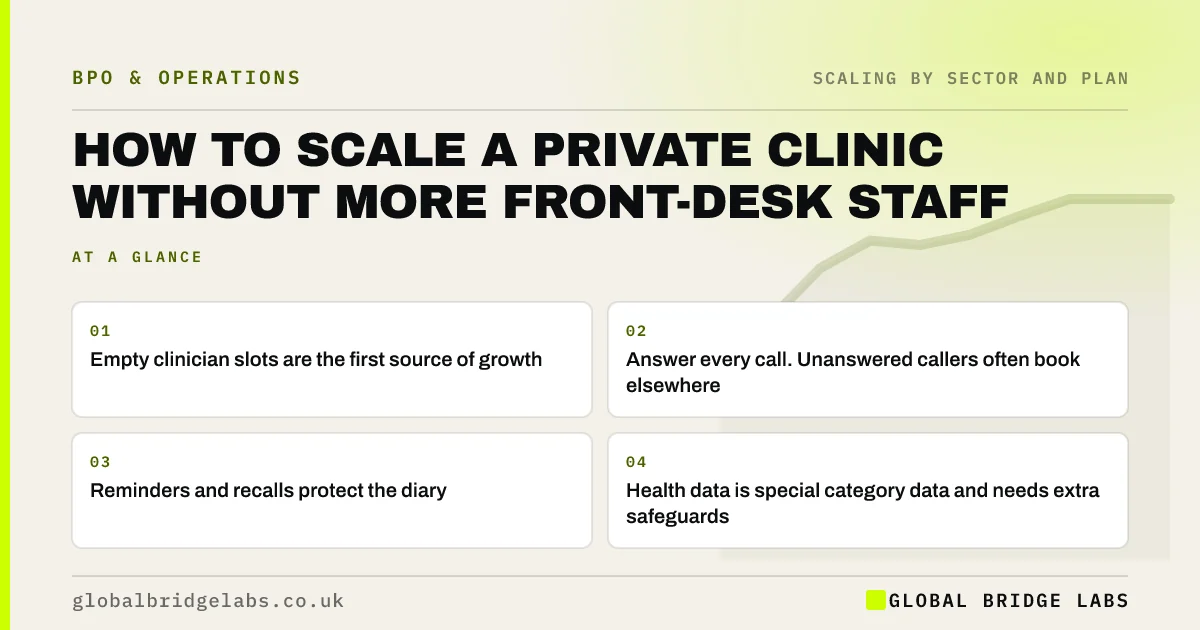
To scale a private clinic, fill more of the clinician hours you already have before adding rooms or staff. That means answering every call, booking and confirming appointments reliably, reducing missed appointments and recalling patients on time. A managed patient-contact team can supply that capacity, with strict safeguards for health data.
- Empty clinician slots are the first source of growth.
- Answer every call. Unanswered callers often book elsewhere.
- Reminders and recalls protect the diary.
- Health data is special category data and needs extra safeguards.
Front desk stretched and diary gaps appearing? Message us on WhatsApp with your call volumes.
Chat on WhatsApp →Where does a growing clinic get stuck?
A growing clinic gets stuck at the front desk. Reception is greeting patients, taking payments and answering the phone at once, so calls ring out at busy times. New patients who cannot get through book elsewhere, and existing patients are not recalled. Clinicians have gaps in their day while the phone goes unanswered.
How do you measure the lost capacity?
Measure three things for a month: calls received against calls answered, the percentage of clinician hours booked, and missed appointments. Multiply empty and missed slots by your average appointment value. The figure is usually larger than the cost of fixing patient contact.
- Answer rate: calls answered divided by calls received.
- Diary fill: booked hours divided by available hours.
- Missed appointment rate.
- Recall rate: patients due who have rebooked.
What can be handled away from the front desk?
Patient contact that does not need physical presence can be handled away from the desk. A managed team can answer overflow or all calls, book and reschedule in your practice system, send confirmations and reminders, run recall lists and respond to routine email and web enquiries.
What safeguards does health data need?
Health information is special category data under UK GDPR and needs a higher level of protection. You need a lawful basis and a separate condition for processing, a written processor contract, access limited to booking information wherever possible, and a safeguard for any international transfer. Clinical questions must always be passed to qualified staff.
- Processor contract and confidentiality terms.
- Role-based access to the practice system.
- No clinical advice from the contact team.
- Transfer safeguard if data leaves the UK.
- Updated privacy notice.
Want to discuss your requirements and the data safeguards involved? Message us on WhatsApp.
Chat on WhatsApp →What does patient-contact cover cost?
As indicative market ranges, managed offshore reception and booking teams cost £9–£18 per hour and onshore UK providers £20–£35 per hour. Many clinics start with overflow and peak hours, then extend to recalls. Weigh the cost against the value of the additional appointments filled.
When do you need more clinicians or rooms?
You need more clinicians or rooms when the diary is consistently full, waiting times are lengthening and missed appointments are low. That is real demand exceeding real capacity. Expanding before the existing diary is full adds fixed cost to a problem that was about access, not supply.
What does this look like in practice?
A pattern we see in UK dental, physiotherapy and aesthetic clinics: the receptionist is excellent with patients in the building and cannot reach the phone during check-in. Diverting unanswered calls to a trained team that books into the same diary fills slots that were previously lost, without changing the front-desk role.
Clinic scaling checklist
Work through this before recruiting or expanding.
- Measure call answer rate for a month.
- Calculate diary fill by clinician.
- Track missed appointments and their value.
- Set up confirmations and reminders.
- Run a recall list every week.
- Agree data protection terms before sharing access.
- Add overflow or full call cover.
Next step
Tell us your clinic type, number of clinicians and how calls are handled now. We will estimate the appointments being lost and what cover would recover them.
Message us on WhatsApp for a clinic capacity review, or book a 30-minute consultation.
Chat on WhatsApp →Sources and further reading
- Special category data · Information Commissioner's Office
- Contracts and liabilities between controllers and processors · Information Commissioner's Office
- International transfers of personal data · Information Commissioner's Office
Frequently asked questions
How can a private clinic see more patients without more staff?
A clinic can see more patients by filling existing clinician time: answer every enquiry, make booking easy, send reminders to reduce missed appointments and recall patients when they are due. Moving phone and booking work away from a busy front desk is usually the quickest gain.
Can a clinic outsource its reception?
Yes. Many clinics outsource call answering, appointment booking, reminders and recalls, either as overflow or fully. Because patient information is involved, a written data processing contract, restricted access and clear rules about passing clinical questions to qualified staff are essential.
Is patient data allowed to be handled by an outsourced team?
It can be, with the right safeguards. Health data is special category data under UK GDPR. The clinic must have a lawful basis and condition for processing, a processor contract, appropriate security and, for overseas teams, a valid transfer mechanism. Limit access to what booking requires.
How do I reduce missed appointments?
Reduce missed appointments by confirming at the time of booking, sending reminders by text or message a day or two before, making rescheduling easy, and following up non-attenders promptly. A clear cancellation policy, communicated in advance, also helps.
Written by

Global Bridge Labs (GBL) is a UK–Sri Lanka partner for social media, websites and BPO. Everything here comes from client delivery, not theory.