On this page
- 01Key takeaways
- 02Why are hospitality websites often slow?
- 03What do guests need to see first?
- 04Why are PDF menus a speed problem?
- 05How do you speed up the booking step?
- 06What can stay rich?
- 07What does this look like in practice?
- 08Hospitality speed checklist
- 09Next step
- 10Sources and further reading
- 11Frequently asked questions
Key takeaways
Hospitality websites are slow for understandable reasons: the business sells atmosphere, so the site is full of photographs and video. But a diner on the pavement wants the menu, the hours and a table, and a guest wants a price and a date. If those wait behind a full-screen video, a menu file and a booking tool that loads last, the booking goes to a platform that takes commission.
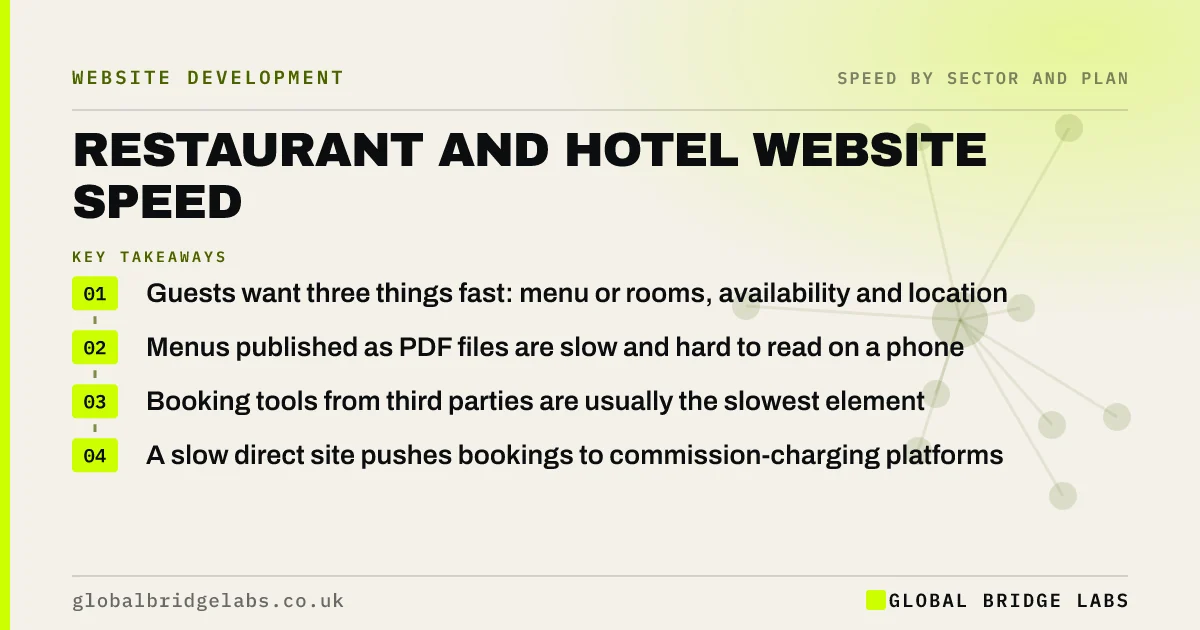
- Guests want three things fast: menu or rooms, availability and location.
- Menus published as PDF files are slow and hard to read on a phone.
- Booking tools from third parties are usually the slowest element.
- A slow direct site pushes bookings to commission-charging platforms.
Want your menu and booking journey timed on a phone? Send us the URL on WhatsApp.
Chat on WhatsApp →Why are hospitality websites often slow?
Hospitality websites are slow because imagery is central to the sale and nobody wants to compromise it. A restaurant leads with video of the dining room. A hotel opens with a gallery of every room type. Add a booking engine, a map, a review feed and a newsletter pop-up, and the first screen on a phone can take many seconds to become usable.
What do guests need to see first?
Guests arrive with a task, and it is rarely to admire the photography.
- Restaurants: menu, opening hours, location and a way to book.
- Hotels: dates, price, room types and a way to book direct.
- Both: a phone number that can be tapped.
- Both: one strong image that sets the tone, sized for a phone.
Why are PDF menus a speed problem?
A PDF menu is a separate file that must be downloaded and opened in a viewer, often several megabytes because it was designed for print. On a phone it appears at a size that needs pinching and scrolling sideways. The Nielsen Norman Group has described PDFs as unfit for on-screen reading for over twenty years.
Publishing the menu as an ordinary web page makes it appear with the rest of the site, readable without zooming, and visible to search engines. Keep the PDF as a download for those who want to print it.
Want your menu rebuilt as a fast web page? Ask us on WhatsApp.
Chat on WhatsApp →How do you speed up the booking step?
Booking engines and table reservation tools are supplied by other companies and load from their servers. Embedded at the top of a page, they hold everything up.
- 1. Put a clear Book button on the first screen.
- 2. Open the supplier's hosted booking page, or load the widget on tap.
- 3. Keep the widget off pages where nobody books.
- 4. Test a complete booking on mobile data every month.
- 5. Keep the phone number beside the button.
What can stay rich?
Atmosphere still sells. Keep the photography, and deliver it properly: one hero image sized for the screen, galleries that load as the guest scrolls, and video kept for wider screens or behind a play button. The trade-off is between everything at once and the right thing first, not between beautiful and fast.
What does this look like in practice?
A pattern we see in restaurants and small hotels: the homepage opens with a video, the menu is a print-ready PDF and the booking calendar is embedded halfway down. Someone deciding where to eat tonight gives up on the menu and books through an app that lists a competitor first.
A text menu, a Book button in the first screen and a still image on mobile keep that guest on the direct site. Across client work at Global Bridge Labs (GBL), we have seen a 2.4x enquiry rate from conversion changes like these.
Hospitality speed checklist
- Open the site on a phone outside, on mobile data.
- Time how long to reach the menu or room prices.
- Convert PDF menus to web pages.
- Move Book and Call buttons into the first screen.
- Replace video with a still on small screens.
- Make a test booking and time each step.
Next step
Every booking that leaves your site for a platform costs you commission. We will time the journey from search to confirmed table or room and show you where guests drop out.
Message us on WhatsApp for a hospitality website speed review.
Chat on WhatsApp →Sources and further reading
- PDF: still unfit for human consumption, 20 years later · Nielsen Norman Group
- Best practices for using third-party embeds · web.dev (Google)
- Optimise Largest Contentful Paint · web.dev (Google)
Frequently asked questions
Why is my restaurant website slow?
Usually because of large photographs, background video, a menu supplied as a PDF and a third-party booking widget. Each adds weight, and on a phone they delay the things a diner wants: the menu, the hours and a way to book.
Should a restaurant menu be a PDF or a web page?
A web page. It loads with the rest of the site, reads without zooming on a phone and can be found by search engines. A PDF is slow to open and awkward on a small screen. Offer it only as an optional download.
How fast should a hotel booking page load?
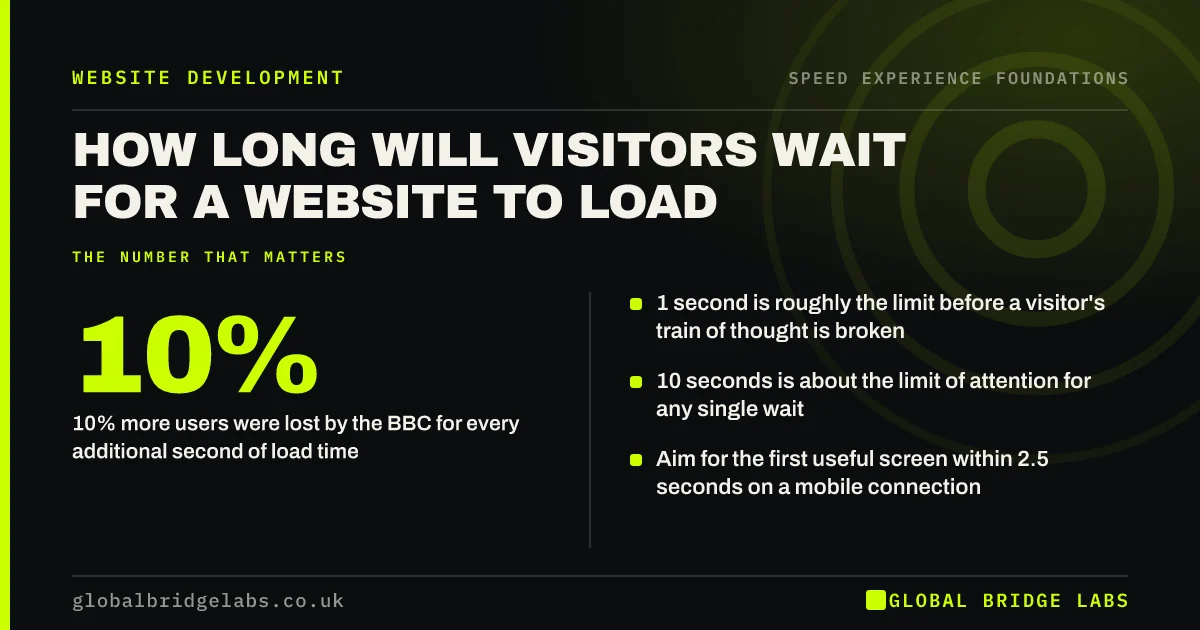
The first screen, with dates and a Book button, should appear within about 2.5 seconds on mobile. The booking engine can load on tap. Every step after that should respond at once and show progress, because guests are entering payment details.
Does a slow website cost a hotel direct bookings?
It can. A guest who finds the direct site slow or awkward will often book the same room through a travel platform, on which the hotel pays commission. A quick, clear direct booking route protects that margin.
Written by

Global Bridge Labs (GBL) is a UK–Sri Lanka partner for social media, websites and BPO. Everything here comes from client delivery, not theory.