On this page
Key takeaways
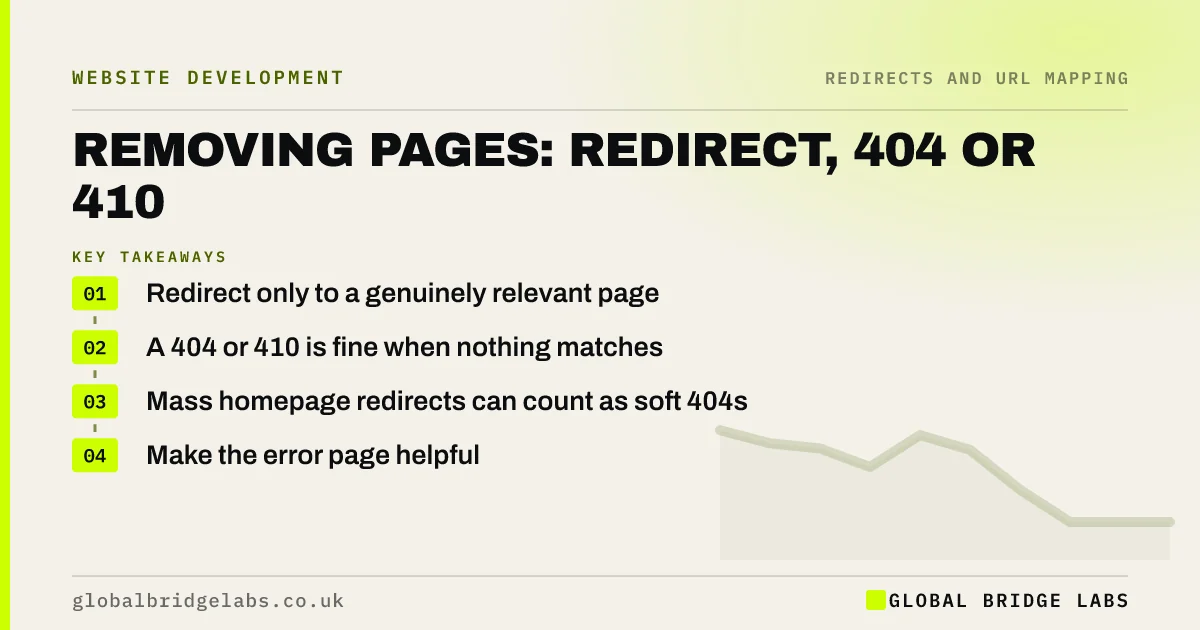
When a page is retired in a migration, redirect it only if a genuinely relevant page exists, such as a replacement product or an updated guide. If nothing is related, let it return a 404 or 410 with a helpful error page. Redirecting everything to the homepage seems tidy but confuses visitors, and Google may treat those redirects as soft 404s anyway.
- Redirect only to a genuinely relevant page.
- A 404 or 410 is fine when nothing matches.
- Mass homepage redirects can count as soft 404s.
- Make the error page helpful.
Deciding what to do with old pages? Message us on WhatsApp.
Chat on WhatsApp →When should a removed page redirect?
Redirect when the visitor on the old page would be well served by a specific new page. A discontinued service can go to its closest replacement. An outdated guide can go to the updated version. A merged page goes to the page it was merged into. The test is simple: would the visitor feel they arrived at what they were looking for, or something close to it?
When is a 404 or 410 better?
If there is no relevant destination, letting the page go is honest and clean. Google's documentation explains that it treats 404 and 410 similarly and drops those URLs from its index over time.
- 404: not found, the default for missing pages.
- 410: gone, a clear signal the removal is deliberate.
- Either way, keep the page out of the sitemap and internal links.
- Check whether the URL has backlinks before letting it go.
How do you make the error page useful?
A good error page explains that the page has moved or gone, offers a search box and links to the main sections and the most popular pages, and gives a way to get in touch. It should return a real 404 or 410 status code, not a normal 200, otherwise search engines treat it as a real page. Track visits to it after launch to find redirects you missed.
Want a second opinion on your removals list? Send it to us on WhatsApp.
Chat on WhatsApp →What does this look like in practice?
A pattern we see: a business retires 60 old event pages and redirects them all to the homepage. Search Console flags many as soft 404s and visitors from old links leave immediately. Letting most return a 410, and redirecting the handful with backlinks to a current events page, gives a cleaner result for both.
Removed pages checklist
- Redirect only to relevant pages.
- Use 404 or 410 when nothing matches.
- Check backlinks before letting a page go.
- Make the error page helpful.
- Remove retired URLs from sitemaps and links.
Next step
Filter your redirect map for rows with no new URL, and check each for traffic and backlinks. Redirect the valuable ones to relevant pages and let the rest return a 404 or 410.
Message us on WhatsApp about retiring pages, or book a 30-minute consultation.
Chat on WhatsApp →Sources and further reading
- How HTTP status codes and network errors affect Google Search · Google Search Central
- Redirects and Google Search · Google Search Central
- Improving the dreaded 404 error message · Nielsen Norman Group
Frequently asked questions
Should I redirect deleted pages to the homepage?
Generally no. Redirecting unrelated pages to the homepage frustrates visitors and may be treated as a soft 404 by Google. Redirect to a specific relevant page if one exists. Otherwise, return a 404 or 410 with a helpful error page that points visitors to useful sections.
What is the difference between a 404 and a 410?
A 404 means the page was not found; a 410 means it is gone and will not return. Google treats them similarly and removes both from its index over time. A 410 makes the removal clearer, which some teams prefer for deliberately retired pages.
Do 404 errors hurt my SEO?
404s for pages that genuinely no longer exist are normal and do not harm the rest of the site. The harm comes when pages that still have traffic or backlinks return 404s by mistake. Check those carefully and redirect them to relevant pages where possible.
Written by

Global Bridge Labs (GBL) is a UK–Sri Lanka partner for social media, websites and BPO. Everything here comes from client delivery, not theory.