On this page
- 01Key takeaways
- 02What is local sponsorship?
- 03What does sponsorship actually buy?
- 04How do the costs compare?
- 05How do you judge whether a sponsorship is worth it?
- 06How does social media make sponsorship work harder?
- 07What rules should you know?
- 08When is sponsorship the right call?
- 09When is social media the better use of the money?
- 10What does this look like in practice?
- 11Next step
- 12Sources and further reading
- 13Frequently asked questions
Key takeaways
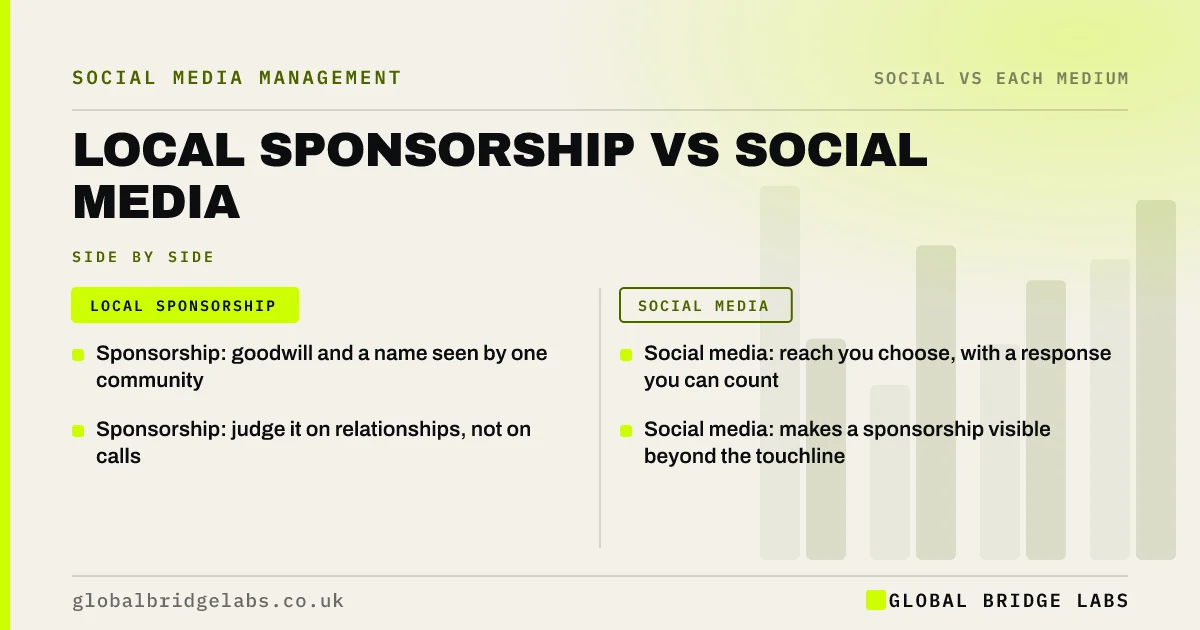
Local sponsorship vs social media is rarely a fair fight on enquiries, because sponsorship is not built to produce them. It buys goodwill and familiarity in a community. Social media is what turns that goodwill into something people can see, share and act on.
- Sponsorship: goodwill and a name seen by one community.
- Social media: reach you choose, with a response you can count.
- Sponsorship: judge it on relationships, not on calls.
- Social media: makes a sponsorship visible beyond the touchline.
Asked to sponsor something? Message us on WhatsApp and we will help you decide.
Chat on WhatsApp →What is local sponsorship?
Local sponsorship is paying or providing goods to support a club, team, school, charity or event in return for your name being displayed. Typical forms are a kit sponsor, a pitch-side board, a programme advert, a prize at a fair or naming an award.
What does sponsorship actually buy?
Sponsorship buys association. Your name sits beside something people care about, and the families involved learn that you support it. That can make you the first firm they think of. It does not explain what you do or ask anyone to act, which is why it seldom produces a countable response on its own.
How do the costs compare?
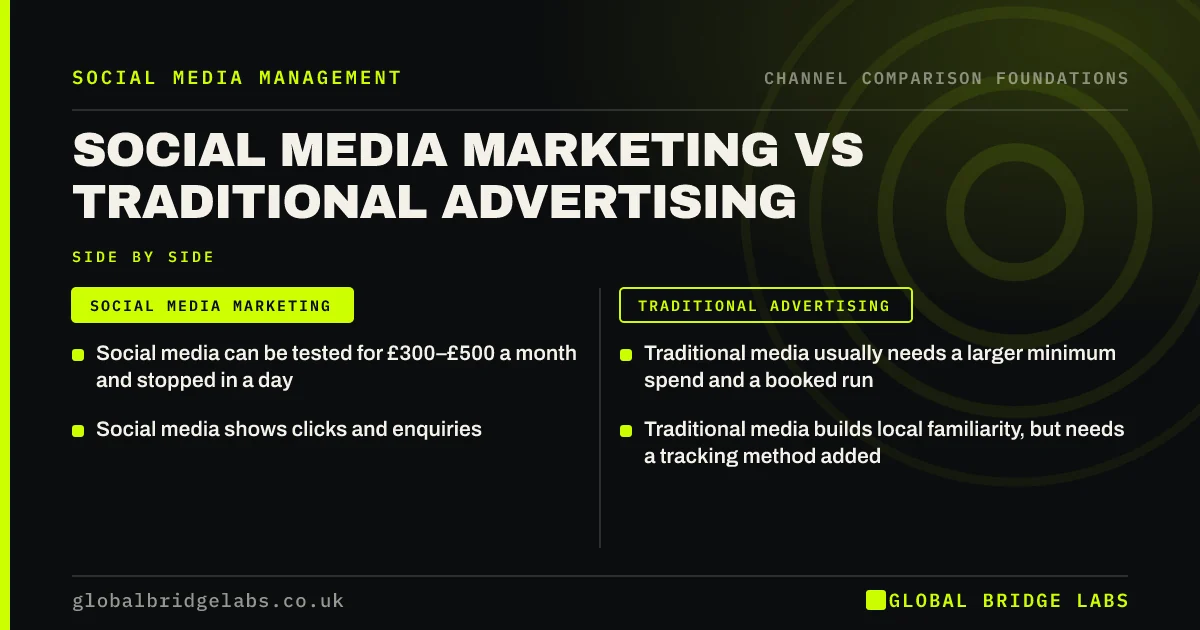
Local sponsorship ranges from under £100 for a raffle prize to a few thousand pounds for a kit or a headline event. Paid social can be tested from £300–£500 a month. The comparison is less about price than purpose: one buys goodwill, the other buys reach and enquiries.
Want to weigh a sponsorship against a local social campaign? Message us on WhatsApp and we will discuss your requirements.
Chat on WhatsApp →How do you judge whether a sponsorship is worth it?
Judge it on fit before cost. Ask whether the people involved are your buyers, how many of them there are, and whether you would support it anyway. A club with 200 local families who own homes is a real audience for a builder. A regional event with no link to your customers is a donation.
- Are the members or attendees your buyers?
- How many households does it reach?
- What will you receive, in writing?
- Would you back it even with no return?
How does social media make sponsorship work harder?
Social media gives the sponsorship a life beyond the banner. Post the kit handover, the match results, the event and the people. The club will often share your posts with its own followers, who are the audience you paid to reach. That turns a static logo into a run of content.
What rules should you know?
Agree in writing what each side provides and for how long. If the club or a member posts about you because of the arrangement, advertising rules require that commercial relationships are clear to the audience. Sponsoring a registered charity is usually straightforward, but keep the paperwork for your accounts.
When is sponsorship the right call?
Sponsorship is the right call when your market is a community and reputation within it matters more than reach. Trades, estate agents, dentists, cafes and independent shops often gain, because their customers are neighbours.
When is social media the better use of the money?
Social media is the better use when you need enquiries this quarter, when your buyers are spread beyond one community, or when you could not explain what the sponsorship would do. If the request comes with pressure and no audience figures, it is a donation and should come from a different budget.
What does this look like in practice?
A pattern we see with local firms: several small sponsorships are agreed each year out of goodwill, and none is ever mentioned on the firm's own channels. The money did good. It simply did nothing for the business, because nobody outside the club ever knew.
Next step
List what you sponsor and decide, for each, three posts you could make about it this year. If you cannot think of three, question the fit.
Message us on WhatsApp for help planning the content, or book a 30-minute consultation.
Chat on WhatsApp →Sources and further reading
Frequently asked questions
Is sponsoring a local sports team worth it?
It can be if the families involved are your likely customers and you make the sponsorship visible on your own channels. Expect goodwill and familiarity, not a rush of calls. Treat it as community presence and judge it over a season.
How much does local sponsorship cost?
It varies from under £100 for a prize or programme advert to a few thousand pounds for a team kit or headline event sponsorship. Ask exactly what is included, how long it lasts and how many people will see your name.
How do I measure the return on sponsorship?
Direct measurement is difficult. Ask new customers how they heard of you, note any who mention the club or event, and watch searches for your name locally. Count the content and introductions it produced as part of the return.
Should I sponsor or spend on social media advertising?
If you need enquiries soon, spend on social media advertising, which can be targeted and tracked. If you want long-term standing in a community you already serve, sponsorship helps, particularly when you also post about it. Many local firms do a little of each and judge them by different measures.
Written by

Global Bridge Labs (GBL) is a UK–Sri Lanka partner for social media, websites and BPO. Everything here comes from client delivery, not theory.