On this page
- 01Key takeaways
- 02What makes a product page convert?
- 03What should appear around the add-to-basket button?
- 04How should product images work?
- 05What should a product description include?
- 06What are the legal essentials on a UK product page?
- 07When does more product page content hurt?
- 08What does this look like in practice?
- 09Product page checklist
- 10Next step
- 11Sources and further reading
- 12Frequently asked questions
Key takeaways
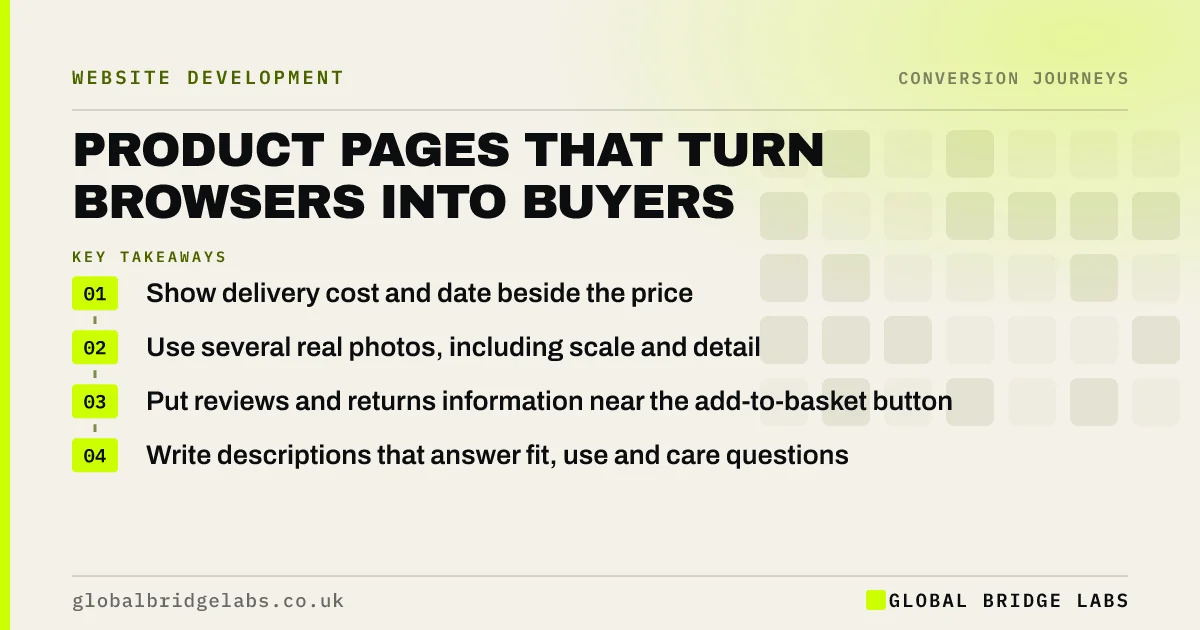
Product pages convert when they answer everything a shopper would ask in a shop: what it looks like up close, what it is made of, whether it will fit, what it costs to deliver, when it will arrive and what others thought. A good product page has a photo and a price. A high-converting one removes every reason to hesitate before the add-to-basket button.
- Show delivery cost and date beside the price.
- Use several real photos, including scale and detail.
- Put reviews and returns information near the add-to-basket button.
- Write descriptions that answer fit, use and care questions.
Want your best-selling product page reviewed? Message us on WhatsApp.
Chat on WhatsApp →What makes a product page convert?
A product page converts when it gives the shopper enough confidence to buy without seeing or touching the product. That means clear images, specific information, the full cost, delivery expectations, proof from other buyers and an easy route to buy. Missing any one of these sends shoppers to a competitor who shows it.
What should appear around the add-to-basket button?
The area around the button is where the decision is made. Put the answers to last-minute doubts there.
- Price, including VAT for consumer sales.
- Delivery cost and estimated delivery date.
- Stock availability, stated honestly.
- Returns policy in one line.
- Rating summary and review count.
- Accepted payment methods.
How should product images work?
Images replace handling the product. Show it from several angles, in use, at a recognisable scale and in close-up detail. Show every variant. Compress images and size them correctly so the page stays fast on mobile.
What should a product description include?
A converting description answers the questions buyers ask customer service. Start with the benefit and main use, then give dimensions, materials, compatibility, care instructions and what is in the box. Use bullet points for specifications so shoppers can scan.
Send us a product description on WhatsApp and we will show what is missing.
Chat on WhatsApp →What are the legal essentials on a UK product page?
UK consumer law requires clear information before purchase, including the total price with taxes, delivery charges and the main characteristics of the goods. The Consumer Contracts Regulations also give consumers cancellation rights for most online purchases, which you must explain. Fake scarcity or reviews can breach the Digital Markets, Competition and Consumers Act 2024.
When does more product page content hurt?
Long pages full of generic text, auto-playing videos and cross-sell carousels can bury the essentials and slow the page. Put the decision information at the top, and move secondary content, such as long brand stories or related products, lower down.
What does this look like in practice?
A UK furniture retailer's product pages had two photos and a short paragraph. Customer service received the same questions every day about dimensions, assembly and delivery. We added a dimensions diagram, a scale photo, an assembly note, delivery date by postcode and reviews near the button. Returns for 'not as expected' fell and conversion on those pages improved.
Product page checklist
- Show price, delivery cost and delivery date together.
- Use several photos, including scale and detail.
- Answer fit, use and care questions in the description.
- Put reviews and returns information near the button.
- State stock honestly.
- Meet UK pre-contract information rules.
- Test the page on mobile for speed.
Next step
Product pages are where most e-commerce buying decisions are made. Improving your top-selling pages often lifts revenue more than adding new products. We can help you start.
Message us on WhatsApp for a product page review, or book a 30-minute consultation.
Chat on WhatsApp →Sources and further reading
- Consumer Contracts (Information, Cancellation and Additional Charges) Regulations 2013 · legislation.gov.uk
- Cart abandonment rate statistics · Baymard Institute
- Google Merchant Center Help · Google
- Digital Markets, Competition and Consumers Act 2024 · legislation.gov.uk
Frequently asked questions
How do I improve my product page conversion rate?
Show delivery cost and date beside the price, use several real photos including scale, answer fit and care questions in the description, place reviews and returns information near the add-to-basket button, and make sure the page loads fast on mobile.
What should be on a product page?
Clear images, the product name, price including VAT, delivery cost and date, stock status, a specific description with specifications, reviews, returns information, payment options and an add-to-basket button. UK law requires key pre-contract information. Put delivery cost and date beside the price so shoppers see the full cost before they reach checkout.
Do product reviews increase sales?
Genuine reviews usually help, especially when they mention fit, quality and delivery. They must be real and presented fairly under UK consumer law. Place a rating summary near the price and detailed reviews further down. Reviews that mention size, quality and delivery answer the questions shoppers otherwise email about.
How long should a product description be?
Long enough to answer the questions buyers would otherwise ask customer service. Lead with the main benefit, then use bullet points for dimensions, materials, compatibility and care. Avoid filler text that pushes the essentials down. Bullet points make specifications easy to scan on a phone.
Written by

Global Bridge Labs (GBL) is a UK–Sri Lanka partner for social media, websites and BPO. Everything here comes from client delivery, not theory.