On this page
Key takeaways
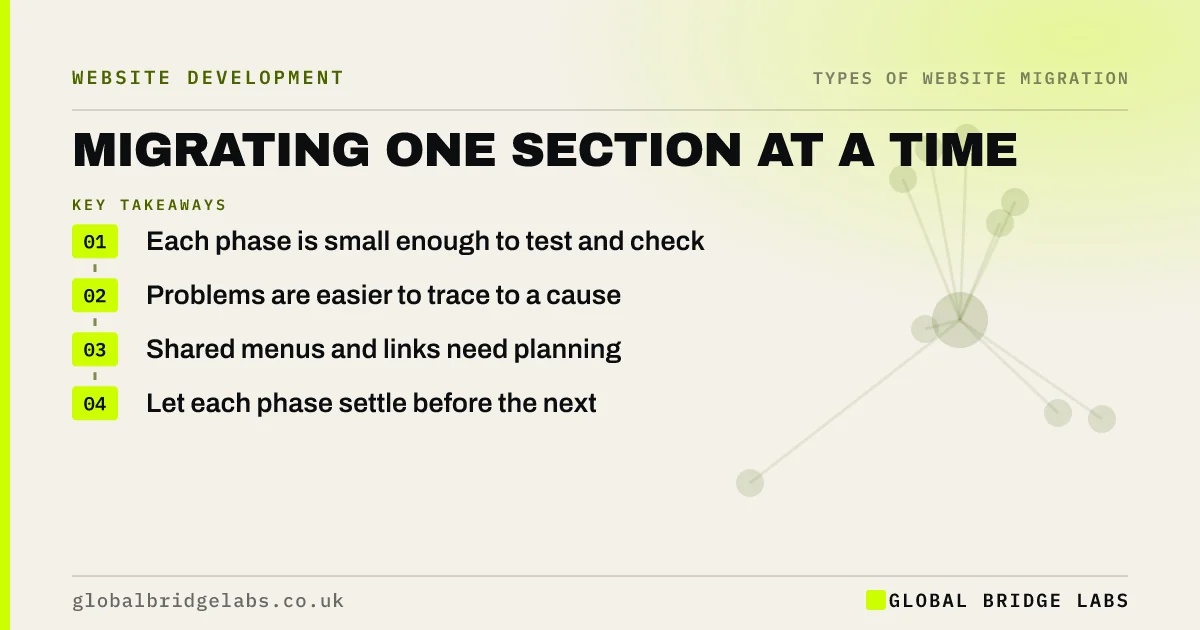
A phased migration moves one section at a time, such as the blog first, then services, then the shop. It reduces risk because each change is small enough to check, and problems can be traced to a cause. It needs careful handling of shared menus and internal links between phases.
- Each phase is small enough to test and check.
- Problems are easier to trace to a cause.
- Shared menus and links need planning.
- Let each phase settle before the next.
Planning a big rebuild? Message us on WhatsApp about phasing it.
Chat on WhatsApp →When does phasing help?
Phasing helps when a single launch would combine several high-risk changes, such as a new platform, a new structure and a new domain. It also helps large sites, sites with a busy season, and businesses that cannot afford a dip across everything at once. Moving the lowest-risk or lowest-traffic section first lets you test the process before touching the pages that bring most enquiries.
How do you plan the phases?
Split the site into sections that can move cleanly, and give each a short plan of its own.
- Choose a first section with modest traffic.
- Build a redirect map for that section only.
- Keep menus and footers linking to both old and new sections.
- Launch, monitor for two to four weeks, then review.
- Move the next section once the first has settled.
What are the risks of phasing?
The main risk is a messy in-between period. Visitors may move between two designs, internal links can point at old URLs that later change again, and tracking may sit in two places. Keep a single list of every URL that has moved, update internal links as each phase launches and avoid changing a URL twice. Set an end date so the old platform does not linger for years.
- Update internal links after a migration
- Keep analytics and tracking working through a migration
- Redirect chains and loops: how to find and fix them
Want help splitting your migration into phases? Message us on WhatsApp.
Chat on WhatsApp →What does this look like in practice?
A pattern we see on larger service sites: the blog moves first to the new platform, with identical slugs in a new folder. Two weeks later, traffic is stable and the redirect process is proven. The service pages follow a month later, and because the team has already done one phase, the second launch is quick and calm.
Phased migration checklist
- Split the site into clean sections.
- Start with a lower-traffic section.
- Map and redirect each section separately.
- Keep shared menus and links working.
- Set an end date for the old platform.
Next step
List the sections of your site and their search traffic. Pick the one with the least to lose as your first phase, and use it to test the whole process.
Message us on WhatsApp about a phased migration, or book a 30-minute consultation.
Chat on WhatsApp →Sources and further reading
- Site moves with URL changes · Google Search Central
- Redirects and Google Search · Google Search Central
- SEO link best practices for Google · Google Search Central
Frequently asked questions
Is it better to migrate a website all at once or in phases?
For small sites with few changes, all at once is usually fine. For large sites, or projects combining a new platform, domain and structure, phases reduce risk because each change can be checked on its own. Phasing takes longer overall but makes problems easier to trace and fix.
How long should I leave between phases?
Usually two to four weeks, enough to see whether the first phase has settled in Search Console and analytics. If a phase shows problems, fix them before moving on. Set an overall end date so the old and new platforms do not run side by side for too long.
Can I run two platforms on one domain?
Yes, with the right server setup, such as routing a folder to a different platform. It is common during phased moves. Keep menus, footers and tracking consistent across both, and plan the routing carefully with your developer so redirects and canonicals work.
Written by

Global Bridge Labs (GBL) is a UK–Sri Lanka partner for social media, websites and BPO. Everything here comes from client delivery, not theory.