On this page
- 01Key takeaways
- 02Why is stepping back so hard for owners?
- 03What should you hand off first?
- 04How do you hand off decisions?
- 05How do you stay in control after stepping back?
- 06How long does it take to step back?
- 07What are the risks of stepping back too fast?
- 08Does stepping back make a business more valuable?
- 09What should a weekly owner report include?
- 10What does this look like in practice?
- 11Stepping back checklist
- 12Next step
- 13Sources and further reading
- 14Frequently asked questions
Key takeaways
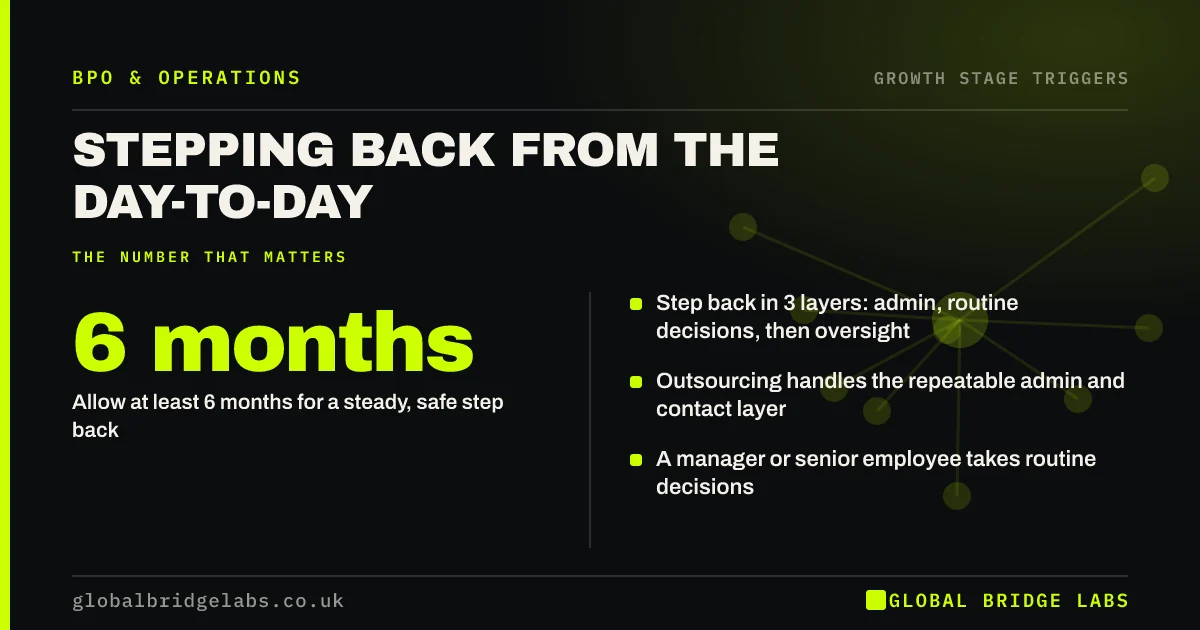
To step back from day to day operations, hand off in layers: first repeatable admin and customer contact, then management of routine decisions, and finally oversight through a weekly report. Outsourcing takes the repeatable layer quickly; a manager or senior employee takes the decisions. Plan it over 6 to 12 months, not in a week.
- Step back in 3 layers: admin, routine decisions, then oversight.
- Outsourcing handles the repeatable admin and contact layer.
- A manager or senior employee takes routine decisions.
- Allow at least 6 months for a steady, safe step back.
Want to step back from the daily grind? Message us on WhatsApp and tell us what still needs you.
Chat on WhatsApp →Why is stepping back so hard for owners?
Because the business was built around the owner. Customers call them, staff ask them, and processes live in their head. Stepping back without changing that just means the phone rings on holiday. The business has to be rearranged so that daily work runs without the owner, and that takes deliberate steps.
What should you hand off first?
Hand off the repeatable work first, because it takes the most hours and is easiest to write down: email and enquiries, calls, bookings, invoicing, chasing and data entry. An outsourced team can take these within weeks, which frees the owner's time to train someone on the decisions.
How do you hand off decisions?
Write down the rules you use for routine decisions, such as discounts, refunds, scheduling priorities and supplier choices, and give a named person authority within those rules. Review their decisions weekly at first, then monthly. Keep only the decisions that genuinely need you: strategy, major clients, pricing and senior hires.
- Refunds and credits up to a set value.
- Scheduling and priority calls.
- Routine supplier orders within budget.
- Standard quotes within agreed pricing.
Want help writing your decision rules down? Ask us on WhatsApp.
Chat on WhatsApp →How do you stay in control after stepping back?
Through a short weekly report and a monthly review. The report covers a few numbers that show the business is healthy: enquiries, sales, cash, reply times and any escalations. If the numbers are fine, you do not need to be in the detail. If they move, you know where to look.
How long does it take to step back?
Six to twelve months is realistic for most owner-managed SMEs. The first two months move admin and contact out; the next few train someone on decisions; the rest tests the business running with the owner absent for longer periods, such as a two-week holiday without calls.
What are the risks of stepping back too fast?
Customers who relied on the owner feel abandoned, staff make decisions without clear rules, and problems surface late. Introduce customers to their new contact personally, write rules before delegating, and keep weekly reports from day one. A gradual step back protects both relationships and results.
Does stepping back make a business more valuable?
Usually. A business that runs without its owner is easier to sell, easier to finance and less risky to buy. Documented processes, a management layer and reliable operations are exactly what buyers look for. Even if you never sell, the business becomes more resilient to illness or absence.
What should a weekly owner report include?
Keep it to one page and the same numbers every week, so changes stand out. It should show whether customers are being served, whether sales are coming in, whether cash is healthy, and what needs the owner's decision. Anything not on the report should not need the owner.
- Enquiries received and converted.
- Median reply time and any complaints.
- Cash position and overdue invoices.
- Backlog in key processes.
- Decisions waiting for the owner, with a recommendation.
What does this look like in practice?
A pattern we see in UK trades businesses run by owners in their fifties: the owner wants to work three days a week. Moving calls, booking and invoicing to a managed team frees 15 hours; promoting the senior engineer to run scheduling frees more. Within a year, the owner takes a two-week holiday without the phone ringing.
Stepping back checklist
Use this to plan your step back.
- Log what still needs you for two weeks.
- Outsource repeatable admin and contact first.
- Write rules for routine decisions.
- Give a named person authority within those rules.
- Set up a weekly report of key numbers.
- Test with progressively longer absences.
Next step
Tell us what still needs you every day. We will suggest which parts can be handed off now and what a 12-month plan could look like.
Message us on WhatsApp about stepping back, or book a 30-minute consultation.
Chat on WhatsApp →Sources and further reading
- Work-related stress and how to manage it · Health and Safety Executive
- Maximum weekly working hours · GOV.UK
- National Minimum Wage and National Living Wage rates · GOV.UK
Frequently asked questions
How do I step back from running my business?
Hand off in layers: first repeatable admin and customer contact, often to an outsourced team; then routine decisions, to a named person with written rules; then keep oversight through a weekly report. Plan it over 6 to 12 months and test with longer absences.
What should a business owner not delegate?
Strategy, pricing, major client relationships and senior hiring usually stay with the owner, at least until a strong management team is in place. Almost everything else, especially repeatable admin and routine decisions, can be handed off with clear processes and rules.
How can I take a holiday without my business falling apart?
Make sure calls, email, bookings and invoicing are covered by someone else, write down the rules for routine decisions, name who decides in your absence, and ask for a short daily or weekly report. Test with a few days first, then longer.
Written by

Global Bridge Labs (GBL) is a UK–Sri Lanka partner for social media, websites and BPO. Everything here comes from client delivery, not theory.