On this page
Key takeaways
Break-even ROAS is the return on ad spend at which ads pay for themselves and no more. Divide 1 by your gross margin: a 40% margin needs a ROAS of 2.5, so £2.50 in sales for every £1 of ads. Anything below loses money on the first order. Set a target above it.
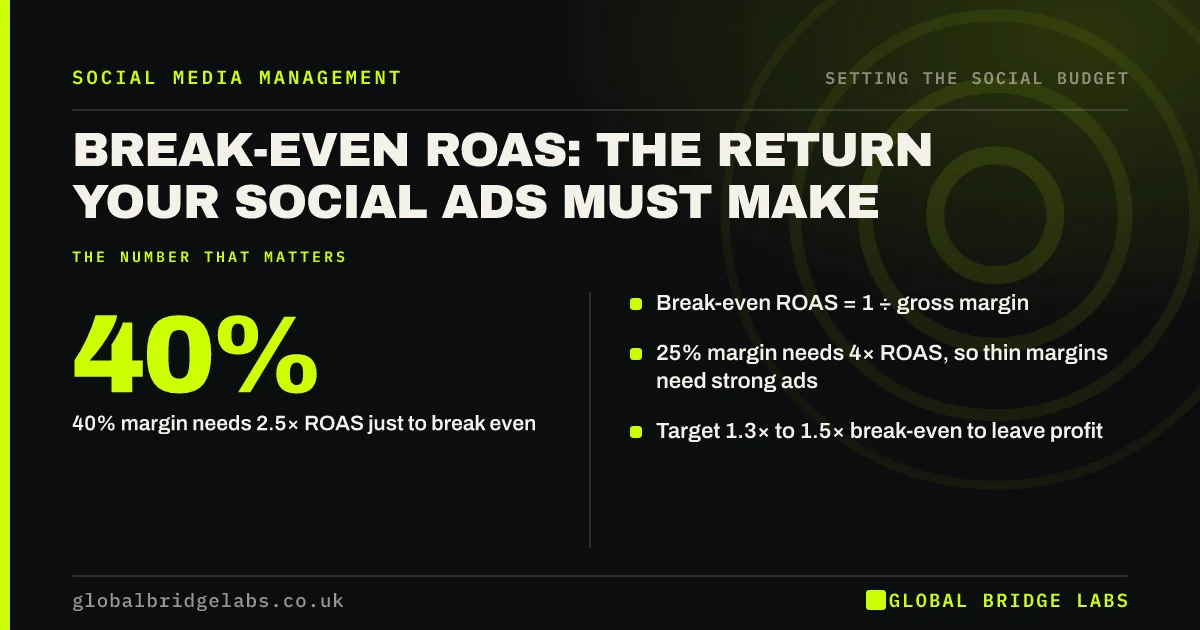
- Break-even ROAS = 1 ÷ gross margin.
- 40% margin needs 2.5× ROAS just to break even.
- 25% margin needs 4× ROAS, so thin margins need strong ads.
- Target 1.3× to 1.5× break-even to leave profit.
Want your break-even ROAS calculated? Message us on WhatsApp.
Chat on WhatsApp →What is ROAS?
ROAS, return on ad spend, is the revenue an ad campaign produces divided by what it cost. £3,000 of sales from £1,000 of ads is a ROAS of 3, often written 3×. It measures revenue, not profit, which is why it must be compared with your margin before you can call a campaign good.
How do you work out break-even ROAS?
Find your gross margin after product cost, delivery, packaging and payment fees, as a decimal. Divide 1 by it. Illustrative example: a £50 order with £30 of costs has a 40% margin, so break-even ROAS is 1 ÷ 0.4 = 2.5. Below 2.5×, every order bought through ads loses money.
- 60% margin: break-even ROAS 1.67×.
- 50% margin: break-even ROAS 2×.
- 40% margin: break-even ROAS 2.5×.
- 25% margin: break-even ROAS 4×.
Send us your margin on WhatsApp and we will discuss your requirements.
Chat on WhatsApp →What target should you set?
Set the target around 1.3 to 1.5 times break-even to cover overheads and leave profit. With a 40% margin, that means aiming for 3.3× to 3.75×. If repeat purchase is strong, you can accept a first-order ROAS nearer break-even, because later orders arrive without new ad spend.
Why can platform ROAS mislead you?
Platforms count sales within their attribution window, which can include people who would have bought anyway, and miss some sales they caused. Compare platform ROAS with total sales against total ad spend each month. If the two tell different stories, trust the business total and test with a pause.
What does this look like in practice?
A pattern we see: an online shop celebrates a 2× ROAS without realising its margin after delivery and fees is 35%, so break-even is 2.86×. Every ad-driven order lost money. Raising prices on bundles or cutting delivery costs often turns the same ads profitable.
ROAS checklist
- Calculate gross margin after all variable costs.
- Divide 1 by the margin to get break-even ROAS.
- Set a target 1.3 to 1.5 times higher.
- Compare platform ROAS with total sales monthly.
- Recalculate when costs or prices change.
Next step
Write your gross margin and break-even ROAS at the top of your ad report. Every campaign is then judged against your profit, not the platform's headline number.
Message us on WhatsApp with your margin, or book a 30-minute consultation.
Chat on WhatsApp →Sources and further reading
- Learn about Meta pixel · Meta
- About Conversions API · Meta
Frequently asked questions
What is a good ROAS for a small business?
A good ROAS is one above your own break-even, which depends on margin. With a 50% gross margin, break-even is 2× and 2.6× to 3× is healthy. With a 25% margin, break-even is 4×. A generic benchmark such as 4× can be poor or excellent depending on your costs.
Is ROAS the same as ROI?
No. ROAS divides revenue by ad spend. Return on investment (ROI) compares profit with the total cost, including product costs, fees and time. A campaign can show a healthy ROAS and still have a negative ROI if margins are thin or production costs are high.
Does ROAS work for service businesses?
Only when you can link sales to ads, which is harder for services sold after a call or quote. Most service businesses are better served by cost per enquiry and close rate, then checking revenue from social customers each quarter.
Written by

Global Bridge Labs (GBL) is a UK–Sri Lanka partner for social media, websites and BPO. Everything here comes from client delivery, not theory.