On this page
Key takeaways
Moving to a new domain is one of the riskiest migrations, because every URL changes at once. Keep the paths the same where you can, redirect each old URL to its matching new URL, verify both domains in Search Console, use the Change of Address tool and keep the old domain renewed for years. Avoid changing platform and structure in the same launch.
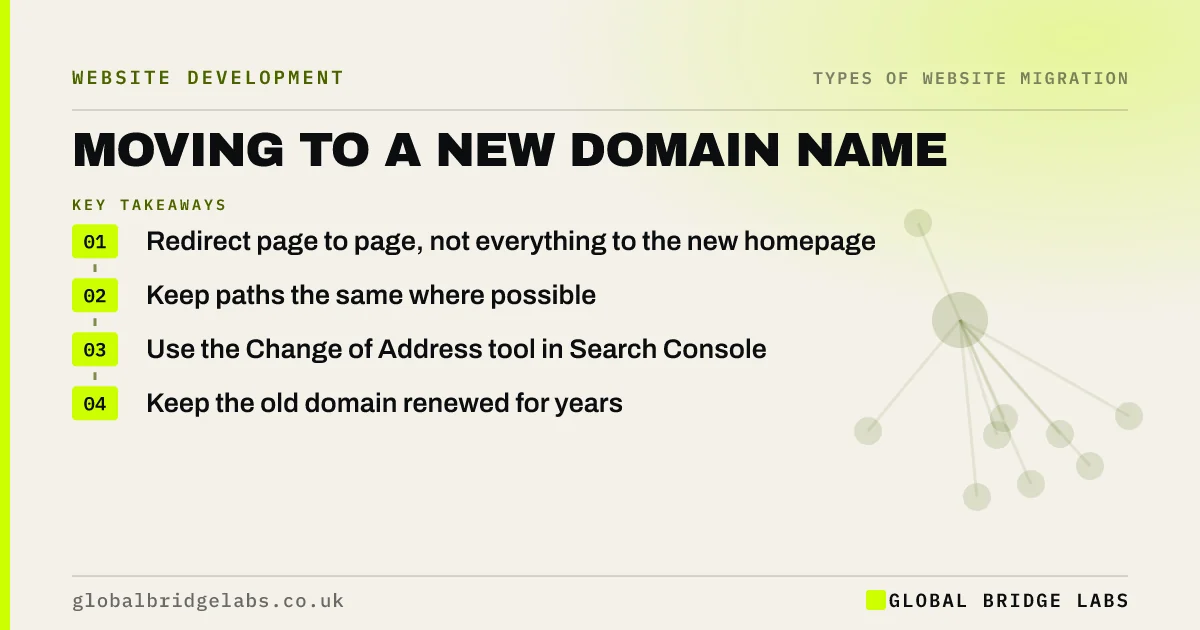
- Redirect page to page, not everything to the new homepage.
- Keep paths the same where possible.
- Use the Change of Address tool in Search Console.
- Keep the old domain renewed for years.
Changing your domain name? Message us on WhatsApp before you buy the new one.
Chat on WhatsApp →Why is a domain change high risk?
Every page has a new address, so search engines must recrawl and reprocess the whole site. Rankings, links and brand searches all depend on the redirects being complete. A domain change also touches things outside the website: email addresses, printed materials, directory listings, the Google Business Profile and any links from partners. Missing any of them leaves a trail of old references.
What are the steps?
Google's guidance on site moves with URL changes sets out the core process, and the Change of Address tool supports it once redirects are live.
- Verify the old and new domains in Search Console.
- Build a redirect map from every old URL to its new URL.
- Keep the same paths so the map is mostly one-to-one.
- Load permanent redirects at page level, not just the homepage.
- Submit the Change of Address request once redirects work.
- Update the Google Business Profile, directories and email signatures.
What should you keep doing after the move?
Keep the old domain registered and the redirects live for at least a year, and ideally for good. Old links from other websites, printed leaflets and bookmarks will keep sending visitors for years, and if the domain lapses someone else can buy it. Ask the sites that link to you most to update their links, and check brand searches weekly for the first two months.
- Let your old domain lapse? What to do now
- Ask for backlinks to be updated after a move
- Domain name expired: how to stop your site disappearing
Want a second check of your domain move plan? Message us on WhatsApp.
Chat on WhatsApp →What does this look like in practice?
A pattern we see after rebrands: the new domain launches with one rule sending every old URL to the new homepage. Service pages and blog posts drop out of search, and Search Console fills with soft 404s. Replacing that rule with page-level redirects, keeping the same paths, usually brings the pages back within weeks.
Domain change checklist
- Verify both domains in Search Console.
- Map every old URL to its matching new URL.
- Load page-level permanent redirects.
- Use the Change of Address tool.
- Keep the old domain renewed and redirecting.
Next step
Before you commit to a new domain, list every place the old one appears: website, email, print, profiles and partner links. That list is half of your migration plan.
Message us on WhatsApp about your domain change, or book a 30-minute consultation.
Chat on WhatsApp →Sources and further reading
- Site moves with URL changes · Google Search Central
- Change of Address tool · Search Console Help
- Redirects and Google Search · Google Search Central
Frequently asked questions
Will changing my domain hurt my SEO?
It usually causes a temporary dip while Google processes the move. With page-level redirects, the same paths, the Change of Address tool and the old domain kept live, most sites recover within weeks to a few months. Sites that redirect everything to the new homepage often lose rankings for much longer.
How long should I keep my old domain?
Keep it renewed and redirecting for as long as practical, and at least a year. Old links, bookmarks, printed materials and emails will keep using it for years. If it lapses, the redirects stop and someone else could buy the domain and use your old reputation.
Should I change domain and platform at the same time?
Avoid it if you can. Each change is manageable on its own, but together they make problems hard to trace. Move platform first with the same domain and URLs, let it settle, then change domain. If both must happen together, plan extra testing and monitoring.
Written by

Global Bridge Labs (GBL) is a UK–Sri Lanka partner for social media, websites and BPO. Everything here comes from client delivery, not theory.