On this page
- 01Key takeaways
- 02What does a navigation redesign include?
- 03What do the market ranges look like?
- 04What drives the cost up or down?
- 05Is it worth paying for research and testing?
- 06How do you judge value?
- 07What does this look like in practice?
- 08Navigation cost checklist
- 09Next step
- 10Sources and further reading
- 11Frequently asked questions
Key takeaways
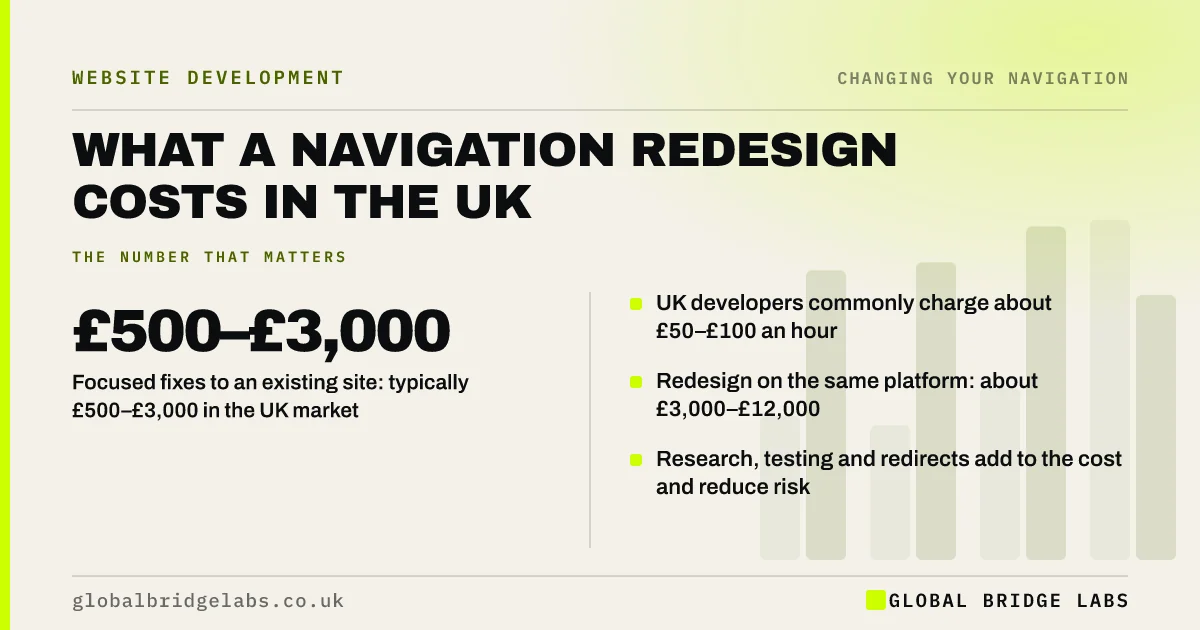
In the UK market, focused navigation fixes on an existing site, such as new labels, order, a header action and dropdown fixes, typically fall within the £500–£3,000 range for focused design fixes. A restructure that includes research, testing and redirects costs more. Navigation rebuilt as part of a redesign on the same platform sits within about £3,000–£12,000. These are market ranges, not GBL prices.
- Focused fixes to an existing site: typically £500–£3,000 in the UK market.
- UK developers commonly charge about £50–£100 an hour.
- Redesign on the same platform: about £3,000–£12,000.
- Research, testing and redirects add to the cost and reduce risk.
Want a costed plan for your navigation changes? Message us on WhatsApp.
Chat on WhatsApp →What does a navigation redesign include?
A navigation redesign can mean anything from renaming three labels to restructuring the whole site. Scope it in layers, so you know what you are paying for.
- Audit and recommendations.
- Label and order changes.
- Header, mobile menu and dropdown fixes.
- Card sorting and tree testing for a new structure.
- Page moves, URL changes and redirects.
- Usability testing before and after.
What do the market ranges look like?
Market ranges vary by supplier, platform and site size. In the UK market, focused design fixes to an existing site, which include navigation labels and structure, typically cost £500–£3,000. Developers commonly charge somewhere around £50–£100 an hour, often with a minimum charge. A redesign on the same platform typically runs about £3,000–£12,000, and a full rebuild £5,000–£20,000 or more.
Want your navigation work scoped against these ranges? Message us on WhatsApp and we will discuss your requirements.
Chat on WhatsApp →What drives the cost up or down?
The biggest drivers are how many pages and templates are involved, whether URLs change, how much research and testing is included, and how the site is built. A well-built site with one menu setting is quick to change; a site with hard-coded menus in several templates takes longer.
- Number of pages, templates and menus.
- Whether URLs change and need redirects.
- Research: card sorts, tree tests, user tests.
- Platform and build quality.
- Languages and regional versions.
Is it worth paying for research and testing?
For label tweaks, usually not; a quick first-click test with a few people is enough. For a new structure, yes: a card sort and tree test before building cost far less than rebuilding a structure that does not work. Testing also protects you from changes that look better but perform worse.
How do you judge value?
Compare the cost with the value of more visitors reaching key pages. As an illustrative example, if a navigation fix adds three enquiries a month and one in three becomes a £1,500 job, it adds about £1,500 a month. A £2,000 fix would pay back in under two months in that example. Use your own figures.
What does this look like in practice?
A pattern we see: an owner expects a menu change to need a new website. The audit shows the structure is sound and the problems are labels, a missing header action and a broken mobile dropdown. That is focused-fix work rather than a redesign.
Navigation cost checklist
- Audit first to scope the real problem.
- Separate label fixes from restructures.
- Ask whether URLs will change.
- Budget for testing on structural changes.
- Compare cost with the value of extra enquiries.
Next step
List the navigation problems you know about and mark each as wording, structure or technical.
Message us on WhatsApp for a costed navigation plan, or book a 30-minute consultation.
Chat on WhatsApp →Sources and further reading
- Card sorting: uncover users' mental models · Nielsen Norman Group
- Tree testing: fast, iterative evaluation of menu labels and categories · Nielsen Norman Group
- Site moves with URL changes · Google Search Central
Frequently asked questions
How much does it cost to redesign a website menu?
In the UK market, focused fixes such as relabelling, reordering and fixing dropdowns typically sit within £500–£3,000, often charged at about £50–£100 an hour. Restructuring with research, testing and redirects costs more. These are market ranges, not a fixed price.
Do I need a new website to fix navigation?
Usually not. Most navigation problems are labels, order, missing links and mobile behaviour, which can be fixed on the existing site. A redesign makes sense when the platform or page structure itself blocks the fixes.
What affects the cost of a navigation change?
The number of pages and templates, whether URLs change, how much research and testing is included, the platform and how the menu is built. Hard-coded menus across several templates take longer than a single menu setting.
Written by

Global Bridge Labs (GBL) is a UK–Sri Lanka partner for social media, websites and BPO. Everything here comes from client delivery, not theory.